When a lithium-ion battery in a phone, laptop, or power bank overheats in the cabin, flight attendants run a two-stage protocol: knock down visible flames with a halon extinguisher, then soak the device with water or another non-alcoholic liquid to cool the cells. Halon can’t stop the chemical reaction inside the battery — only the water stage does that.
Crews then let the cooled device rest untouched for about 10 to 15 minutes, seal it in a containment bag or water-filled container, and monitor it for the rest of the flight while updating the flight deck on whether a diversion is warranted.
Ask most passengers what happens when a phone bursts into flame in economy, and they’ll picture a flight attendant blasting it with a fire extinguisher until the flames disappear. That’s only half right — and the missing half is the part that actually keeps the fire from coming back mid-flight.
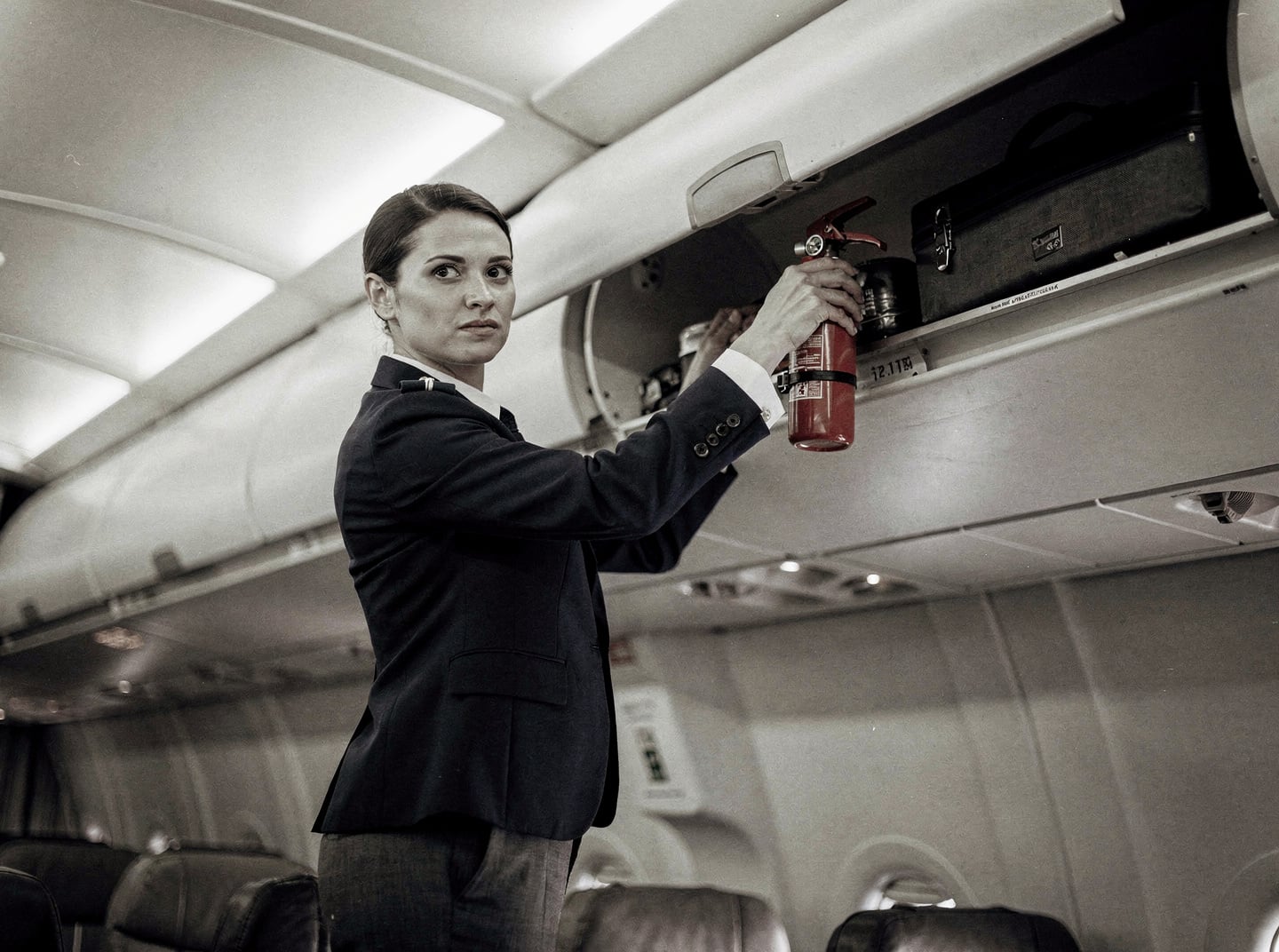
Halon, the gas inside the small red extinguishers tucked into every galley, knocks down open flame well. It’s nearly useless against what’s happening inside a lithium-ion cell that has entered thermal runaway — a self-sustaining reaction that generates its own heat and oxygen, independent of anything happening in the cabin around it. You can’t smother a reaction that doesn’t need your air.
That gap between what an extinguisher can do and what a battery fire actually requires is why cabin crews train on a second, quieter stage: cooling. It’s the part passengers rarely notice, executed calmly while everyone else assumes the emergency ended when the flames went out.
This is the sequence flight attendants train to execute, from first smoke to the moment ground crews meet the aircraft — and the reasoning behind each step of it.
Halon buys time. It doesn’t put the fire out.
The response starts the moment a crew member confirms what they’re seeing: smoke, a hissing sound, or the sharp smell of an overheating cell, rather than a wiring fault or a galley mishap. Crews reach for the halon extinguisher first, and they move fast — knocking down visible flame typically takes under a minute or two once the extinguisher is deployed.
That’s the easy part. Halon 1301 and Halon 1211, the compounds installed on most passenger aircraft, extinguish burning electrolyte and stop flame from spreading to seat fabric or an overhead bin. What they can’t reach is the chemistry happening inside the battery itself. FAA testing found halon controlled the open flame but did nothing to stop adjacent cells inside the same pack from following the first one into thermal runaway, one after another.
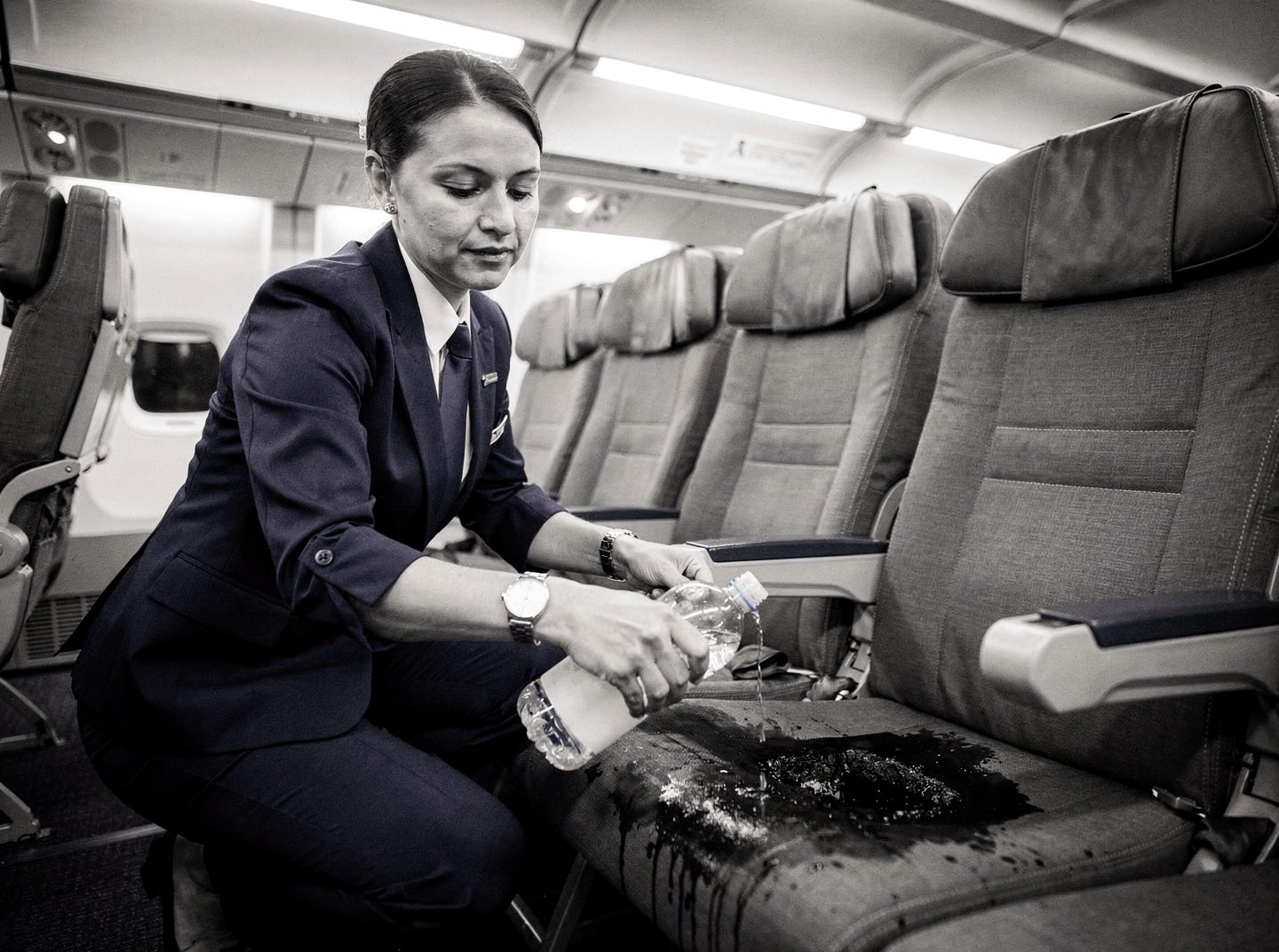
Water does what halon can’t. In those same tests, water proved better than anything else at pulling heat out of the remaining cells, breaking the chain reaction — which is why the second stage is unglamorous and, in the moment, sometimes a little improvised. Crews douse the device in water or another non-alcoholic liquid until the crackling and steam stop.
In one FAA case file, a flight attendant went through the aircraft’s onboard supply mid-emergency and started collecting water bottles from nearby passengers to keep dousing a smoldering bag — the official sequence, improvised with whatever passengers could spare.
Flight deals
most people never see
Our AI monitors 150+ airlines for pricing anomalies that traditional search engines miss. Air Traveler Club members save $650 per trip per person on average: see how it works.
Each deal saves 40–80% vs. regular fares:

The rules crews are trained never to break
Two instincts are almost universal in a crisis, and cabin crews train specifically to override both of them.
The first is reaching for ice — it flows from ordinary experience, since ice cools things. But packing a smoldering battery in ice, or throwing a blanket over it, insulates the cells instead of cooling them. Trapped heat has nowhere to go except deeper into the battery, which can accelerate the exact chain reaction crews are trying to stop.
The second instinct is to grab the device and get it away from people. Crews resist that too.
A battery in thermal runaway can rupture violently, with cells venting gas or exploding one after another with no warning. Moving it risks an injury for no safety benefit.
As one International Civil Aviation Organization working paper puts it bluntly: “If device is still hot or smoking, do not move the device; repeat procedures above.”
The ten-to-fifteen-minute rule: cooling, containment, and the long watch
Once the steam and crackling stop, the emergency isn’t over. It just enters a quieter, more tedious phase that matters just as much as the firefighting itself.
Both agencies instruct crews to leave the cooled device alone for at least 10 to 15 minutes before moving it. The reasoning is specific to how lithium cells fail — a pack that looks like it has stopped smoking can still have cells inside that haven’t ruptured yet, and those cells can reignite the fire minutes later without warning.
Not every containment bag performs the same in a real event. When an FAA Technical Center evaluation tested bags and boxes from five different manufacturers, it found sharp differences — several tore or had trouble venting gases correctly near the top of their advertised battery-energy rating. The report only labeled the products Manufacturer A through Manufacturer E, so there’s no way to know which brand any given airline actually stocks in its galleys.
Only after the rest period, and only with no renewed heat or smoke, are crews trained to move the device into a container or dedicated fire containment bag designed to keep it fully submerged. From there, it’s watched continuously, with updates relayed to the flight deck so the pilot in command can weigh whether the situation still calls for a diversion.
That’s roughly what played out on a Delta flight from Atlanta to Fort Lauderdale, when a battery pack in a passenger’s backpack ignited midair. Crew knocked down the flames, cooled the device, and sealed it in a containment bag before moving it to the lavatory. “It’s in a containment bag. No smoke in the cabin at this point. No active fire,” the crew reported — yet the pilots still diverted to Fort Myers rather than continue on, declaring an emergency out of caution rather than any sign the fire had restarted.
Where this protocol actually comes from
The two-stage sequence isn’t an arbitrary compromise. It’s the result of a specific round of FAA fire-safety testing run in 2010. That work, documented in report DOT/FAA/AR-10/31, tested what actually stopped a lithium cell fire from spreading to its neighbors inside the same pack.
The tests showed halon and water couldn’t be swapped for each other. That finding became the backbone of the guidance ICAO and the FAA later issued for cabin crews.
ICAO’s dangerous goods working paper DGP.24.WP.038.4 and the FAA’s Advisory Circular 120-80B, written by separate regulatory bodies, land on nearly identical instructions: extinguish, cool, wait 10 to 15 minutes, contain, monitor. That level of agreement between two independent processes is unusual in aviation regulation, and it’s a sign the underlying chemistry left drafters very little room to disagree.

Questions? Answers.
Are airlines required to carry fire containment bags?
No. The FAA does not currently require operators to carry battery fire containment equipment, though a number of airlines have chosen to stock their fleets with it anyway.
What is UL 5800, and why does it matter for these bags?
UL 5800 is the standard covering battery fire containment products, first published in 2020. It sets baseline performance requirements for the bags and boxes marketed specifically for this scenario, though carriers aren’t obligated to use products certified under it.
Is this a separate training module, or part of general fire training?
Thermal-runaway response is folded into standard recurrent cabin crew fire training rather than taught as a standalone course. All cabin crew are trained to respond to these events as a baseline requirement, though frontline surveys suggest the depth and consistency of that training varies between carriers.