A Halon extinguisher can knock down the visible flames from a lithium battery fire, but it can’t stop the chemical reaction burning inside the cell. That reaction — thermal runaway — keeps generating its own heat and oxygen even after the fire looks out. The FAA’s 2025 safety alert, SAFO 25002, tells crews the real fix is to pour large volumes of water onto the battery and bring its temperature down.
Through August 2025, the FAA verified 50 lithium battery incidents among 97 total smoke, fire, or extreme-heat events on US flights — the highest yearly count on record.
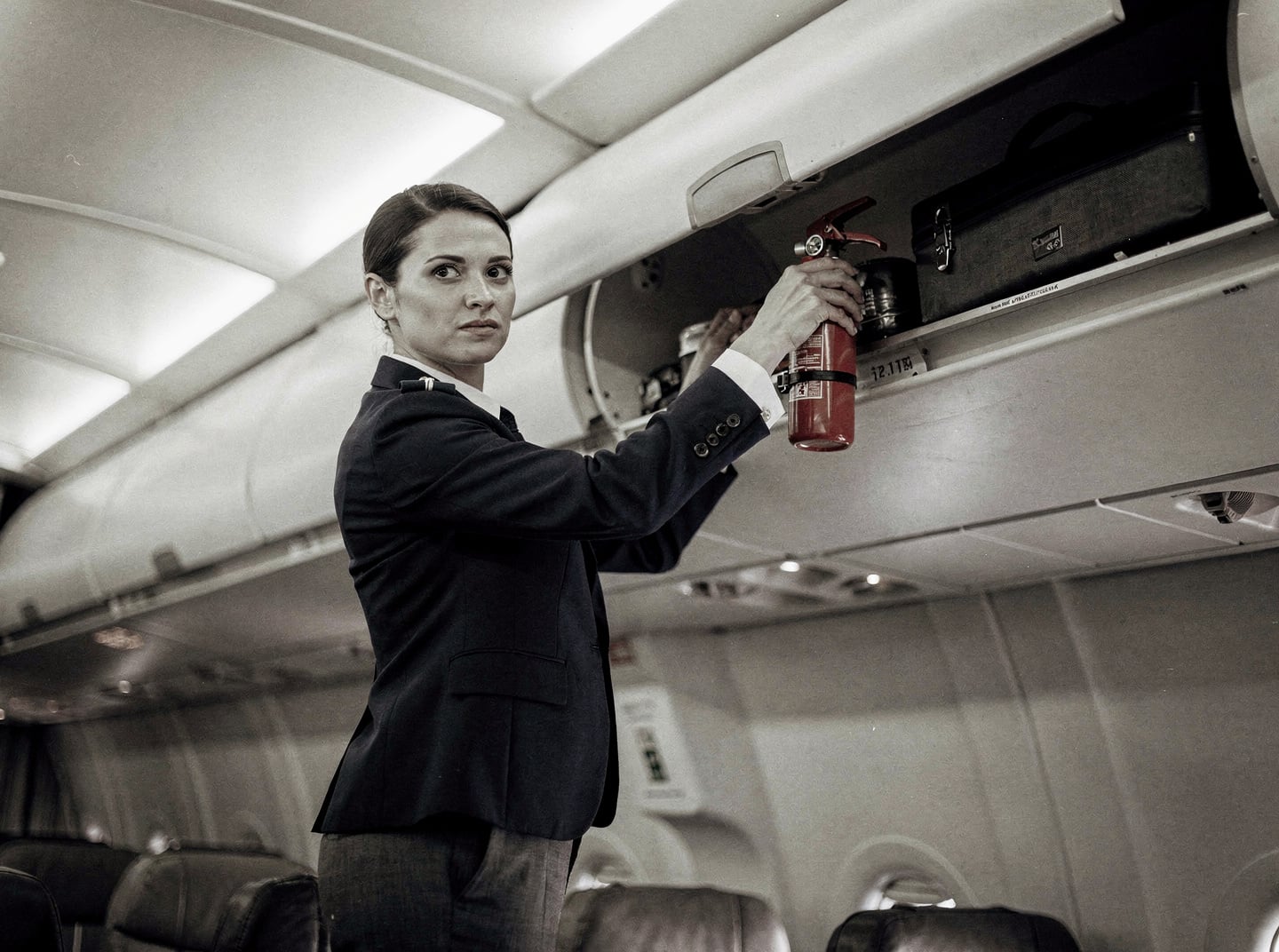
On a flight bound for Colorado Springs, a lithium primary battery in a passenger’s seat went into thermal runaway and started throwing flames into the cushion beside it. Crew reached for a 3-pound Halon 1211 extinguisher first — standard cabin equipment — and it did exactly what Halon is built to do. The visible flame died almost instantly.
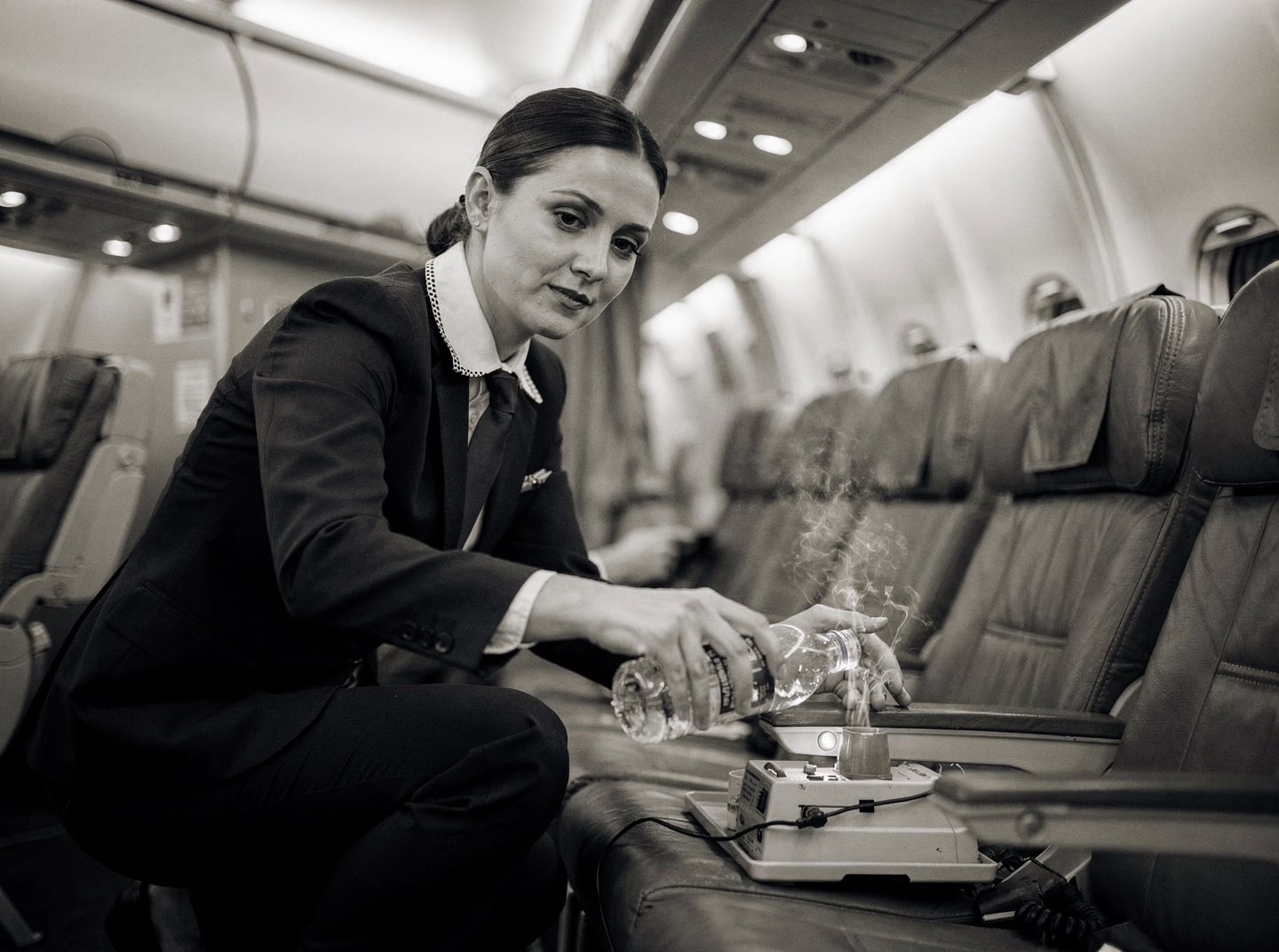
The emergency didn’t end there. The battery and the seat material kept smoldering and radiating heat, threatening to reignite, until crew emptied a 10-pound water extinguisher onto the wreckage and kept it coming until the temperature actually dropped.
That NTSB-documented sequence is the plainest illustration of a problem the FAA spelled out for airlines in a September 2025 safety alert: the standard extinguisher carried on nearly every commercial aircraft can’t stop a lithium battery fire from the inside. This is why, and what it means for anyone who’s ever tucked a phone or laptop into an overhead bin.
Fifty batteries, ninety-seven incidents: what the FAA’s 2025 tally actually shows
Through August 2025, the FAA had logged 97 smoke, fire, or extreme-heat events on US flights. Fifty of those were confirmed lithium battery incidents — verified, not suspected.
That leaves 47 events the agency hasn’t broken down by cause.
There’s no published split, and no way to reconstruct one from public records alone.
The battery share is still the highest the FAA has recorded since it began tracking these events in 2006. Two 2022 snapshots show why the curve keeps bending upward: cumulative lithium battery cargo-and-baggage incidents rose from 365 that May to 375 by July, a pace consistent with the agency’s own finding that these fires were happening more than once a week on passenger aircraft.
Across tens of millions of US flights each year, fifty verified incidents is a very small share. Airlines and regulators, however, have to plan for a weekly occurrence rate across the whole system — that makes thermal runaway a standard hazard, not a rare event.
Flight deals
most people never see
Our AI monitors 150+ airlines for pricing anomalies that traditional search engines miss. Air Traveler Club members save $650 per trip per person on average: see how it works.
Each deal saves 40–80% vs. regular fares:

What FAA’s own cargo-hold tests found when they tried to stop the chain reaction
The Colorado Springs incident is one data point. The FAA’s technical center ran the controlled version, packing a test cargo compartment with 5,000 18650-format lithium-ion cells and dousing them with everything from gaseous Halon 1301 to plain water pumped through a 60-gallon-per-minute deluge system.
The gaseous agents barely moved the needle. According to the FAA Technical Center, streaming extinguishing gases were essentially ineffective at halting propagation from one cell to the next — and pumping in more of the gas didn’t meaningfully change that.
Water behaved the opposite way. In the same tests, water-based agents pulled more heat out of the cells than the gases did, and adding more water made them work better still. More Halon didn’t.
That’s the lab-bench version of what happened in that Colorado Springs cabin — Halon handled the flame, and only sustained water actually ended the event.
The alert didn’t invent a rule — it activated one that already existed
SAFO 25002, the FAA’s 2025 alert on lithium batteries carried by passengers and crewmembers, doesn’t create a new regulation. It leans on an obligation airlines already carry under 14 CFR Part 5, Subpart C, which requires certificate holders to run ongoing safety risk management processes: identifying hazards, assessing them, and building in controls.
FAA guidance folds cabin lithium battery risk directly into that existing framework. Airlines were already supposed to be managing this — the alert is the FAA saying, loudly, that the risk has grown enough to warrant a fresh look at stowage, crew training, and passenger education.
What the alert doesn’t do is mandate new equipment. Advisory Circular 120-80B tells flight attendants to knock down a burning device’s flames with Halon or water, then immediately follow with water or another nonalcoholic liquid. The reason, per the National Transportation Safety Board‘s filed version of that circular, is that only water or a similar liquid cools cells enough to stop reignition or spread to the batteries beside it.
Fire containment bags — the pouches some carriers now stock for smoldering devices — remain optional.
The FAA has no formal test standard or approval process of its own for them, even though manufacturers sometimes claim certification.
The closest thing to an industry benchmark is ANSI/CAN/UL 5800, a voluntary standard for battery fire containment products. Europe’s regulator, EASA, treats the bags similarly — approved as an installation option under special conditions, never mandatory.
EASA adds one pointed restriction: a device already showing active thermal runaway shouldn’t go into a containment bag at all. Only a device that’s already cooled belongs inside one.
Inside the cell: why cooling is the only lever that works
Thermal runaway starts small — an internal short circuit, a manufacturing flaw, or physical damage that pushes one cell’s temperature up fast. The electrolyte and separator break down, internal pressure spikes, and the cell vents hot, flammable gas. That gas can ignite on its own, or the heat can simply jump to the cell sitting next to it.
Halon interrupts the flame by starving the combustion happening in open air.
It does almost nothing to the heat already trapped inside the battery — the actual engine driving the reaction forward.
The FAA says this outright. SAFO 25002 warns that Halon extinguishers “can briefly suppress open flames” but “do not halt the thermal runaway process,” and that the primary response is pouring large amounts of water on the battery to cool it while suppressing the flames at the same time.
Water works because it does what Halon can’t — it physically pulls heat out of the cell. That’s not a firefighting preference; it’s the only process in a cabin that actually lowers the battery’s temperature fast enough to break the chain reaction.
What this means for the phone, laptop, and power bank in your bag
Stow lithium-powered devices where you — or the crew — can actually see and reach them fast. A phone buried at the bottom of a rollaboard in the overhead bin is much harder to respond to than one in a seatback pocket or an accessible outer pouch.
Follow basic packaging discipline. Keep terminals away from loose metal, keys, or other batteries, since a short circuit at the terminal is one of the more common triggers for thermal runaway in the first place.
If a device starts smoking, hissing, or getting hot enough to feel through the seatback, don’t try to move it or pack it away. Alert the crew right away. The right response is to douse the device with water or another nonalcoholic liquid, then leave it alone until it has fully cooled.