Summary
- Eastern Canadians can save 30-60% flying east via Europe/Middle East hubs versus trans-Pacific routes
- Secondary hubs (Calgary, Montreal) work well but require one-stop connections for most Asian cities
- Cross-border positioning to Seattle, Minneapolis, or Detroit often unlocks C$400-800 savings on long-haul
- Allow 4-6 hour buffers on separate tickets; total trip cost often erases cheaper U.S. departure advantages
Listen to the podcast version of this article:
Why your hub choice actually matters
Your flight to Asia shouldn’t feel like a coin toss. One itinerary delivers a fair fare and a smooth ride; another sticks you with a 2 a.m. layover and a seat that steals your elbow room. The single decision that most shapes your price, routing, and comfort is which hub you start from.
This guide shows Canadians how to use the right Canadian (and occasionally U.S.) gateways to unlock better prices and easier trips to Asia–Pacific. We’ll walk through Canada’s power hubs, then the smartest cross‑border springboards, and share the pro tactics frequent flyers use to make long hauls feel less long.
Remember: there isn’t a single “best” hub. Be flexible about origin, check aircraft types, and watch sales—win on price, comfort, or both. Subscribe to fare alerts if you want the deals to come to you.
Major Canadian hubs (and what they’re best at)
These four hubs are Canada’s strongest springboards to Asia–Pacific. Each card highlights where the hub shines, what you’ll likely fly, key pros/cons, and “Stopover sweet spots” to help you save money or add a mini‑trip—so you can pick the right gateway for your route, budget, and comfort level.
1. Vancouver YVR
West Coast heavyweight with deep schedules into Northeast Asia and strong one‑stop options onward to Southeast Asia and Oceania.
- Best for: Tokyo, Osaka, Seoul, Taipei, Hong Kong; Southeast Asia via Japan/Korea/Taiwan; Australia/NZ via Asia hubs.
- Airlines & aircraft: Air Canada, ANA, JAL, Korean Air, Asiana, EVA, China Airlines, Cathay, Philippine, Singapore (mix of A350/787/777/A330/A380) plus U.S. partners over SEA/SFO/LAX.
- Why choose YVR: Shortest great‑circle hops from Canada to Japan/Korea/Taiwan, dense schedules, strong premium‑cabin competition, efficient international transfers.
- Watch‑outs: Peak summer/winter holiday crowds; weather irregular ops in shoulder seasons—build buffers on separate tickets.
Stopover sweet spots
- HND/NRT (Tokyo): Superb Japan domestic feed + NE Asia.
- ICN (Seoul): Ultra‑efficient hub with wide dispersion.
- TPE (Taipei): Excellent Southeast Asia reach and often‑sharp pricing. Offers stopover program.
- HKG: Handy for South China/SE Asia when schedules fit.
- SIN: Smooth onward links into Indonesia/Malaysia/Thailand and Australasia.
Pick if: you want maximum West Coast choice and frequent departures.
Skip if: you need ultra‑tight connections or dislike mega‑bank peaks.
| Route | Avg OTA price | Avg ATC price |
|---|---|---|
| YVR → Tokyo | C$1,220 | C$427 (65% off) |
| YVR → Seoul | C$1,150 | C$598 (48% off) |
| YVR → Taipei | C$1,350 | C$743 (45% off) |
| YVR → Singapore | C$1,450 | C$464 (68% off) |
| YVR → Manila | C$1,300 | C$611 (53% off) |
Flights to Asia for half-price. Thanks, AI.
Our custom AI finds rare deals that save 40–80% compared to regular fares. Why overpay?
See how it works →
2. Toronto Pearson YYZ
Canada’s biggest global gateway and Star/oneworld playground; great for nonstop Japan/Korea and plentiful one‑stops into Southeast Asia via partner hubs.
- Best for: Tokyo, Seoul; Southeast Asia via HND/ICN/TPE/DOH; India via Europe/Middle East.
- Airlines & aircraft: Air Canada, ANA, JAL, Korean Air, EVA (via partner one‑stops), Singapore (one‑stop), Qatar, Emirates, Etihad; mix of A350/787/777/A380.
- Why choose YYZ: Sheer frequency, alliance choice, premium‑cabin depth, huge domestic feed from across Central/Eastern Canada.
- Watch‑outs: Terminal changes add time; long queues in peak banks—aim for same‑terminal connections and healthy layovers.
Stopover sweet spots
- HND/NRT (Tokyo): Strong for Japan + onward Asia.
- ICN (Seoul): Very efficient for SE Asia.
- TPE (Taipei): Excellent SE Asia dispersion with typically competitive fares.
- DOH/DXB: Broad web across South/Southeast Asia and Australasia with frequent promos.
Pick if: you want maximum East‑of‑the‑Prairies options and premium availability.
Skip if: you prefer smaller airports or you’re tight on inter‑terminal layovers.
| Route | Avg OTA price | Avg ATC price |
|---|---|---|
| YYZ → Tokyo | C$1,400 | C$672 (52% off) |
| YYZ → Seoul | C$1,750 | C$840 (52% off) |
| YYZ → Singapore | C$1,650 | C$842 (49% off) |
| YYZ → Bangkok | C$1,600 | C$512 (68% off) |
| YYZ → Manila | C$1,650 | C$858 (48% off) |
3. Montréal–Trudeau YUL
Manageable East‑of‑Toronto hub with competitive Japan/Korea access and sharp one‑stops via Europe or the Middle East.
- Best for: Tokyo, Seoul (seasonal); Southeast Asia via HND/ICN/TPE; alternately via IST/DOH.
- Airlines & aircraft: Air Canada (+ ANA/JAL/Korean seasonal), Qatar/Emirates/Etihad via one‑stop; A350/787/777.
- Why choose YUL: Smaller‑airport feel than YYZ, solid premium availability off‑peak, Francophone Africa/Europe connectivity if you’re mixing trips.
- Watch‑outs: Fewer daily frequencies than YYZ; winter weather buffers.
Stopover sweet spots
- HND/NRT & ICN: Gateways for Japan/NE Asia and onward SE Asia.
- IST (Istanbul): Competitive fares and broad Asia/Africa coverage.
- DOH (Doha): Excellent dispersion to South Asia/SE Asia/Australasia.
Pick if: you’re in Québec/Atlantic Canada or can position cheaply to YUL.
Skip if: you need many same‑day frequency options to a single city.
| Route | Avg OTA price | Avg ATC price |
|---|---|---|
| YUL → Tokyo | C$1,350 | C$459 (66% off) |
| YUL → Seoul | C$1,700 | C$544 (68% off) |
| YUL → Singapore | C$1,700 | C$459 (73% off) |
| YUL → Bangkok | C$1,650 | C$644 (61% off) |
| YUL → Manila | C$1,750 | C$928 (47% off) |
4. Calgary YYC
Prairie‑to‑Pacific springboard with growing Asia service and strong one‑stop choices via West Coast or partner hubs.
- Best for: Tokyo (nonstop/seasonal), Seoul (seasonal); Southeast Asia via YVR/SEA/ICN/TPE.
- Airlines & aircraft: Air Canada, WestJet (var.), partners via YVR/SEA/ICN/TPE; A350/787/777 on long sectors.
- Why choose YYC: Easier experience than mega hubs; good mileage angles; easy domestic feed from the Prairies/Rockies.
- Watch‑outs: Fewer frequencies; expect one‑stops to many Southeast Asia cities; winter weather margins.
Stopover sweet spots
- YVR/SEA: Quick hops into dense Asia banks.
- ICN/TPE: Efficient dispersion into SE Asia.
- HND/NRT: Reliable Japan access + onward.
Pick if: you want calm transfers from Alberta/Saskatchewan.
Skip if: you need multiple dailies to secondary Asian cities.
| Route | Avg OTA price | Avg ATC price |
|---|---|---|
| YYC → Tokyo | C$1,300 | C$481 (63% off) |
| YYC → Seoul | C$1,500 | C$630 (58% off) |
| YYC → Singapore | C$1,600 | C$864 (46% off) |
| YYC → Bangkok | C$1,650 | C$908 (45% off) |
| YYC → Manila | C$1,650 | C$874 (47% off) |
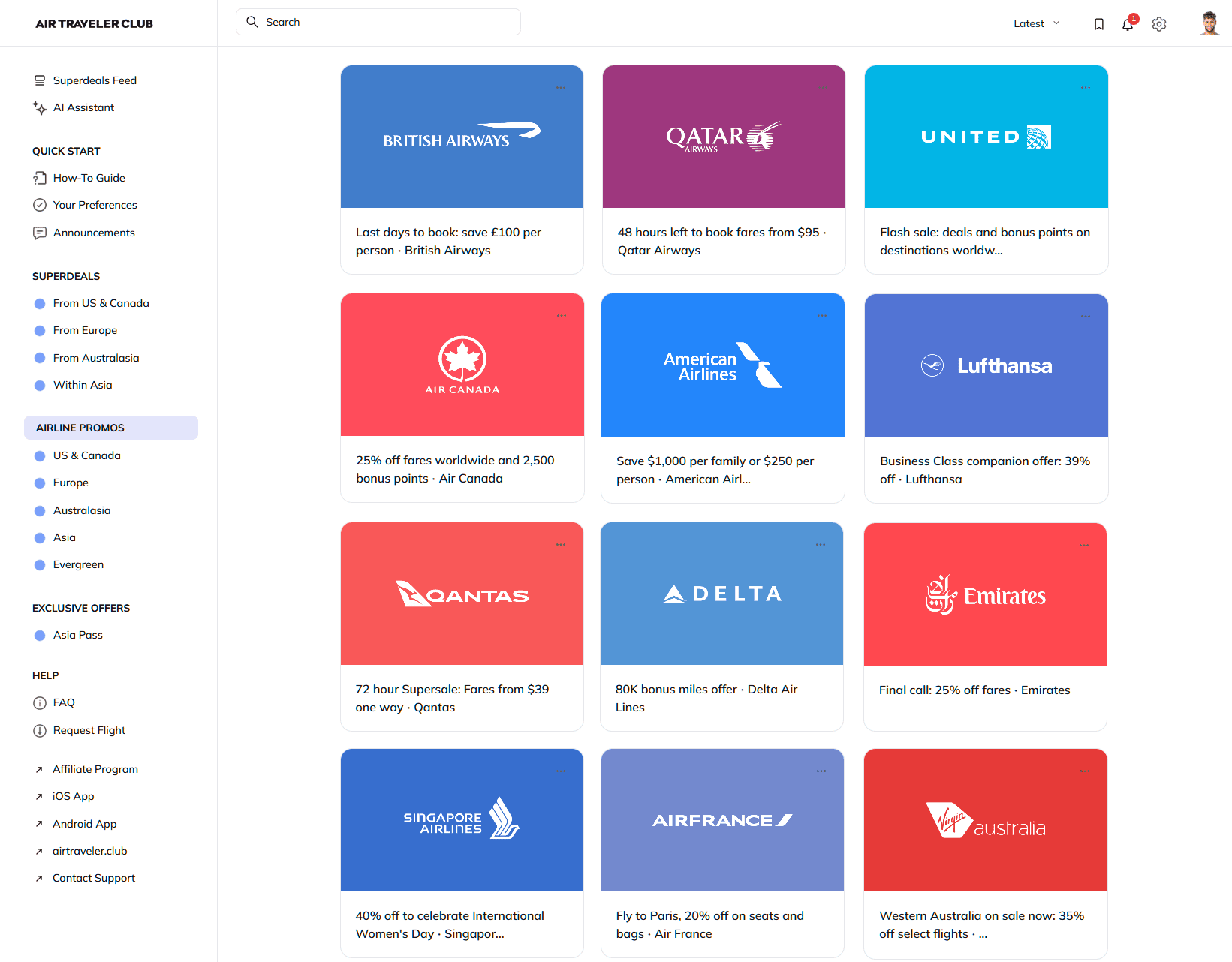
Our AI detects sales and promotions from 150+ airlines
- Genuine gems—vetted by travel experts
- Browse all active promos on our platform
- Never miss a new promo with real-time alerts
Comfort matters more than you think
On 10–13 hour sectors, the plane you pick changes how you feel when you land. Read our full guide to picking best planes for Canada to APAC comfort (with recommended airlines).
Secondary Canadian hubs (feeders and positioning points)
Beyond Vancouver, Toronto, Montréal, and Calgary, Canada’s other airports play a much smaller role in nonstop or one‑stop service to Asia–Pacific. Still, a few are worth noting:
Edmonton YEG
- Status: Occasional seasonal service to East Asia in past years, but currently relies on connections via Vancouver, Calgary, or U.S. hubs.
- Use case: Good for positioning flights; sometimes competitive long‑haul pricing when bundled with WestJet or Air Canada connections.
Ottawa YOW
- Status: No direct Asia service. Most routings connect through Toronto, Montréal, or U.S. hubs.
- Use case: Convenient for capital region travelers when domestic add‑ons are priced attractively.
Winnipeg YWG
- Status: No direct Asia flights. Heavy reliance on Calgary, Vancouver, or Minneapolis (Delta hub).
- Use case: Can leverage proximity to U.S. border airports (MSP, ORD) for better Asia fares.
Halifax YHZ
- Status: No Asia service. Typically connects via Montréal, Toronto, or European hubs.
- Use case: For South Asia or Southeast Asia trips, eastbound routings via London/Doha/Istanbul can be competitive.
Secondary West Coast airports (Victoria YYJ, Kelowna YLW)
- Status: No direct Asia service.
- Use case: Short hops to Vancouver or Seattle; sometimes cheaper positioning fares than starting at YVR directly.
Bottom line: Apart from the big four (YVR, YYZ, YUL, YYC), Canada’s other airports mainly serve as feeders. They don’t usually host nonstop Asia flights today, but they matter for positioning and can influence the total trip cost when paired with the right long‑haul gateway.
Should you fly west or east from Canada to Asia?
One of the classic puzzles is direction: cross the Pacific westbound, or fly east via Europe or the Middle East? From Canada, it depends heavily on your starting region.
Western Canada (BC/AB)
Westbound almost always wins. YVR/SEA/SFO/LAX have dense capacity to Japan/Korea/Taiwan with sharp pricing and clean routings. Going east adds flights and time with little cost upside, unless you’re chasing a unicorn fare or redeeming miles on a Gulf carrier.
Central/Eastern Canada (ON/QC/Atlantic)
Eastbound via London/Frankfurt/Istanbul/Doha is better than many assume—especially for South Asia and parts of Southeast Asia. The distance can be longer, but promos (particularly in premium cabins) can undercut trans‑Pacific fares by 30–60% at times. The cherry on top is an optional European/Middle‑East stopover.
Other factors
- Competition & pricing: The Pacific has density and sharp fares from both full-service and budget airlines; Europe/Middle East shine when JV promos drop.
- Stopovers: Westbound offers Tokyo/Seoul/Taipei. Eastbound unlocks London/Istanbul/Doha/Dubai.
- Jet lag & time zones: Both directions are long; recovery strategy often matters more than the compass.
Bottom line: For Western Canadians, west is the natural direction. For Eastern Canadians, going east via Europe/Middle East can be logical, cheaper, and sometimes more enjoyable.
Smart cross‑border springboards: U.S. airports Canadians can leverage
Canada has fewer mega‑hubs than the U.S.—but that’s not a disadvantage if you’re willing to position. A short hop, drive, bus, or train to the right U.S. gateway can unlock cheaper fares, better schedules, or more premium seats —a strategy known as The Continental Hop Trick. Here are the most useful cross‑border launchpads and when to consider them.
Pacific Northwest & BC
- Seattle (SEA): Compact, efficient, deep banks to Japan/Korea/Taiwan and consistent sales. Gold for Greater Vancouver/Victoria/Bellingham/Fraser Valley.
- Bellingham (BLI): Occasional ultra‑low‑cost positioning to West Coast hubs; useful for price‑sensitive travelers within driving distance.
- Portland (PDX): Smaller than SEA with periodic promos; good backup when SEA prices spike.
Prairies & Rockies
- Minneapolis–St. Paul (MSP): Smooth Delta hub with reliable Japan/Korea links; good for Winnipeg/Regina/Saskatoon/Thunder Bay.
- Denver (DEN): Growing Asia connectivity via partner hubs; useful from southern Alberta/Saskatchewan when schedules align.
Ontario/Québec & Great Lakes
- Detroit (DTW): Minutes from Windsor, efficient long‑haul ops, strong Japan/Korea options.
- Buffalo (BUF): Budget‑friendly positioning to JFK/EWR/BOS/ORD; helpful for GTA and Niagara region.
- Chicago O’Hare (ORD): Star/SkyTeam crossroads with plentiful Asia one‑stops; reachable from Southern Ontario.
- New York (JFK/EWR): Huge alliance breadth and frequent premium promos.
- Boston (BOS): Manageable airport with competitive Japan/Korea/Taiwan links; a savvy alternative to NYC.
Atlantic Canada
- Boston (BOS) / New York (JFK/EWR): Best coverage for Japan/Korea and onward SE Asia.
- Washington Dulles (IAD): Star‑heavy, tidy transfers; often less chaotic than NYC in peak banks.
$2500 in savings from top travel brands
Discounts on premium services, free hotel stays, free guided tours, big rebates on travel gear, and much more.
Get discounts →
Practical tips for cross‑border positioning
- Preclearance & NEXUS: Most major Canadian airports have U.S. preclearance; NEXUS can slash queue time both ways.
- Allow real buffers: If you’re on separate tickets, leave 4–6 hours between arrival and your transpacific departure (more if crossing a land border).
- Bags & terminals: Separate tickets usually mean re‑checking bags; keep terminals in mind at JFK/LAX/ORD.
- Total trip cost: Add fuel/parking/border wait time when comparing a “cheaper” U.S. departure.
Common mistakes
Flying long‑haul to Asia–Pacific from Canada (or via U.S. hubs) can save money and open better routes—but it’s also where many travelers trip up. Here are 10 common mistakes and how to dodge them:
- Assuming your local airport is always cheapest. A C$100–C$200 positioning hop to a bigger hub can unlock C$400–C$800 savings on the long haul.
- Ignoring West Coast gateways when starting in the East. Positioning to YVR/SEA/SFO often shortens the transpacific segment and lowers fares.
- Not checking flight‑deal services. Skipping specialized platforms can cost you hundreds. Air Traveler Club surfaces deals up to 80% off regular fares (so called Superdeals).
- Booking tight connections across terminals. At hubs like JFK or LAX, a layover is a gamble.
- Ignoring aircraft type and cabin layout. Not all 787s/A350s are equal—seat width/pitch vary by airline.
- Mixing separate tickets with no safety margin. Positioning can save money—but only if you allow generous buffers.
- Forgetting total trip cost on cross‑border departures. Fuel, tolls, parking, border time, and bag fees can erase a fare advantage.
- Chasing the wrong loyalty angle. Sometimes the cheapest fare earns poor mileage. If status/miles matter, price in the value.
Questions? Answers.
Which Canadian hub (YVR/YYZ/YUL/YYC) is cheapest for Southeast Asia?
Usually YVR. Westbound one-stops via TPE/ICN/NRT often price best. From Ontario/Québec, YYZ and YUL can be competitive via DOH/IST—especially to Southeast and South Asia. YYC is rarely the lowest unless a sale hits.
Are nonstops to Asia worth the premium vs one‑stops via Tokyo/Seoul/Taipei or U.S. hubs?
Often, yes—if you value time and reliability. Nonstops save ~2–6 hours and dodge immigration/terminal hops. If the price gap is ≤ C$200–C$300 (economy) or ≤ C$500–C$800 (business), nonstop is usually worth it; bigger gaps favour a one‑stop.
Which departures have the best lie‑flat A350/787 options without big surcharges?
YVR (ANA, JAL, EVA, Cathay, Singapore) and YYZ (ANA, JAL, Korean, Qatar) lead. Via the U.S., SEA/SFO/JFK add depth. Target A350/787/777 with 1‑2‑1; avoid surcharge‑heavy carriers on cash tickets.
What minimum connection time at JFK/EWR/LAX/ORD/SEA on separate tickets?
Plan 4–6 hours. Same‑terminal with no immigration: ~3 hours can work. Any U.S. entry/terminal change/checked bags: 4–6 hours (more in winter). Overnighting pre‑transpacific is safest.
On separate tickets (YYZ→JFK + JFK→Asia), will bags interline and who rebooks if delayed?
Assume no interline and no protection. You’ll likely reclaim/re‑check bags and the onward airline isn’t obliged to rebook. Use longer layovers, buy a through‑ticket, or get insurance that covers misconnects.
Winter delays: are YYZ/YYC/YUL risky—should I position to YVR or the U.S. West Coast?
Yes, YYZ/YUL/YYC see more winter disruptions. YVR/SEA generally run smoother. Position west when practical, or build buffers/overnight if starting in the East. To avoid weather-related disruptions entirely, learn about airport hubs that can offer year-round reliable departures.
From Eastern Canada, is it better to go east via Europe/Middle East than over the Pacific?
For South & Southeast Asia, eastbound via LHR/IST/DOH/DXB is often cheaper with strong premium availability. For Japan/Korea/Taiwan, the Pacific via YVR/SEA is shorter and simpler.