Superdeals are AI-detected pricing anomalies — 40–80% below a route’s normal fare — verified by a human expert and checked independently against real market data before they’re ever shown to members. They work exactly like any other flight deal you’d hunt for yourself. The difference is what’s doing the hunting, and how good the deals turn out to be.
You already know the usual flight search engines — Expedia, Skyscanner, Kayak. They’re good at one thing: showing you what’s on the market right now. What none of them do is flag the moment a fare breaks from its normal range. That’s the gap Superdeals fills: watching thousands of routes continuously for the fares that shouldn’t exist, on exactly the routes you’d actually book.
Standard deals might save you 5–20%. A Superdeal guarantees at least 40% off, with many climbing to 80% — every one of them a round-trip fare, in economy or business class.
Why Superdeals matter more right now
With fares up sharply over the past couple of years, it’s fair to wonder if Superdeals still hold up. The causes are mostly structural: fuel costs spiked, aircraft manufacturers fell behind on deliveries just as demand rebounded, and on many long-haul routes only a handful of carriers compete, so there’s little pressure to bring prices back down once fuel costs ease.
If anything, Superdeals hold up better in this environment. When supply and demand fall this far out of balance, pricing algorithms respond by swinging harder, and more often, chasing shifting demand in real time. That volatility is exactly what produces Superdeals: pricing anomalies, overcapacity gaps, sudden discounts to fill a flight fast.
That matters more with every passing month. As regular fares climb, Asia becomes harder to reach for travelers on a tighter budget. A 40–80% discount doesn’t just save money — it can bring the price back down to roughly what flying cost years ago, putting Asia within reach again.
What a Superdeal actually is
A Superdeal is a flight priced 40–80% below what that route normally costs — not a sale an airline announced, but a genuine pricing anomaly: a new route launched with introductory fares, a sudden overcapacity gap, an aircraft swap, a cancelled group booking reopening seats. Our AI catches it, and a human checks it, before it ever reaches a member.
- At least 40% off, up to 80%
- Round-trip only
- Economy and business class — business seats make up roughly 10–20% of listings
- 1–8 months out, typically 1–4 week trips
Where we cover
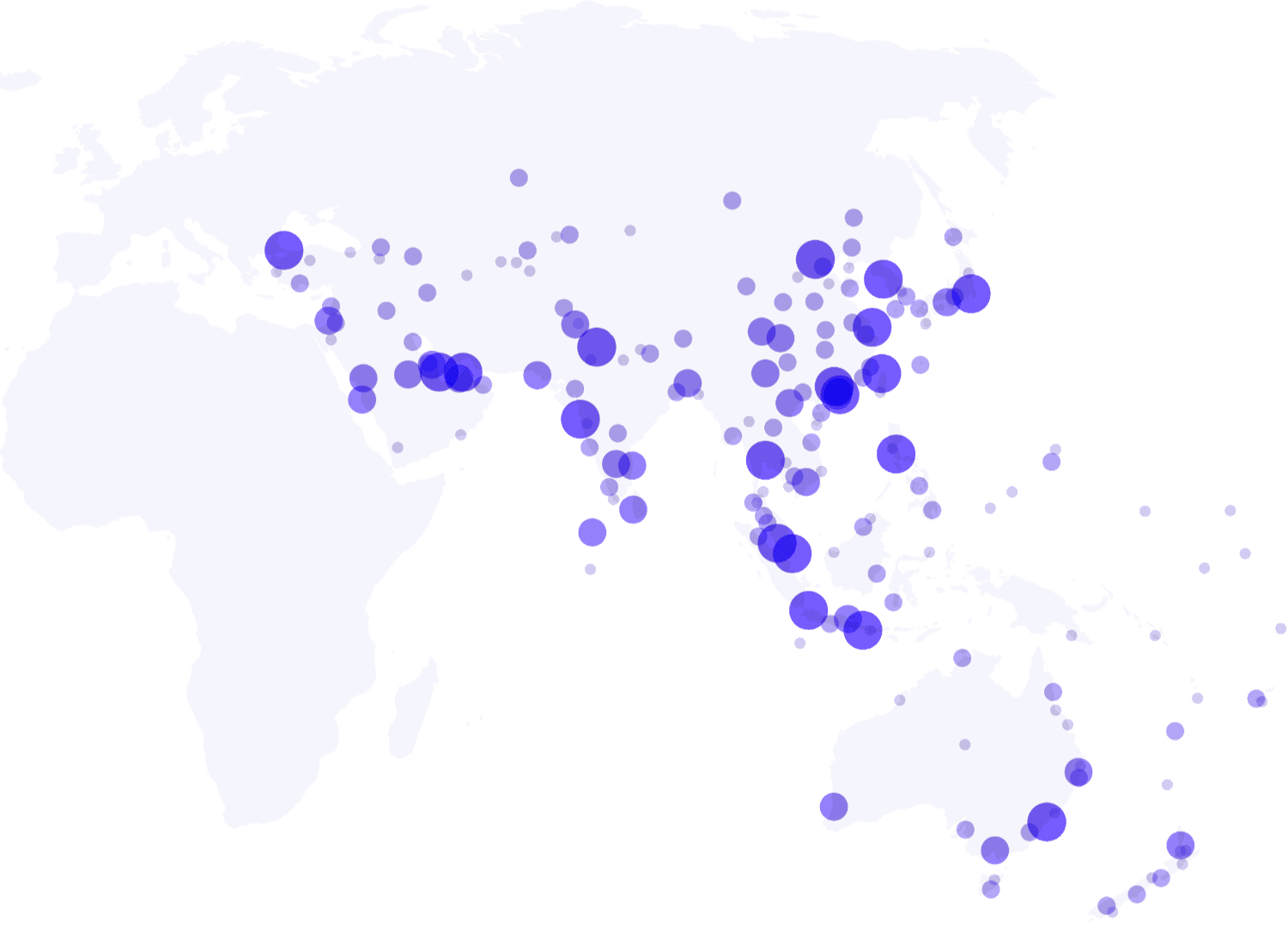
Superdeals span more than 60 countries across the Asia Pacific region — from popular picks like Japan, India, Thailand, Indonesia, and Vietnam to far less obvious ones like Fiji or Papua New Guinea. Departures come from four regions:
- North America — US and Canada, 51 airports
- Europe — 59 airports
- Australasia — Australia and New Zealand, 27 airports
- Within Asia, for deals departing from inside the region — 190+ airports
Hundreds of airports across those four regions feed into the platform — generally, the bigger your home hub, the more Superdeals you’ll see departing from it.
How we find and verify a Superdeal
Airline pricing algorithms are dynamic — constantly adjusting fares based on current and historical supply and demand. Sudden, sharp drops happen too, largely at random: a seasonal dip, a wave of cancellations, an unscheduled flight or new route added close to departure.
Plotted against weeks of pricing history, a Superdeal shows up as a sharp, unmistakable dip — understanding these broader airfare trends, and watching hundreds of routes continuously, is how we catch the exact moment one appears.
We combine AI tools, in-house automation, and manual observation to catch these drops as they form — watching thousands of flight routes hourly for prices that break from their normal pattern.
But a low price alone isn’t enough to be worth your time — a fare that saves 60% on a 30-hour itinerary with three layovers isn’t a deal, it’s a trap. That’s why every flagged fare goes to a real travel expert next, who checks the actual routing before anything gets published: is the layover reasonable, is the airline one we’d fly ourselves, is the aircraft decent for the cabin you’re booking. Nothing goes out that we wouldn’t book on our own trip.

Why fares actually drop
Airline pricing algorithms adjust constantly based on demand, competition, and capacity. A handful of situations reliably trigger a real drop:
- A new route launches with introductory pricing
- An airline adds flights on an existing route and needs to seed early bookings
- A last-minute aircraft swap floods the market with unsold seats
- A route runs overcapacity and the algorithm cuts price to fill it
- A large group booking cancels, reopening a block of seats
- Unsold seats from a charter or tour block get released to the public
- A rare steep discount appears close to departure
- An airline runs a planned or unplanned promotional sale
- Occasionally, a genuine pricing mistake — rare, and usually gone within hours
What “40–80% off” is actually measured against
Every deal site claims big discounts, and most of those numbers are measured against a price nobody can actually verify. It’s fair to wonder if we’re doing the same thing — quietly picking a “normal” price high enough to make the discount look bigger than it really is.
We’re not, and you don’t have to take our word for it. Every Superdeal links to that exact route on Google Flights, where a color-coded bar compares today’s price to what that route has actually cost over the past year — using Google’s own independent pricing data, not ours. If that bar shows green, the deal is genuine: an outside party confirming it, not just us saying so.
What you’ll actually see
Each Superdeal is a real listing, not a teaser.
On the card
Departure and destination cities, the discounted price, the discount percentage, and how long ago we found it.
On the full listing
Open it up and you’ll see the normal price next to the Superdeal price, your exact savings, total travel time, the full itinerary with layovers, and the airline and aircraft for each leg. If the deal shows up on more than one date, alternative dates are listed too.
One link takes you straight to that exact flight on Google Flights, ready to book directly with the airline. For the full step-by-step, see How to Book Superdeals.
Alerts, wherever you are
The moment a Superdeal on your route publishes, it can reach you four different ways: a mobile push notification, an in-app alert, an email — or, if you’ve got the members-only platform open, a notification right there on the page. You control which ones are on; new members start with all four enabled.
Every currently active Superdeal is always browsable on the platform too, whether or not you’re getting alerts for it. Alerts just tell you the moment a new one appears — you’re never limited to what happens to land in your inbox.
Deals are organized by region into “Spaces”: your home region — North America, Europe, or Australasia — plus Within Asia, for deals departing from inside the region. Turn on both if you want the widest net.
Members get real-time alerts and the full live feed: 100+ Superdeals per region, updated daily. The free newsletter is a separate, lighter track — about one sample deal a week, no real-time alerts, no platform access. It’s a preview, not a limited version of membership.
Can’t find a Superdeal for the exact route you need? Use Request a Flight to tell us the route and dates — our team will try to match a deal to it.
How Superdeals compares to everything else
Checking fares by hand means comparing weekday prices, tracking the calendar, and hoping a sale lands before you book. A Superdeal skips all of that — the comparison’s already made by the time you see the price.
Here’s how it actually stacks up against every other way to save:
| Strategy | Typical savings |
|---|---|
| Book directly with the airline | 2–10% |
| Fly on a weekday | 5–15% |
| Fly early morning | 15–20% |
| Accept a stopover instead of nonstop | 10–30% |
| Book 4–6 months ahead | 10–30% |
| Travel in low season | 10–30% |
| Book round-trip instead of two one-ways | 10–35% |
| Redeem frequent flyer miles | 10–40% |
| Wait for an airline sale or promo | 10–50% |
| Continental Hop Trick (positioning flight + Superdeal) | 15–40% |
| Superdeal | 40–80% |
None of these strategies are wrong — they’re just slower, smaller versions of what a Superdeal already does automatically. You could spend an afternoon combining half of them for a 25% discount, or stack every single one and still likely land under 30%. A Superdeal starts at 40%, before you’ve done anything at all.
That gap isn’t just a bigger number. It’s the difference between economy and a business class upgrade, for the same budget.
So, what’s the catch?
Forty to eighty percent off sounds like there has to be a catch — and there is one, though it isn’t hidden. It’s timing: a Superdeal typically holds its listed price for 12 to 72 hours, climbs over the following few days, and settles back to normal within two to three weeks.
That’s less limiting than it sounds, because Superdeals rarely appear on a single isolated date. They cluster — a run of nearby dates that often carry similarly low pricing, not just the one sample date shown. Each listing includes an Alternative dates section for exactly this reason: it’s a launchpad for the trip you actually want, not a fixed itinerary. For the full breakdown of how to match a deal to your own schedule, see Finding Superdeals that match your schedule.
To be upfront, though: if you need one exact, non-negotiable date, Superdeals aren’t built primarily for you — flexibility is what makes the discount possible in the first place. Even then, it’s not all-or-nothing. A cluster can span a week or more, so there’s a real chance your fixed date already falls inside one, even without trying.
Questions? Answers.
If it’s real, why doesn’t the airline just show me these fare drops?
They technically do – every Superdeal is bookable directly through the official airline site. But “show” is generous: the fare sits buried in the airline’s own booking system, only surfacing if you search the exact route and exact dates, during the narrow window where the drop happens.
Airlines have all the tools and data to surface these drops in real time – they just choose not to. Making it easy to find would work against them: it’s in their interest to keep demand, and prices, as high as possible. Just look at any airline’s own “Sale” or “Deals” page – it rarely offers a genuinely great discount, maybe a small saving, never 40% or more. That’s marketing, not pricing reality: airlines want you paying close to the regular fare. A temporary algorithmic dip just sits there unadvertised until demand catches up and it climbs back.
Are Superdeals nonstop flights, or do they usually have layovers?
Superdeals are mostly built for long-haul routes to begin with, so a layover shows up more often than not. Of course, we also feature nonstop Superdeals whenever the fare drop is attractive enough on its own – it’s not one or the other.
These routes can get extreme. Nonstop New York to Singapore already runs nearly 19 hours. Nonstop London to Tokyo runs around 14 hours, and nonstop Perth to London clocks in around 17 hours 45 minutes. At that length, a real break often beats one uninterrupted marathon. It also tends to cost less, since airlines price connections lower to fill seats on less popular legs.
We manually curate every deal for reasonable connection length, but sometimes we deliberately keep a longer one – a real stopover, not just a layover – at an airport with a genuinely good program attached: Doha, Istanbul, and Incheon among them, where the break can mean a free hotel night or guided city tour instead of dead airport time.
Learn more: Airline stopover programs
Can I get a one-way Superdeal, or is it round-trip only?
Round-trip only, every time. If you only need a one-way ticket, you can still use the deal as a starting point on Google Flights to check one-way prices yourself.
Is there a limit to how many flights I can book?
No caps. Your membership gives you unlimited access to every Superdeal, Airline Promo, and Asia Pass perk on the platform – book as many trips as you want, whenever you find a deal that fits.
The only real constraint is airline availability – seats at that price are limited by the airline’s own system, not by us.
Why can’t I just watch fares myself?
Even if you’re only watching a few routes you’re interested in, you’d need to check them often and continuously – fare drops can appear and vanish within hours. And a handful of routes is limiting: one of the core values of Superdeals is flying cheap to surprising destinations you weren’t even searching for. We’ve built dedicated AI tools for exactly this and keep improving them, so members don’t have to watch anything – deals just land as alerts, ready to book.
Can I score a deal for a trip leaving next week?
Usually not. Superdeals typically appear for trips 1 to 8 months out, not next week. That’s not a limitation unique to us: airlines used to drop unsold-seat prices as departure got closer, but modern pricing algorithms have mostly reversed that. Business travelers routinely pay a premium for last-minute tickets, so airlines sell their cheapest fares first and raise prices as departure nears, not the other way around. Genuine last-minute discounts do occasionally exist, but they’re rare, usually limited to unpopular routes or off-peak dates, and not something to plan a trip around.
Learn more: Last-minute flights: the real cost of convenience
Does my home airport affect how many deals I see?
Yes, significantly. Bigger airports with more airline competition and route options tend to have far more Superdeals – and often deeper discounts too, since more carriers competing on the same routes means more pricing anomalies to catch. If your home airport is smaller, you’ll likely see fewer deals departing from it directly. A short, cheap positioning flight to a nearby major hub can multiply the number of Superdeals available to you.
Learn more: North America edition
Can I see what deals look like before I become a member?
Yes. Our homepage shows live examples of real Superdeals so you can see the kind of savings members get.
Our free newsletter sends 1 sample deal a week and airline promo insights – a good way to get a feel for the quality before joining.
Do you offer a free plan?
Although we don’t offer a free plan, you can subscribe to our free newsletter and receive sample offers. Each week we send select Superdeals and insights into recent airline promotions.
It’s a great way to get a taste of the high-quality deals that are waiting for you on our members-only platform.