Quick summary
American Airlines shut down staffed customer service counters at Washington Reagan National Airport (DCA) as part of a 2026 digital restructuring push — then severe thunderstorms on June 12, 2026 cancelled 34% of DCA flights and delayed 39% more, leaving stranded passengers facing QR codes and app flows instead of agents. American led all carriers globally in cancellations that day, with 9% of its total operation grounded and 36% of mainline flights delayed.
The airline’s own messaging confirmed it is policy “to not have customer service” at the counter. Passengers who know the workarounds — foreign call centers, simultaneous app and phone queuing, credit card protections — recovered faster than those who waited for help that wasn’t coming.
A major thunderstorm system swept through the Mid-Atlantic on June 12, and American Airlines‘ decision to replace staffed counters with QR codes at Reagan National stopped being a cost-efficiency story and became a passenger crisis. One traveler, told directly by airline staff that American’s policy is “to not have customer service,” posted the exchange publicly — and it went viral because it was accurate.
American cancelled 9% of its global operation that day, the highest cancellation rate of any carrier worldwide. At DCA specifically, 34% of flights were cancelled and 39% delayed. PSA Airlines, the regional affiliate operating American Eagle–branded flights, cancelled 31% of its own schedule. Combined weather pressure at Dallas Fort Worth (DFW) compounded the damage across American’s two most weather-exposed hubs simultaneously.
The structural problem is not the storm. Storms happen. The problem is that American dismantled the in-person infrastructure needed to manage them — and the digital replacement is not built for surge conditions.
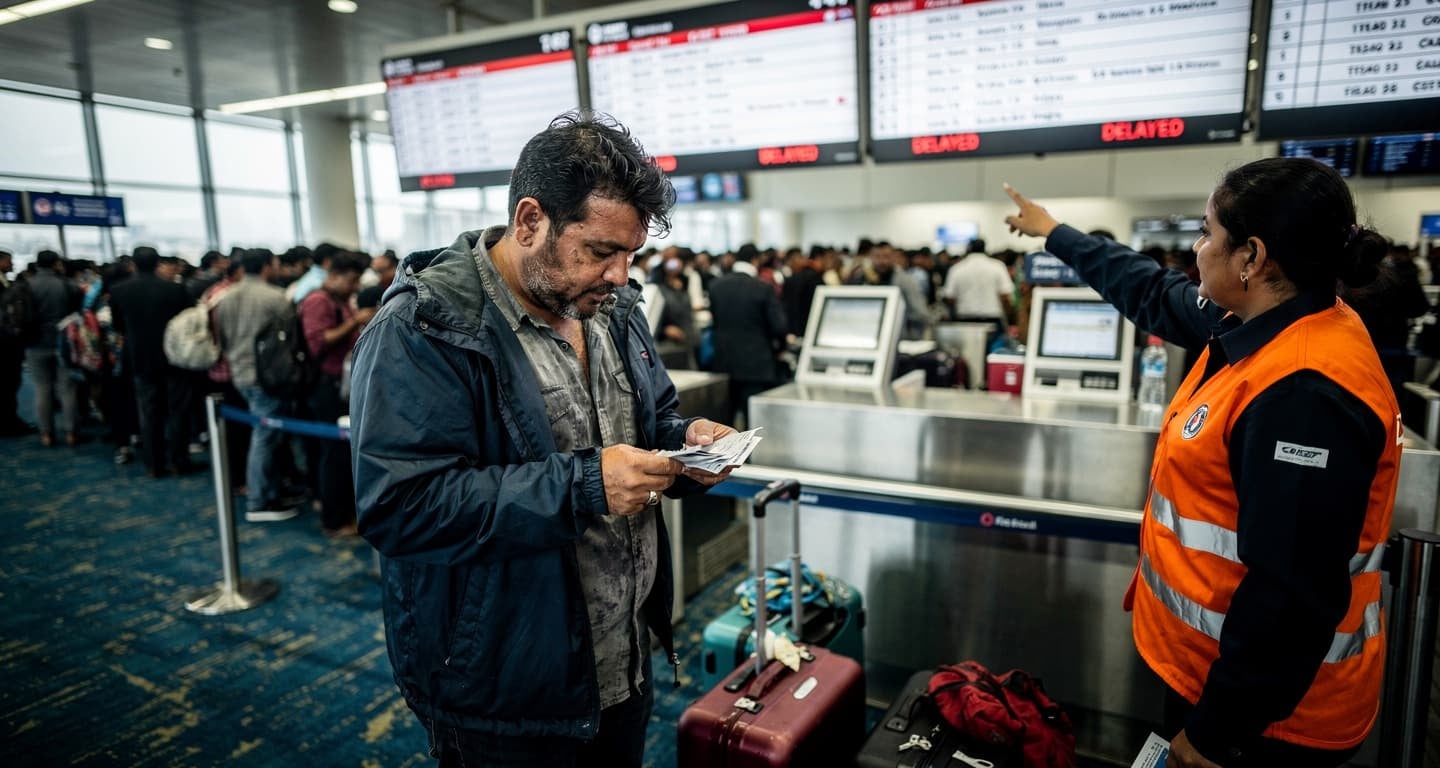
Passengers at DCA found customer service counters dark, gate agents overwhelmed and largely unable to rebook, and app wait times stretching as thousands of simultaneous requests hit the same servers. Some travelers reported waiting more than 24 hours before any staffed assistance appeared. When agents did show up, there weren’t enough of them, and they weren’t positioned to do the volume of rebooking the situation demanded.
How American’s digital pivot collided with DCA’s structural limits
American Airlines announced in 2026 that its new disruption-management model would deliver proactive rebooking, bag tracking, and meal and hotel vouchers entirely through the app and digital notifications — eliminating the need for traditional staffed counters as the primary recovery channel. The airline’s own newsroom framed this as empowering customers with faster, more personalized service.
What the announcement did not address: what happens when every passenger at a hub tries to access that system at the same moment.
DCA operates under slot and perimeter restrictions that make it structurally harder to reaccommodate passengers than at open-market airports. Fewer flights, fewer carriers, fewer alternatives — which means any delay in getting a traveler rebooked increases the probability of a next-day push or a redirect to Dulles or BWI. That math gets worse when the digital queue is jammed and no one is standing behind a counter.
This is not the first time American’s hub infrastructure has buckled under weather pressure. A major winter storm earlier in 2026 left crews and passengers at DFW facing hotel shortages and hours-long waits for assistance — a pattern that predates the June event and suggests a systemic gap, not an isolated bad day. This follows a separate incident in May 2026 when American’s automated rebooking system released confirmed seats from passengers still at the gate, stranding travelers on a Miami–Boston flight before they had even missed a connection.
| Metric | Figure | Context |
|---|---|---|
| DCA flights cancelled | 34% | Severe thunderstorms + FAA air traffic slowdowns |
| DCA flights delayed | 39% | Same event; combined cancellation/delay rate exceeded 70% |
| American mainline flights delayed (global) | 36% | Highest single-day delay rate among major US carriers that day |
| American total operations cancelled (global) | 9% | Led all carriers worldwide in cancellations for June 12 |
| PSA Airlines (American regional) cancellations | 31% | Regional affiliate operating American Eagle–branded DCA routes |
Flight deals
most people never see
Our AI monitors 150+ airlines for pricing anomalies that traditional search engines miss. Air Traveler Club members save $650 per trip per person on average: see how it works.
Each deal saves 40–80% vs. regular fares:

Why the digital model breaks exactly when passengers need it most
Airlines have been reducing customer-facing headcount for years, but the mechanism matters. United Airlines, for comparison, has moved toward virtual agent access — staff work remotely and handle multiple queues simultaneously, rather than being physically absent. American’s model goes further: it assumes the app handles the load. During normal operations, it largely does. During a hub-wide disruption, the app becomes a bottleneck rather than a bypass.
American has also reduced gate staffing on domestic routes, with single agents now handling boarding, seat changes, and passenger screening on flights up to 80% full. That agent cannot simultaneously board a plane and rebook 40 misconnected passengers. So disrupted travelers get redirected — to the customer service counter that no longer exists, or to a phone queue that is also overwhelmed.
The forward signals here are worth watching. The U.S. Department of Transportation’s Airline Customer Service Dashboard is due for a regulatory review cycle — if it tightens minimum disruption-care standards, travelers gain clearer leverage for demanding in-person help. If it doesn’t, expect more airlines to follow American’s low-touch model. American’s next quarterly earnings call is also a pressure point: pointed analyst questions on disruption handling would signal that the cost-cutting calculus is being reconsidered.
Protecting your trip when American’s digital system fails
American’s self-service model will not surge-scale during a hub-wide disruption — passengers who recover fastest are those who work multiple channels simultaneously rather than waiting for one to resolve.
- Open the American app immediately and search “Change Trip” — you may not see all available flights, but confirming yourself on anything workable is faster than any queue. Keep refreshing; availability shifts as other passengers rebook.
- Call American reservations in parallel — do not wait for the app to fail first. If US lines are jammed, dial the UK or Australia English-language numbers using a VoIP app. Elite status holders get faster pickup; call anyway if you don’t have status.
- Check your credit card benefits portal now — Amex Platinum, Chase Sapphire Reserve, and Capital One Venture X all carry trip delay and cancellation protections when the disrupted flight was purchased on the card. Delays of 6+ hours or an overnight stay typically activate coverage. Keep every receipt; file through the issuer’s online portal after travel.
- Know your DOT rights — U.S. rules do not require cash compensation for weather cancellations, but American must refund you if your flight is cancelled or significantly changed and you choose not to travel. Request the refund explicitly; do not accept a voucher if cash is what you need.
- If you have Admirals Club access, use it — club agents handle rebooking and have more flexibility than gate staff during irregular operations.
Watch: The DOT’s next Airline Customer Service Dashboard update and American’s upcoming quarterly earnings call — analyst pressure on disruption handling would be the clearest signal that the current staffing model is under review.

Questions? Answers.
Is American Airlines required to compensate me for a weather cancellation at DCA?
Under current U.S. DOT rules, American is not required to pay cash compensation for weather-related cancellations, since weather is classified as outside the carrier’s control. However, if your flight is cancelled or significantly changed, you are entitled to a full refund to your original payment method if you choose not to travel. Request this explicitly — the airline is not obligated to offer it proactively.
Do EU261 protections apply if I’m flying American Airlines from Europe during a weather disruption?
For EU261 or UK261 claims on American-operated flights departing from EU or UK airports, weather qualifies as extraordinary circumstances — meaning cash compensation is generally not owed. However, duty-of-care obligations (meals, accommodation, communication) may still apply depending on delay length and specific conditions. Check the official guidance at europa.eu or gov.uk for your specific situation.
What’s the fastest way to rebook when American’s app is overwhelmed during a disruption?
Work all channels simultaneously rather than sequentially. Open the app and search alternatives while dialing reservations — by the time an agent picks up, you may already have a flight confirmed, or the agent can access inventory the app isn’t showing. If US lines are jammed, the UK and Australia English-language American numbers typically have shorter wait times and can rebook domestic US itineraries.
Does American Airlines have to provide hotel accommodation during a weather delay?
No. U.S. carriers are not legally required to provide hotel accommodation for weather-related disruptions. American’s digital model now delivers hotel vouchers through the app during irregular operations, but availability and issuance speed vary. Your best immediate fallback is a credit card with trip delay coverage — Amex Platinum, Chase Sapphire Reserve, and Capital One Venture X all reimburse hotel costs for covered delays, subject to the thresholds and documentation requirements in each card’s benefits guide.