Quick summary
Severe thunderstorms and FAA air traffic slowdowns on June 12, 2026 cancelled 34% of all flights at Washington Reagan National Airport (DCA) and delayed another 39% — more than 70% of the day’s operation disrupted. American Airlines recorded the highest cancellation rate of any carrier globally that day, grounding 9% of its total operation and delaying 36% of mainline flights, while regional partner PSA Airlines cancelled 31% of its schedule. The crisis exposed a deliberate policy decision: American had already shut down its staffed customer service counters at DCA, replacing them with QR codes and app-based self-service.
Some stranded passengers waited more than 24 hours before receiving staffed assistance. American is simultaneously laying off 656 customer-service employees across Phoenix and Dallas as part of its 2026 restructuring.
American Airlines walked into Friday’s storm with its hands tied behind its back — by its own design.
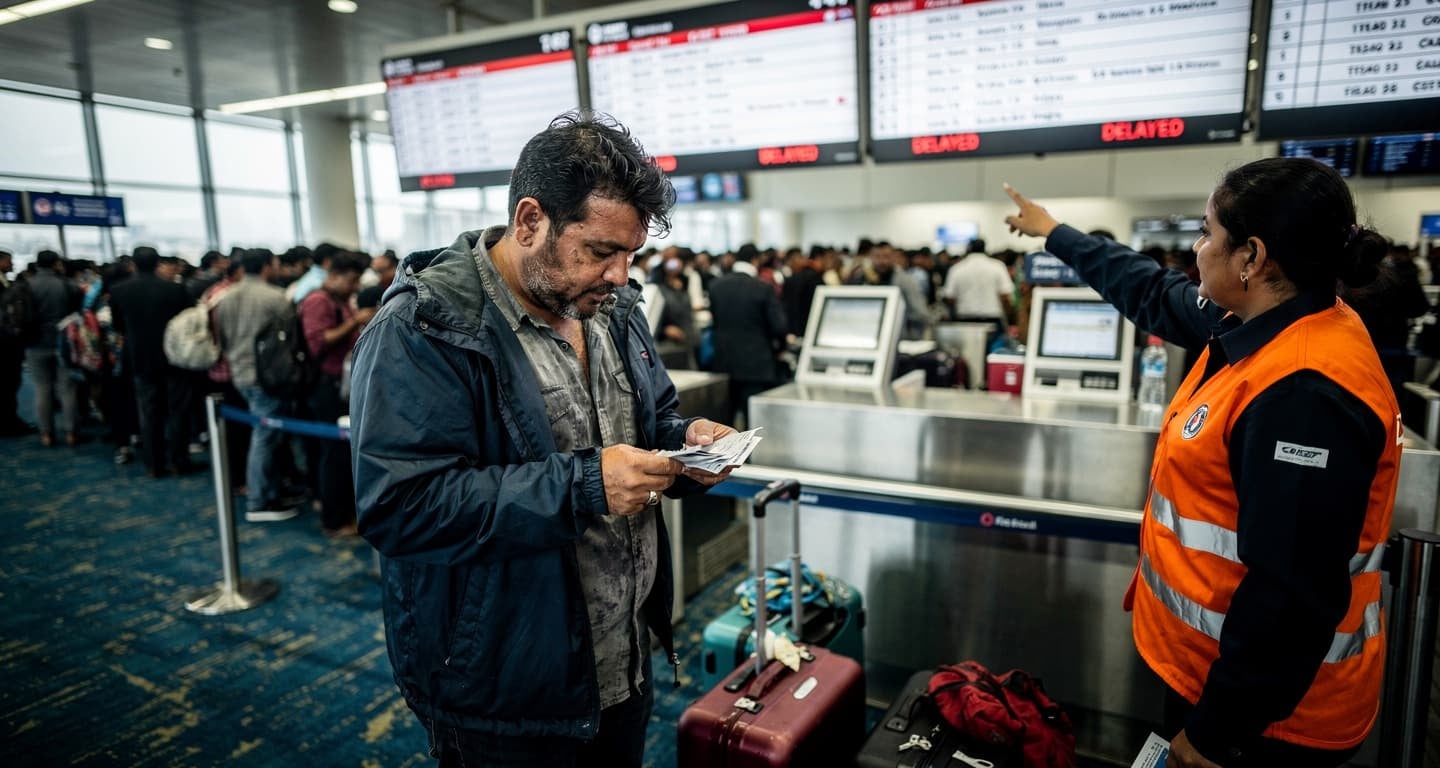
When thunderstorms swept the Mid-Atlantic on June 12 and the FAA imposed flow restrictions over the Washington area, the result at Ronald Reagan Washington National Airport was predictable: mass cancellations, cascading delays, and thousands of passengers suddenly needing help. What was not inevitable was what those passengers found when they looked for it. The customer service counters were dark. The agents were not there.
American had removed most staffed service counters at DCA as part of a broader 2026 push toward digital self-service, directing passengers to QR codes, its mobile app, and phone lines. That infrastructure held up fine on ordinary days. It did not hold up when every disrupted traveler in the terminal hit it simultaneously.
Gate agents, already stretched thin under American’s reduced staffing model, were pulled away from boarding duties to handle rebooking requests they lacked the numbers and authority to process quickly. The airline that led the world in cancellations that day had effectively pre-removed its own emergency response capacity. United Airlines, operating at the same airport under the same weather, was widely noted for keeping agents reachable — a contrast that did not go unnoticed by stranded travelers.
What the June 12 breakdown actually looked like on the ground
The disruption numbers are stark. Combined thunderstorm activity and FAA traffic management programs forced cancellations and delays across more than 70% of DCA’s scheduled operation. American’s mainline network absorbed a 9% global cancellation rate — the worst of any carrier worldwide that day — and PSA Airlines, which operates short-haul American Eagle routes out of DCA, cancelled nearly a third of its flights. Passengers connecting through DCA to American’s hubs at Dallas–Fort Worth, Charlotte, and Chicago O’Hare found their onward options evaporating in real time.
The staffing picture made a bad situation structurally worse. American’s 2026 digital experience push had already repositioned the airline away from counter-based service at DCA. Live agents were designated only for major irregular operations events — which this clearly was — but the staff who appeared were too few, and by multiple passenger accounts, not accustomed to high-volume rebooking work. One traveler reported being told directly that the airline’s policy is “to not have customer service.” Staffed help, for some, arrived roughly 24 hours after the disruption began.
The layoff context matters here. American has confirmed plans to cut 656 customer-service positions — 335 in Phoenix and 321 in Dallas — as part of a 2026 restructuring toward centralized, digital support models. DCA’s counter closures are part of the same strategic direction, detailed further in American’s digital-only support failure during the June 12 storms.
| Carrier / Scope | Cancellations | Delays | Key factor |
|---|---|---|---|
| All carriers at DCA | 34% | 39% | Thunderstorms + FAA flow restrictions |
| American Airlines (mainline, global) | 9% of total operation | 36% of mainline flights | Highest cancellation rate globally that day |
| PSA Airlines (American Eagle regional) | 31% of schedule | Data pending | DCA short-haul concentration amplified exposure |
| American customer service counters at DCA | Unstaffed (policy) | N/A | 2026 digital restructuring removed routine counter service |
Flight deals
most people never see
Our AI monitors 150+ airlines for pricing anomalies that traditional search engines miss. Air Traveler Club members save $650 per trip per person on average: see how it works.
Each deal saves 40–80% vs. regular fares:

Why digital-only support fails exactly when passengers need it most
The mechanics of this failure are not complicated, but they are worth understanding because the same conditions will recur. American’s self-service model works on the assumption that demand for rebooking is distributed — a few passengers at a time, spread across the day. Major weather disruptions violate that assumption completely. Every cancelled flight produces its full passenger load of people needing the same thing at the same moment.
App infrastructure and phone queues are not built for that kind of simultaneous surge. When they slow or fail, passengers default to the physical environment — gate agents, ticket counters, any human being in an airline uniform. At DCA on June 12, those humans were not there in sufficient numbers, and the ones who were present had limited rebooking authority. The result is a queue that does not move, seats that disappear while passengers wait, and a customer experience that no amount of app investment can retroactively fix.
United’s approach — deploying agents more flexibly rather than eliminating counter presence — held up better under the same weather. That is not a coincidence. It reflects a different calculation about where the cost of understaffing actually lands.
Steps to protect your DCA trip right now
American’s DCA counter policy has not changed — the next storm will produce the same conditions. These steps apply to any booking touching Washington National on American or PSA.
- Load your trip and enable alerts now. Open the AA app, confirm your itinerary is visible, and turn on push notifications. When disruption hits, the app’s “Rebook” function is your fastest first move — but only if your trip is already loaded and your contact details are current.
- Pre-select your backup flights before you travel. Use Google Flights or the AA website to identify same-day alternatives via CLT, DFW, or PHL. Note flight numbers and departure times. When the app offers rebooking options, you will move faster than passengers who are searching from scratch.
- Call and queue simultaneously. If the app cannot rebook you, join any available line while dialing American’s reservations number. Elite-status holders get faster phone pickup. International call centers — UK and Australian lines in particular — can sometimes be reached faster than U.S. queues during domestic mass disruptions.
- Ask about IAD and BWI alternatives. If same-day AA options from DCA are exhausted, request rerouting through nearby Dulles or Baltimore. United operates nonstop Asia services from IAD; BWI adds Southwest and other carrier options for domestic connections.
- Document everything for card benefits. Keep receipts for meals, hotels, and transport. Trip delay coverage on premium travel cards activates after delays of 6 hours or more on tickets charged to the card — file through your card’s benefits administrator with airline delay documentation and receipts.
Watch: Any American Airlines corporate statement or DOT guidance on airline customer service staffing standards in the second half of 2026. If American announces restored or hybrid counter staffing at key hubs, it signals the digital-only model failed on its own terms. If the U.S. Department of Transportation issues new rules on in-person support during mass disruptions, it could force a broader industry shift.

Questions? Answers.
Is American Airlines legally required to compensate passengers for the June 12 DCA cancellations?
For U.S. domestic itineraries disrupted by weather, federal law does not mandate cash compensation. Thunderstorms and FAA traffic management programs are treated as events outside the airline’s control. American’s own customer service commitments — not DOT regulations — govern whether meal vouchers or hotel accommodation are offered. The U.S. DOT’s airline customer service dashboard lists each carrier’s voluntary commitments; check American’s entry for current policy. EU261 compensation does not apply to purely domestic U.S. flights, and weather disruptions are generally excluded as extraordinary circumstances even on qualifying international itineraries.
What is American Airlines’ current policy on customer service counters at DCA?
As of June 2026, American has removed routine staffed customer service counters at DCA. The airline directs passengers to its mobile app, QR codes, and phone support for standard disruption handling. Live agents are designated for major irregular operations events, but the number deployed during June 12’s disruption was widely reported as insufficient for the volume of affected passengers. This policy is part of a broader 2026 restructuring that includes the elimination of 656 customer-service positions across Phoenix and Dallas.
Which nearby airports offer alternatives to DCA when American cancels flights?
Washington Dulles (IAD), approximately 26 miles from central Washington, is the primary alternative — United operates nonstop services to Asia from IAD, and multiple carriers offer domestic connections. Baltimore/Washington International (BWI), roughly 32 miles away, adds Southwest and other carriers for domestic routing. Both airports require ground transport from DCA, so factor in travel time and security re-screening when evaluating same-day alternatives. IAD is generally the stronger option for international connections; BWI for domestic flexibility.
Can credit card travel insurance cover costs when American Airlines cancels due to weather?
Yes, in many cases. Trip delay benefits on cards like Amex Platinum, Chase Sapphire Reserve, Chase Sapphire Preferred, and Capital One Venture X typically activate when a common carrier trip is delayed by 6 or more hours or requires an overnight stay — regardless of whether the cause is weather or airline fault. Coverage applies when the ticket was charged to the card. File claims through each card’s benefits administrator with receipts and official delay documentation from the airline. Check your individual card’s benefit guide for specific coverage limits and exclusions, as terms vary.