Quick summary
Air Canada flight AC937, a Boeing 787-9 Dreamliner, declared a general airborne emergency and turned back to Edinburgh Airport on June 14, 2026, after departing at approximately 09:40 BST on a scheduled service to Montréal-Trudeau International Airport. The crew activated squawk code 7700 and executed a rapid descent from approximately 38,000 feet to 10,000 feet before returning to Edinburgh, where emergency services were placed on standby. No injuries have been reported.
The cause of the emergency has not been disclosed. Passengers on today’s EDI–YUL service and anyone connecting beyond Montreal face immediate rebooking pressure — the window to secure alternatives is narrowing fast.
Air Canada AC937 was roughly one hour into its transatlantic crossing when the crew squawked 7700 — the universal signal that something has gone seriously wrong — and turned the aircraft back toward Scotland. The Boeing 787-9, registration C-FRTU, had already departed Edinburgh 40 minutes late before the emergency unfolded several hundred miles off the coast of the Western Isles. It descended rapidly from cruising altitude and tracked east over the Hebrides toward the Central Belt, with emergency services standing by on the ground.
The nature of the emergency remains undisclosed. A 7700 squawk covers everything from a serious technical fault to a medical crisis on board — and until Air Canada or regulators say otherwise, the cause is unknown.
What is known: the aircraft did not continue to Montreal. That means passengers booked on today’s service are facing a cancelled or heavily delayed flight, and anyone with onward connections from Montréal-Trudeau is already at risk of misconnecting. The EDI–YUL route operates with limited daily frequency, which makes alternative routing — not just rebooking on the next AC937 — the more realistic near-term option for most affected travelers.
No injuries have been reported. The story is developing in real time.
What the emergency means for the EDI–YUL route right now
Flight tracking data shows AC937 executing a rapid descent from approximately 38,000 feet to 10,000 feet before turning back — a profile consistent with a crew managing a pressurisation issue, a medical emergency requiring lower altitude, or another urgent technical condition. The aircraft was several hundred miles into the North Atlantic when the decision was made, placing it well beyond any realistic diversion option other than returning to the UK.
Edinburgh was the logical return point. The aircraft tracked back over the Hebrides and toward the Central Belt, with emergency services placed on standby at the airport. That level of ground preparation is standard procedure for a 7700 declaration, and does not by itself indicate the severity of the underlying cause.
For context on how Air Canada handles disruptions of this kind, the airline’s Flight Disruptions page outlines rebooking obligations and passenger rights under the Canadian Air Passenger Protection Regulations. The short version: if the disruption is within the airline’s control and not safety-related, compensation applies. If it is safety-related, rebooking is mandatory but cash compensation is not.
Our earlier reporting on this incident — including the confirmed registration C-FRTU and the rapid descent profile — is available in ATC’s Air Canada 787 emergency coverage.
| Time (BST) | Event | Impact for passengers |
|---|---|---|
| ~09:40 | AC937 departs Edinburgh, 40 minutes late | Delayed start compresses connection buffers at YUL |
| ~10:40 | Crew activates squawk 7700; rapid descent begins | Flight will not reach Montreal; rebooking required |
| ~10:40–11:30 | Aircraft descends from ~38,000 ft to ~10,000 ft, turns back over Hebrides | Emergency services placed on standby at Edinburgh |
| ~11:30+ | Aircraft tracking toward Central Belt / Edinburgh | Return landing expected; cause still undisclosed |
| Next 24 hrs | Air Canada inspection and regulatory reporting window | Aircraft may be removed from service; schedule impact TBC |
Flight deals
most people never see
Our AI monitors 150+ airlines for pricing anomalies that traditional search engines miss. Air Traveler Club members save $650 per trip per person on average: see how it works.
Each deal saves 40–80% vs. regular fares:

Your rights — and what the regulatory framework actually requires
Two separate passenger rights regimes apply here, depending on where you bought your ticket and where your journey started. For passengers departing Edinburgh, UK261 — the UK’s post-Brexit equivalent of EU261 — requires Air Canada to provide meals, accommodation if an overnight stay becomes necessary, and re-routing to your final destination. Cash compensation between £220 and £520 is payable only if the cause is within the airline’s control and does not qualify as an extraordinary circumstance. A safety-driven technical issue may well fall into that exemption — which is exactly why the cause disclosure matters so much.
For the Canadian side of the equation, the Air Passenger Protection Regulations (APPR) set minimum compensation of CAD 400 for delays of 3–6 hours, CAD 700 for 6–9 hours, and CAD 1,000 for nine or more hours — but again, only when the disruption is within the carrier’s control and not safety-related. The full compensation thresholds are set out in the Air Passenger Protection Regulations (SOR/2019-150). Regardless of cause, Air Canada must rebook you — that obligation is unconditional.
One angle many travelers miss: premium credit cards can fill the gap when airline obligations fall short. The American Express Platinum Card’s Trip Delay Insurance typically activates after a covered delay of 6+ hours or an overnight stay, reimbursing reasonable meals and lodging. Chase Sapphire Reserve carries similar Trip Delay Reimbursement coverage. If your delay crosses that threshold, start documenting receipts now — claims must be filed promptly and with supporting documentation.
Steps to take right now if you’re affected
The EDI–YUL route has limited daily frequency — alternative seats will fill quickly as Air Canada works through its rebooking queue.
- Check your booking immediately: Go to aircanada.com or the Air Canada app and pull up your AC937 or EDI–YUL reservation. If it shows delayed, cancelled, or equipment change, do not wait for an email — call Air Canada reservations directly or use the online change tool to request rebooking via London Heathrow, Dublin, or Toronto Pearson under APPR and UK261 rules.
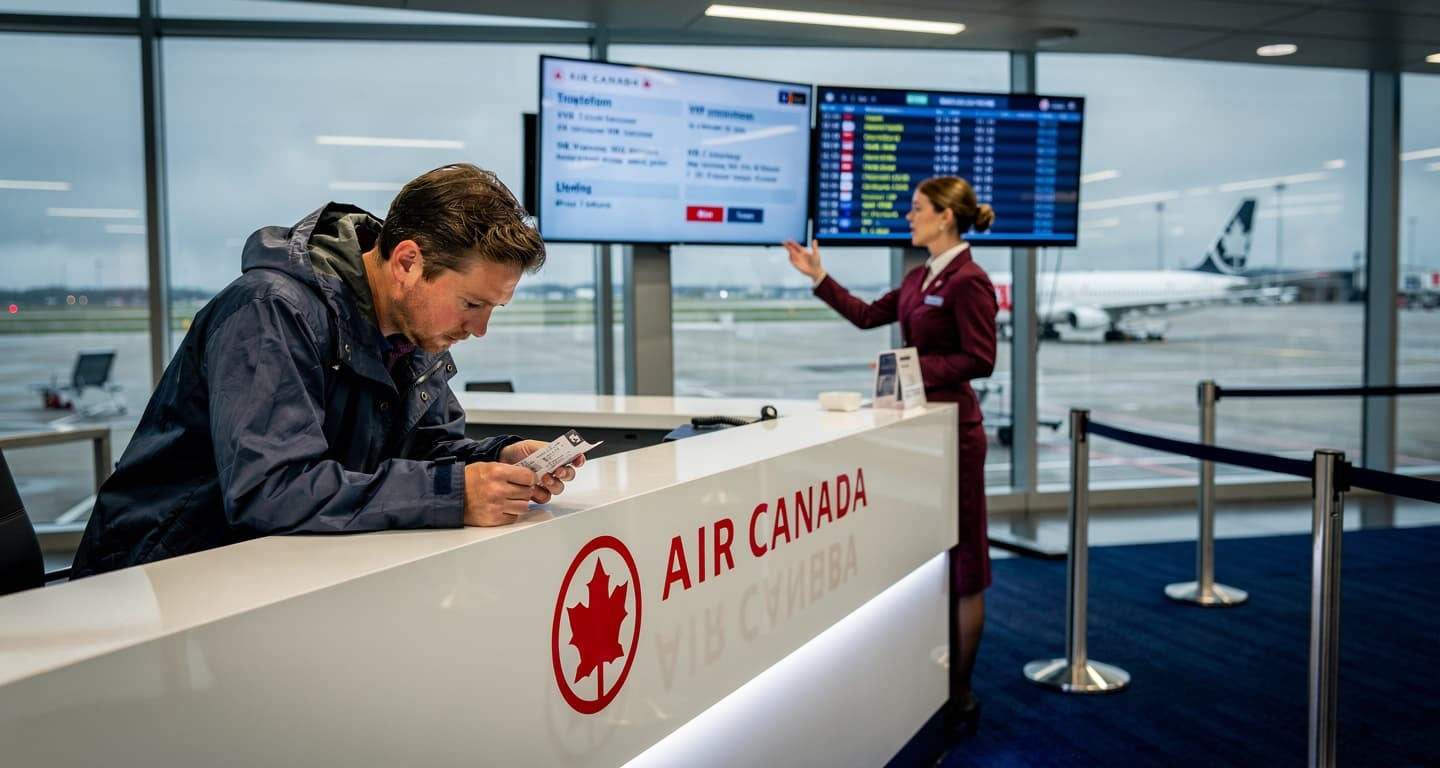
- If you’re already at Edinburgh Airport: Go directly to the Air Canada check-in or customer service desk. Ask for rebooking on the next available service to your final destination and request meal vouchers. If your new departure is the following day, request hotel accommodation — this is a UK261 entitlement regardless of cause.
- If you’re connecting beyond Montreal: Contact Air Canada now and flag your onward connection explicitly. Ask for a single rebooking that covers your full itinerary to final destination — not just the EDI–YUL leg. If you misconnect at YUL, go directly to an Air Canada customer service desk and invoke your APPR rebooking rights.
- If you have a future EDI–YUL booking in the next 72 hours: Monitor your booking closely. Consider building in longer connection buffers at Montreal, and price alternatives via Toronto or London Heathrow on Air Canada or a Star Alliance partner in case rolling disruptions affect subsequent rotations.
- Document everything: Keep receipts for all meals, transport, and accommodation from the moment the disruption is confirmed. If your delay exceeds 6 hours, open a claim with your credit card’s travel benefits administrator while the timeline is fresh.
Watch: Air Canada’s Flight Disruptions page and media centre within the next 24 hours — if the airline discloses the cause and confirms the aircraft’s return to service, it signals limited longer-term impact for the route. If extended maintenance is noted, expect rolling schedule changes. Separately, watch for any occurrence summary or safety communication from Transport Canada Civil Aviation over the coming days — if published, it indicates heightened regulatory follow-up on this 787-9 event and possible fleet-wide implications; if absent, the incident is likely being treated as a contained, single-aircraft issue.

Questions? Answers.
What does a 7700 squawk actually mean, and how serious is it?
A 7700 squawk is a transponder code that signals a general emergency to air traffic control. It covers a wide range of scenarios — from serious technical faults to medical emergencies on board — and immediately triggers priority handling by ATC and ground crews. It does not by itself indicate the severity of the underlying cause, but it is never routine. The fact that the crew also executed a rapid descent from approximately 38,000 feet to 10,000 feet suggests the situation required urgent action, not just precautionary notification.
Am I entitled to compensation for this disruption?
It depends on the cause. Under UK261 (for passengers departing Edinburgh), cash compensation of £220–£520 applies only if the disruption is within Air Canada’s control and does not qualify as an extraordinary circumstance. A safety-driven technical issue may be exempt. Under Canada’s APPR, compensation of CAD 400–1,000 applies for delays within the airline’s control and not safety-related. In both cases, Air Canada must rebook you and provide care (meals, accommodation if overnight) regardless of cause — that obligation is unconditional.
Will this affect other Air Canada flights from Edinburgh in the coming days?
Potentially. If the aircraft is removed from service for inspection — which is standard procedure following a 7700 declaration and rapid descent — subsequent EDI–YUL rotations could face equipment swaps or schedule adjustments. Crew duty-time limits may also affect the next departure. Monitor your booking closely for the next 72 hours and check Air Canada’s Flight Disruptions page for updates. If Transport Canada Civil Aviation issues a broader safety communication, it could indicate fleet-wide implications beyond this single aircraft.
What are my best alternative routing options if EDI–YUL is disrupted?
The most practical alternatives are via London Heathrow (LHR–YUL or LHR–YYZ connecting to YUL on Air Canada or a Star Alliance partner), via Dublin (DUB–YUL on Air Canada), or via Toronto Pearson (EDI–YYZ–YUL on Air Canada). Ask Air Canada to rebook you on any of these routings at no additional cost under your APPR or UK261 entitlements. Availability will tighten quickly as other affected passengers rebook, so act as early as possible.