Quick summary
European citizens entering Kuwait pay 3 Kuwaiti Dinars (€9) for a Visa on Arrival processed through self-service kiosks in the immigration hall at Kuwait International Airport. The machines accept credit cards and sit before passport control — no advance application, no document uploads, no 1-3 day e-visa wait. Austria, Belgium, France, Germany, Greece, and 20+ other EU nations qualify automatically for the 90-day tourist visa.
The kiosk system fails occasionally during peak hours or when credit card readers glitch. Carrying 3-10 KD in cash eliminates the risk of being sent to the manual counter queue. This article covers the exact eligibility list, payment backup strategies, when the e-visa portal makes sense instead, and what happens when your passport doesn’t meet the 6-month validity rule.
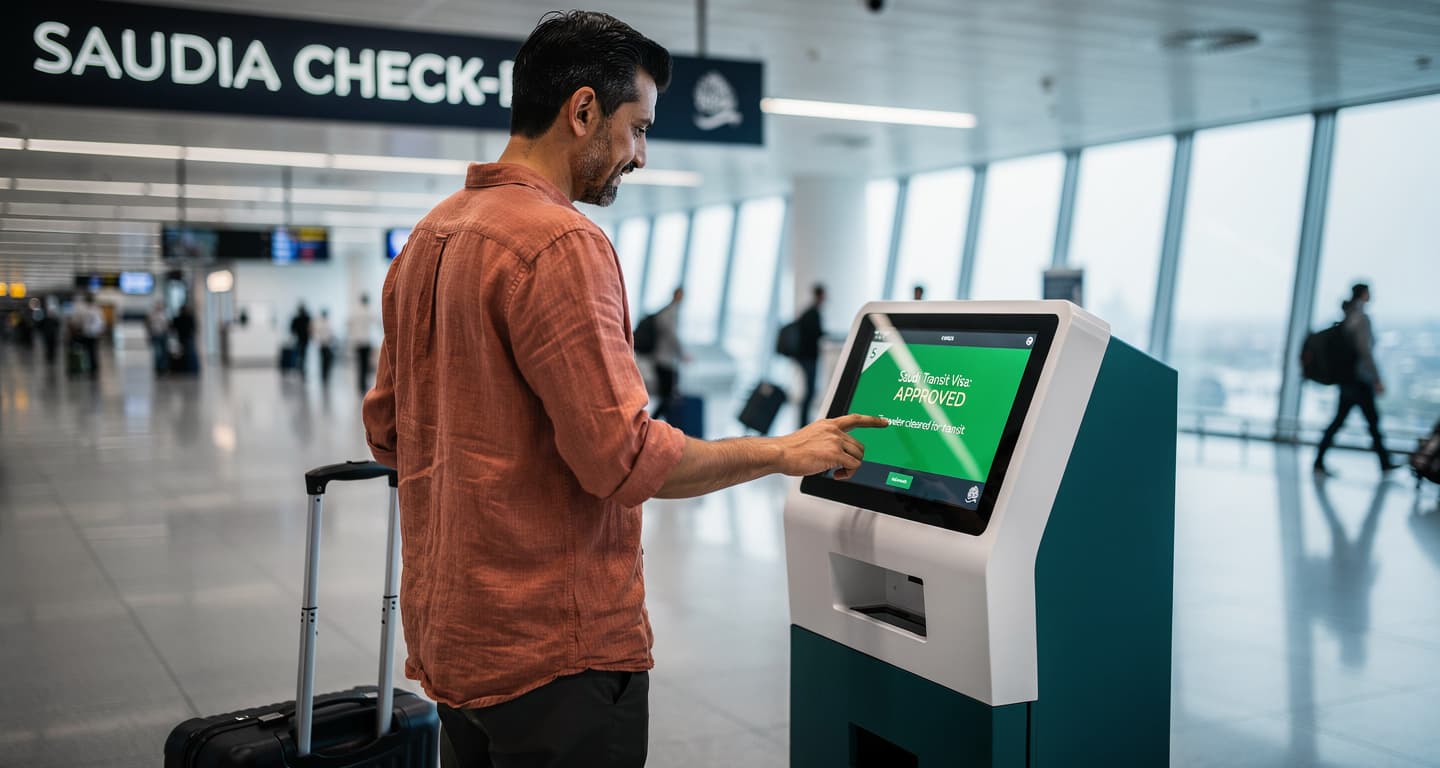
Europeans flying into Kuwait International Airport clear immigration faster than travelers from most other regions — 3 KD buys instant entry via airport kiosks that process Visa on Arrival applications in under 5 minutes. The machines sit in the immigration hall before passport control. Insert your passport, tap your credit card, collect the visa sticker. No interview, no paperwork, no advance approval from Kuwait’s Ministry of Interior.
Air Traveler Club’s analysis of Middle East entry requirements for European travelers shows Kuwait’s kiosk system eliminates the 1-3 day e-visa processing window that catches out travelers who assume online applications are faster. The airport route costs the same 3 KD but delivers the visa immediately upon arrival. For spontaneous bookings on Europe-Kuwait routes — particularly during Gulf carrier flash sales — the kiosk advantage matters: you can book a Friday departure and land Saturday morning without waiting for e-visa approval.
The system covers 27 EU member states plus Switzerland, Norway, and Iceland. Your passport needs 6 months validity from entry date and at least 2 blank pages. Bring both a credit card and 3-10 KD in cash — the kiosks accept Visa and Mastercard, but card reader failures during peak arrival waves send unprepared travelers to the manual counter queue where waits stretch to 45-90 minutes.
Which Europeans qualify for the 3 KD kiosk visa
Kuwait’s Visa on Arrival program covers all EU member states without exception. Kuwait’s embassy eligibility list includes Austria, Belgium, Bulgaria, Croatia, Cyprus, Czech Republic, Denmark, Estonia, Finland, France, Germany, Greece, Hungary, Ireland, Italy, Latvia, Lithuania, Luxembourg, Malta, Netherlands, Poland, Portugal, Romania, Slovakia, Slovenia, Spain, and Sweden. Add Switzerland, Norway, Iceland, and Liechtenstein through separate bilateral agreements.
The visa grants 90 days for tourism or business. It is not extendable at immigration offices inside Kuwait — overstaying triggers fines of 10 KD per day and potential entry bans. If you need longer than 90 days, apply for a standard e-visa before departure or exit and re-enter on a new Visa on Arrival (though back-to-back entries within short windows raise questions at passport control).
GCC residents holding valid residency permits from Saudi Arabia, UAE, Bahrain, Oman, or Qatar also qualify for Visa on Arrival as of August 2025, but their process differs — they use a separate counter and must show 6 months of continuous GCC residency. Europeans bypass that requirement entirely.
How the airport kiosk system actually works
The self-service kiosks sit in a dedicated area immediately after you exit the jet bridge and before you reach passport control booths. Kuwait International Airport’s official visa services page confirms the machines accept credit cards (Visa, Mastercard) and Kuwaiti Dinar cash. The interface displays instructions in English and Arabic.
Insert your passport into the scanner. The machine reads the biometric page and checks your nationality against the eligibility database. If you qualify, the screen prompts payment: 3 KD via card or cash slot. Tap or insert your card, wait 10-20 seconds for authorization, then collect your passport with the visa sticker attached. The entire process takes 3-5 minutes when the system functions normally.
| Method | Cost | Processing Time | Documents Required | Best For |
|---|---|---|---|---|
| Airport Kiosk | 3 KD | Instant (3-5 min) | Passport only (6mo valid, 2 blank pages) | Spontaneous bookings, solo travelers |
| E-Visa Online | 3 KD | 1-3 days | Passport scan, photo, hotel booking, financial proof | Group applications, advance planning |
| Manual Counter | 3 KD | 45-90 min queue | Passport, cash only (no cards) | Kiosk failure fallback |
Peak arrival times — typically 06:00-09:00 and 22:00-01:00 when Gulf carrier banks land simultaneously — create kiosk queues of 15-30 people. The machines occasionally freeze mid-transaction or reject credit cards without explanation. When that happens, you have two options: try a different kiosk (there are 8-12 machines in the hall) or join the manual counter queue where officers process visas by hand. The manual counter accepts cash only — no cards — which is why carrying 3-10 KD eliminates the risk of being stuck without payment options.

Flight deals
most people never see
Our AI monitors 150+ airlines for pricing anomalies that traditional search engines miss. Air Traveler Club members save $650 per trip per person on average: see how it works.
Each deal saves 40–80% vs. regular fares:

When the e-visa portal makes more sense than the kiosk
Kuwait’s Ministry of Interior e-visa system requires uploading a passport scan, recent photo, hotel booking confirmation, and proof of financial means (bank statement or credit card). The portal processes applications in 1-3 business days and emails the approved visa as a PDF. You print it and show it at passport control, bypassing the kiosk entirely.
This route makes sense for group travel — families or tour groups can submit all applications together and receive batch approval. It also works when you’re booking 2-4 weeks ahead and want confirmation before finalizing hotel reservations or onward flights. The e-visa costs the same 3 KD per person, paid via the portal using a credit card.
The system’s weakness is technical instability. The upload interface frequently rejects passport scans for unclear reasons (file size, image quality, or unexplained server errors). Approval emails sometimes land in spam folders, and the portal occasionally goes offline for maintenance without advance notice. If you’re departing in 5-7 days and the e-visa hasn’t arrived, you’re stuck waiting — there’s no expedited processing option and no way to check application status beyond the automated email.
What happens when your passport fails the validity check
The kiosk machine scans your passport’s machine-readable zone and calculates validity from the expiration date printed on the biometric page. If your passport expires within 6 months of your Kuwait entry date, the screen displays an error message and ejects your passport without processing payment. You’re directed to the manual counter where an immigration officer reviews your case.
Officers at the manual counter have some discretion for passports that fall just short of the 6-month rule — if you’re entering for a 5-day business trip and your passport expires in 5 months and 20 days, they may approve entry with a warning. But this is inconsistent and depends on the officer’s interpretation of the rule. The safer move is renewing your passport before booking Kuwait flights if you’re within 7-8 months of expiration.
The 2 blank pages rule is stricter. If your passport lacks sufficient space for the visa sticker and entry/exit stamps, the kiosk rejects it immediately and the manual counter will deny entry outright. Kuwait does not issue visas on separate paper — the sticker must go in your passport. Travelers who arrive with full passports are typically sent back on the next available flight at their own expense.
How this compares to other Gulf visa systems
Kuwait’s 3 KD fee is the lowest among Gulf states for European visitors. UAE charges 100 AED (€25) for a 30-day tourist visa, though many Europeans receive free 90-day entry stamps on arrival. Qatar offers free 90-day Visa on Arrival for EU citizens with no fee at all. Bahrain charges 5 BD (€13) for a 14-day e-visa. Oman requires a 20 OMR (€48) e-visa applied in advance — no Visa on Arrival option for Europeans.
Kuwait’s kiosk system is faster than UAE’s e-visa portal but slower than Qatar’s stamp-on-arrival process where officers simply stamp your passport at the booth with no separate visa application. The 90-day validity matches Qatar and exceeds Bahrain’s 14-day window, making Kuwait competitive for longer Gulf visits or multi-country itineraries.
US citizens pay 10 KD for Kuwait Visa on Arrival — more than triple the European rate. The reason is reciprocal visa fees: the US charges Kuwaiti citizens for B1/B2 visas, so Kuwait mirrors that cost structure. Europeans benefit from EU-Kuwait visa waiver agreements that reduce the fee to the administrative minimum.
When the visa system breaks down
The kiosk machines go offline during system maintenance, typically 02:00-04:00 Kuwait time on weekday nights. If your flight lands during this window, all passengers are routed to manual counters where processing slows to 3-5 minutes per person. A widebody arrival with 250+ passengers creates 2-3 hour queues.
Credit card payment failures spike during Islamic holidays (Eid al-Fitr, Eid al-Adha) when transaction volumes overwhelm the payment gateway. The machines display generic error messages without explaining whether the issue is your card, the network, or the kiosk itself. Trying multiple cards sometimes works; other times the only solution is cash at the manual counter.
Passport damage — bent corners, water stains, torn pages — causes kiosk scanner failures even when the passport is technically valid. The machine can’t read the biometric chip or machine-readable zone and ejects the passport. Officers at the manual counter may accept damaged passports if the photo and data page are legible, but they reserve the right to deny entry and require you to obtain an emergency travel document from your embassy.
What to do before your Kuwait departure
The 3 KD kiosk visa eliminates advance planning for most Europeans, but three preparation steps prevent the common failure points that send travelers to the slow manual counter queue.
- Verify passport validity: Check your passport expiration date and count 6 months forward from your planned Kuwait departure (not arrival) date. If you’re within 7 months of expiration, renew before booking flights — Kuwait immigration does not accept “emergency” or “temporary” passports for Visa on Arrival.
- Exchange 10-15 EUR for Kuwaiti Dinars: Use a currency exchange at your departure airport or order KD online before your trip. The 3 KD visa fee plus 5-7 KD for backup gives you payment options if the kiosk card reader fails. Kuwait airport ATMs sit past immigration, so you can’t access them before clearing the visa checkpoint.
- Carry two credit cards from different banks: Visa and Mastercard both work at the kiosks, but single-card failures are common when issuers flag Kuwait transactions as suspicious or when the chip is damaged. Keep your backup card in your passport holder, not in checked luggage where you can’t access it during immigration.
- Screenshot the Kuwait embassy eligibility page: Save the official visa requirements on your phone in case airline check-in agents at your departure city question your eligibility for Visa on Arrival. Some European airport staff are unfamiliar with Kuwait’s system and may demand proof of a pre-approved visa — showing the official page prevents boarding denials.

Questions? Answers.
Can I pay the 3 KD kiosk fee with US dollars or euros?
The kiosks accept Kuwaiti Dinars (cash) and international credit cards (Visa, Mastercard). They do not accept USD, EUR, or other foreign currency notes. If your credit card fails, you must have KD cash or join the manual counter queue where officers may accept USD at unfavorable exchange rates (typically 1 USD = 0.30 KD instead of the actual 0.31 KD rate).
Do children and infants need separate Visa on Arrival?
Yes. Every traveler entering Kuwait on a European passport — including infants under 2 years old — requires their own Visa on Arrival and pays the full 3 KD fee. The kiosk processes each passport individually, so a family of four pays 12 KD total. Children must have their own passport; they cannot be listed on a parent’s passport for Kuwait entry.
What happens if I overstay the 90-day visa?
Kuwait charges 10 KD per day for overstays, payable at the airport before departure. Overstays exceeding 30 days trigger automatic entry bans ranging from 1-5 years depending on the duration. Immigration officers have discretion to waive short overstays (1-3 days) for medical or flight cancellation reasons if you provide documentation, but this is not guaranteed. Overstays exceeding 90 days may result in detention and deportation at your expense.
Can I extend the 90-day Visa on Arrival inside Kuwait?
No. Kuwait does not allow extensions of tourist Visa on Arrival. If you need to stay longer than 90 days, you must exit Kuwait and apply for a different visa type (business visa, family visit visa) through Kuwait’s embassy in your home country or a neighboring Gulf state. Some travelers exit to Bahrain or Dubai for 1-2 days and return on a new Visa on Arrival, but immigration officers may question this pattern if done repeatedly within a short timeframe.
Is the e-visa faster than the airport kiosk for groups?
Not necessarily. The e-visa portal allows bulk application submission for families or tour groups, but processing still takes 1-3 business days per application. If you’re traveling as a group of 4-6 people and everyone has valid passports with 6+ months validity, using the airport kiosks is faster — each person processes their visa in 3-5 minutes, so a group of six clears in under 30 minutes total. The e-visa makes sense only when you’re booking 2+ weeks ahead and want confirmation before finalizing hotels.
What if the kiosk rejects my credit card?
Try a different kiosk first — card reader quality varies between machines. If multiple kiosks reject your card, join the manual counter queue where officers process visas by hand. The manual counter accepts cash only (no credit cards), so you must have 3 KD in Kuwaiti Dinar notes. If you have no cash and no working card, you’ll need to borrow from another passenger or face potential denial of entry and return on the next flight.
Does Kuwait require proof of onward travel for Visa on Arrival?
Officially yes, but enforcement is inconsistent. The kiosk does not check for onward tickets — it only scans your passport and processes payment. However, airline check-in agents at your European departure airport may demand proof of a return or onward ticket before issuing your boarding pass. If you’re entering Kuwait on a one-way ticket with plans to continue overland to Saudi Arabia or by ferry to Iran, book a refundable ticket out of Kuwait or use a service like OnwardTicket to generate valid proof for check-in.