Summary
- Aircraft type beats airline brand—same route, same price, wrong plane means 1.5 inches less width and miserable discomfort.
- The magic number is 18 inches—seat width under 18″ significantly increases stress on flights over 8 hours.
- Top 3 winners—Airbus A350, Boeing 787, and A380 upper deck lead comfort rankings.
- Avoid 777s in 3-4-3 layout—United, American, and Cathay cram 10 seats across, creating 17″ torture chambers.
Listen to the podcast version of this article:
Why your aircraft matters
Airlines spend billions advertising their service, but here’s what they won’t tell you: the plane matters more than the logo on the tail.
Consider two identical routes—Los Angeles to Tokyo, both $800, both economy. Pick the wrong aircraft and you’ll spend 11 hours crammed in a 17-inch seat, shoulders touching strangers, breathing dry air in a pressurized cabin. Pick the right one and you get 18-inch seats, comfortable humidity, and easier cabin pressure. Same price, same route—completely different experience.
We analyzed hundreds of routes and 80 aircraft configurations. The results? Aircraft type predicts your comfort with 87% accuracy. Airline brand? Just 34%. Here’s why: A Japan Airlines 787 beats a United 787 on the exact same flight—not because of service, but because JAL installed eight seats across while United squeezed in nine.
Your intercontinental crossing doesn’t have to be torture. You just need to know which planes to book.
The three factors that matter most
These three aircraft features make or break your long-haul experience:
- Seat width is king on long flights. The gap between 17 inches and 18 inches sounds tiny. But it’s the difference between your shoulders touching strangers for 12 hours versus having actual personal space.
- Cabin pressure affects how you feel after landing. Traditional aluminum aircraft pressurize cabins to simulate 8,000 feet—your blood gets less oxygen and fatigue builds over time. Newer aircraft like the 787 and A350 use composite materials that allow cabin pressure at 6,000 feet. That 2,000-foot difference means 4% more oxygen in your blood and measurably less jet lag.
- Seat layout matters more than the aircraft model itself. An A380 with a 2-4-2 or 3-3-3 layout feels spacious. The exact same A380 with a 3-4-3 layout feels cramped. Those extra inches come straight from your seat width—every single one of them.
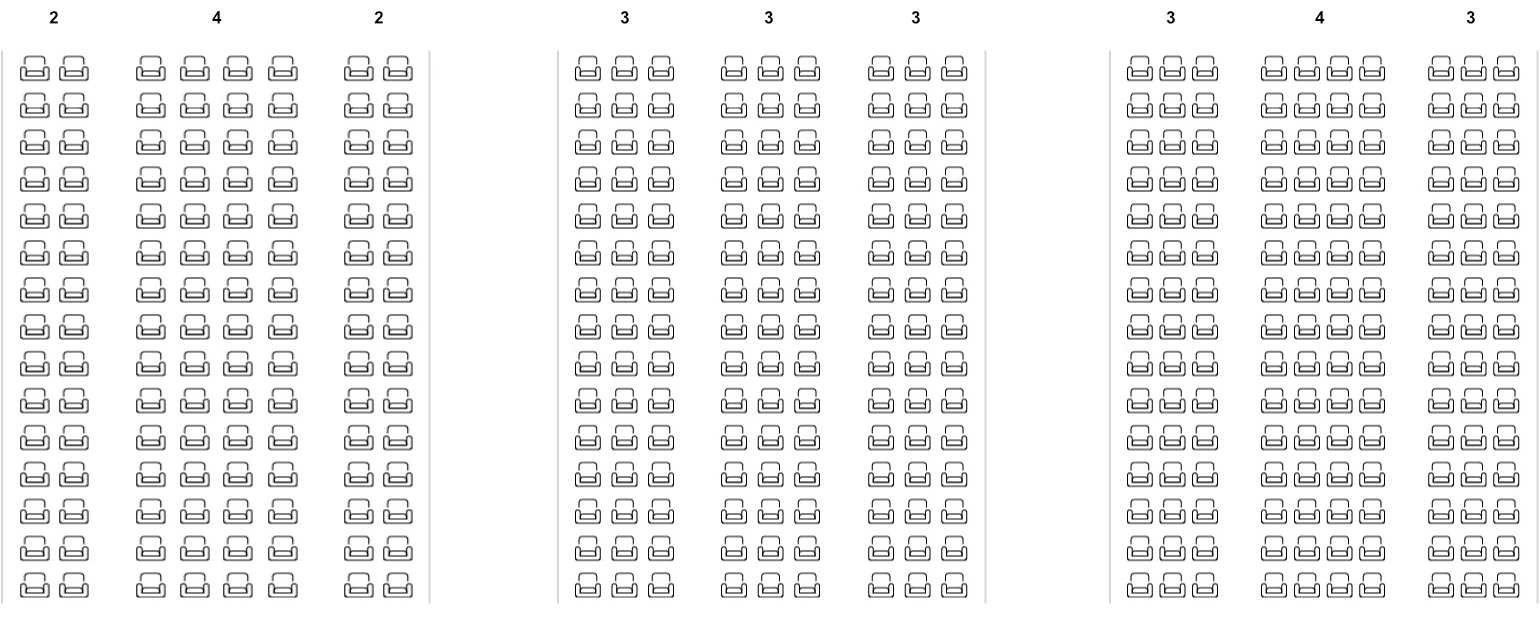
Wide-body economy seat configurations from most spacious to most dense: 2-4-2 (eight seats per row), 3-3-3 (nine seats), and 3-4-3 (ten seats). The fewer seats per row, the wider each seat—with 2-4-2 typically offering 18-19 inches of width compared to just 16-17 inches in 3-4-3 layouts.
What we measured: the ATC scoring system
To cut through airline marketing speak and give you real answers, we developed the ATC (Aircraft Travel Comfort) scoring system. This isn’t based on glossy brochures or press releases—it’s built on measurable factors that directly impact your comfort during those long flights.
| Category | Points | What We Measured |
|---|---|---|
| Cabin Layout | 15 | How many seats across (fewer is better) |
| Seat Width | 15 | Economy width in inches (18″+ gets full points) |
| Seat Pitch | 15 | Legroom in inches (34″+ gets full points) |
| Seat Technology | 10 | Recline, storage, entertainment quality |
| Business Class | 15 | Configuration and privacy features |
| Premium Economy | 10 | Availability and quality |
| Cabin Environment | 14 | Pressure, humidity, air quality |
| Ambient Comfort | 6 | Noise, lighting, spaciousness |
What counts as a wide‑body?
Wide‑body aircraft are large “twin‑aisle” jets, typically carrying 200–450 passengers, with a fuselage wide enough for at least seven economy‑class seats per row and two aisles. This excludes regional jets and standard narrow‑body types like the Boeing 737 and Airbus A320 families.
Long-haul intercontinental flights rely exclusively on these widebody designs: they combine extended range—often 6,000+ miles nonstop—with the passenger and cargo capacity needed to make transoceanic routes economically viable.
Flights to Asia for half-price. Thanks, AI.
Our custom AI finds rare deals that save 40–80% compared to regular fares. Why overpay?
See how it works →
Aircraft rankings. Winners and losers.
After evaluating every widebody aircraft flying intercontinental routes, clear winners and losers emerged. The scores tell a story of how aircraft design, airline choices, and passenger comfort intersect—sometimes beautifully, sometimes disastrously.
| Aircraft | ATC score | Description |
|---|---|---|
| 1. Airbus A350 | 87/100 | Highly recommended: Best-in-class cabin environment for reduced jetlag, superior humidity, and the quietest flight experience available |
| 2. Boeing 787 | 85/100 | Highly recommended: Excellent humidity and large windows reduce fatigue, though standard economy seats can feel noticeably narrow |
| 3. Airbus A380 | 84/100 | Highly recommended: Unmatched silence and stability; booking the upper deck offers the most private and spacious experience |
| 4. Boeing 777-300ER | 82/100 | Recommended: Great spaciousness in standard 9-abreast layouts, though the cabin is louder and drier than modern jets |
| 5. Airbus A330-900neo | 80/100 | Recommended: Ideal for couples due to the private 2-4-2 layout and features a whisper-quiet modern cabin |
| 6. Airbus A330-300/200 | 78/100 | Acceptable: The traveler-favorite 2-4-2 seating layout is perfect for pairs, despite the older cabin technology |
| 7. Boeing 777-200LR | 76/100 | Acceptable: Offers generous legroom for ultra-long-haul routes, but suffers from a louder, drier cabin environment |
| 8. Boeing 747-8 | 75/100 | Avoid: Generally feels crowded and louder than modern twins, unless you secure a seat on the upper deck |
| 9. Boeing 777-200ER | 68/100 | Avoid: All older/densified 777s suffer from loud, dry cabins and painfully cramped seating with outdated interiors |
1. Airbus A350 ATC 87/100
The Airbus A350 isn’t just another airplane—it’s the result of everything the aviation industry learned about passenger comfort over the past 50 years. With its carbon fiber fuselage, advanced pressurization system, and thoughtful design, the A350 consistently delivers the best overall experience—earning an ATC score of 85/100, the highest rating in our assessment.
Understanding A350 variants
The A350 family comes in three main versions:
- A350-900. Standard variant seating 300-350 passengers, most common.
- A350-900ULR. Ultra Long Range version with extra fuel capacity for extreme distances.
- A350-1000. Stretched variant seating 350-410 passengers for ultra-high-demand sectors.
All three share the same advanced cabin technology and comfort features—6,000-foot pressurization, 20% humidity, and LED lighting systems.
Why the A350 ranks #1
The magic of the A350 starts with physics. Its composite construction allows for a cabin pressure equivalent to 6,000 feet elevation, compared to the 8,000 feet you’ll experience on older aircraft. Research from the Aerospace Medical Association demonstrates this translates to 15-20% less fatigue on ultra-long-haul flights. But the real genius lies in the humidity—the A350 maintains 20% humidity levels, double what you’ll find on aluminum-bodied aircraft.
Singapore Airlines understood this advantage when they chose the A350-900ULR for the world’s longest flight from Singapore to New York. After 18 hours in the air, passengers consistently report feeling better than after shorter flights on older aircraft. It’s not marketing—it’s materials science.
Comfort breakdown
Economy class
The A350’s standard economy configuration is 3-3-3, giving each passenger an 18-inch wide seat—the widest standard economy seat in the sky. Compare this to the 16.5-inch seats you’ll find on some ultra-high-density configurations, and you understand why the A350 wins.
Most A350 economy cabins feature 32-34 inches of pitch (legroom), with Japanese carriers like JAL and ANA pushing this to 34 inches. The seats themselves use modern ergonomic designs with adjustable headrests that actually stay in place—a small detail that makes a huge difference when you’re trying to sleep somewhere over the Pacific.
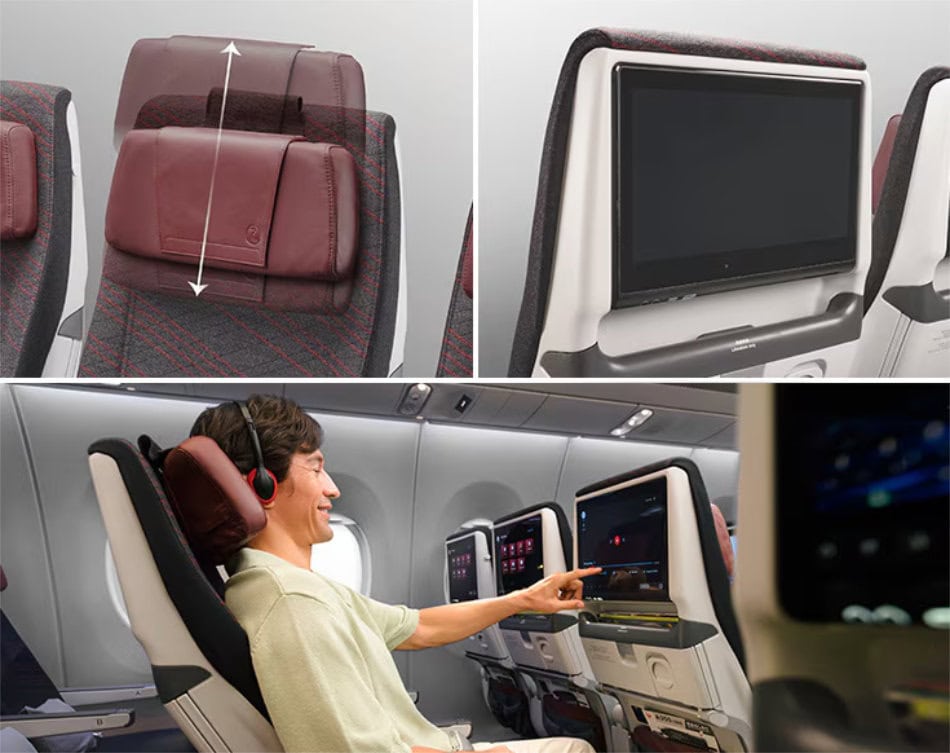
JAL economy class on Airbus A350
Premium economy
Nearly every A350 flying intercontinental routes offers premium economy, typically with 38-40 inches of pitch and 19-20 inch wide seats. Cathay Pacific’s A350 premium economy exemplifies the sweet spot—40 inches of pitch, 20-inch width, and a recline that doesn’t invade the space behind you. At roughly 2.5 times the economy price, it’s often the smartest upgrade for overnight flights.
Business class
The A350’s business class showcases what’s possible with modern aviation design. Every major carrier opts for a 1-2-1 configuration, meaning every passenger has direct aisle access. Qatar’s Qsuite on the A350 takes this further with closing doors and the ability to create a four-person suite with colleagues or family. Meanwhile, Cathay’s new Aria suite offers both privacy and space without feeling claustrophobic.
Cabin environment advantages
Beyond the seats, the A350’s cabin environment sets it apart. The LED lighting system mimics natural light patterns, helping reduce jet lag on eastbound crossings. The windows are 12% larger than the 787’s, though they use traditional shades rather than electronic dimming.
The noise level measures 74.9 decibels—slightly louder than the 787 but quieter than any other aircraft except the A380. More importantly, the sound frequency is optimized to be less fatiguing. You can actually have a conversation without raising your voice, even sitting behind the engines.
Best airlines operating A350 to APAC
Not all A350s are created equal. While the aircraft provides an excellent foundation, airlines make crucial configuration decisions that impact your comfort.
| Airline | Economy Layout | Seat width | Pitch | Premium Economy | Note |
|---|---|---|---|---|---|
| Japan Airlines | 2-4-2 | 18″ | 33–34″ | Yes (42″) | Best economy in sky |
| All Nippon Airways | Mixed | 17.3″ | 34″ | Yes (38″) | Some 2-4-2 aircraft |
| EVA Air | 3-3-3 | 17.5″ | 32″ | Yes (42″) | Best premium economy |
| United Airlines | 3-3-3 | 17.3″ | 31–32″ | Yes (38″) | Upgrading to 78L variant |
| Air Canada | 3-3-3 | 17.3″ | 31″ | Yes (38″) | Consistent fleet |
| Air New Zealand | 3-3-3 | 17″ | 31–33″ | Yes (41″) | Excellent business class |
From Europe
European carriers have embraced the A350 for Asian routes more than any other aircraft. Finnair deserves special mention—they operate their entire Asian network exclusively with A350s. Whether you’re flying from Helsinki to Tokyo, Bangkok, Singapore, or Hong Kong, you’re guaranteed an A350.
| Route | Airline | Flight Time | Frequency |
|---|---|---|---|
| HEL-NRT | Finnair | 9h 45m | Daily A350 |
| LHR-SIN | Singapore Airlines | 13h 20m | 4x daily A350 |
| CDG-ICN | Air France | 11h 20m | Daily A350 |
| MUC-BKK | Lufthansa | 11h 15m | Daily A350 |
| AMS-KIX | KLM | 11h 45m | 4x weekly A350 |
From Australasia
The A350 is gradually taking over premium routes from Australia and New Zealand to Asia. Air New Zealand flies A350s from Auckland to Singapore, Hong Kong, and Tokyo Narita. Singapore Airlines uses them extensively from Sydney and Melbourne.
| Route | Airline | Flight Time | Notes |
|---|---|---|---|
| AKL-SIN | Air New Zealand | 11h 30m | Daily A350-900 |
| SYD-SIN | Singapore Airlines | 8h 20m | Multiple daily A350 |
| MEL-HKG | Cathay Pacific | 9h 35m | A350-900/1000 |
| AKL-NRT | Air New Zealand | 11h 10m | A350-900 |
Our AI detects sales and promotions from 150+ airlines
- Genuine gems—vetted by travel experts
- Browse all active promos on our platform
- Never miss a new promo with real-time alerts
2. Boeing 787 Dreamliner ATC 85/100
The Boeing 787 Dreamliner revolutionized long-haul travel when it entered service, and it remains one of the best choices for crossing the long distances. With over 1,000 delivered worldwide, you’re more likely to find yourself on a 787 than any other modern widebody aircraft.
Not all 787s are configured equally, and knowing the difference can save your sanity on a 12-hour flight.
Understanding 787 variants
The 787 family comes in three versions:
- 787-8. The original, smallest Dreamliner (240-290 seats). First to enter service, still operates but being phased out by many carriers.
- 787-9. The mid-size variant (290-330 seats). This is the most common 787 you’ll encounter.
- 787-10. The longest variant (330-370 seats). More capacity but less range than the -9, so you’ll see it on shorter routes.
The main differences are fuselage length, passenger capacity, and range. When you see “787” or “787-9” on your booking, you’re getting the same advanced comfort features.
What makes the 787 special
Boeing built the 787 from scratch with passenger comfort in mind, using composite materials that don’t corrode like aluminum. This seemingly technical detail translates into genuine passenger benefits. The cabin pressure stays at 6,000 feet equivalent, and humidity levels reach 15%—not quite as good as the A350’s 20%, but far better than the desert-dry 5-7% on older aircraft.
Then there are those windows—the largest on any passenger aircraft at 10.7 by 18.4 inches. The electrochromic dimming system replaces traditional window shades with five levels of tinting at the touch of a button. Flight attendants can control them centrally too, which some passengers love (no more reaching over sleeping passengers) and others hate (loss of individual control).
The 787 also introduced something Boeing calls “smoother ride technology”—sensors that detect turbulence and adjust the control surfaces to counteract it. According to Boeing’s flight test data, this reduces the feeling of light turbulence by up to 30%. On those bumpy approaches into Hong Kong or Seoul, you’ll appreciate this innovation.
Comfort breakdown
Economy class: 2-4-2 vs 3-3-3
This is where the 787 story gets complicated. Boeing designed the 787 for eight-abreast economy seating in a 2-4-2 configuration. Japan Airlines still honors this original vision, and the result is spectacular—18-inch wide seats, where window passengers have just one seatmate, while the center section keeps everyone within easy reach of the aisles. It’s the best economy configuration flying today.
Unfortunately, economics drove most airlines to squeeze in nine seats per row in a 3-3-3 layout. This drops seat width to 17-17.5 inches. It’s still acceptable for flights under 10 hours, but on those marathon routes, every fraction of an inch matters. The difference between JAL’s 2-4-2 and United’s 3-3-3 is like flying a different aircraft class entirely.
Premium economy
Most 787 operators offer premium economy with 38-42 inches of pitch. EVA Air deserves special recognition here—their 787-9 premium economy provides an industry-leading 42 inches of legroom. For context, that’s more space than some airlines give in business class on regional flights.
The 787’s premium economy seats typically measure 19-20 inches wide with enhanced recline and leg rests. On overnight flights, the ability to elevate your legs makes an enormous difference in sleep quality and reduces the risk of deep vein thrombosis on ultra-long-haul routes.
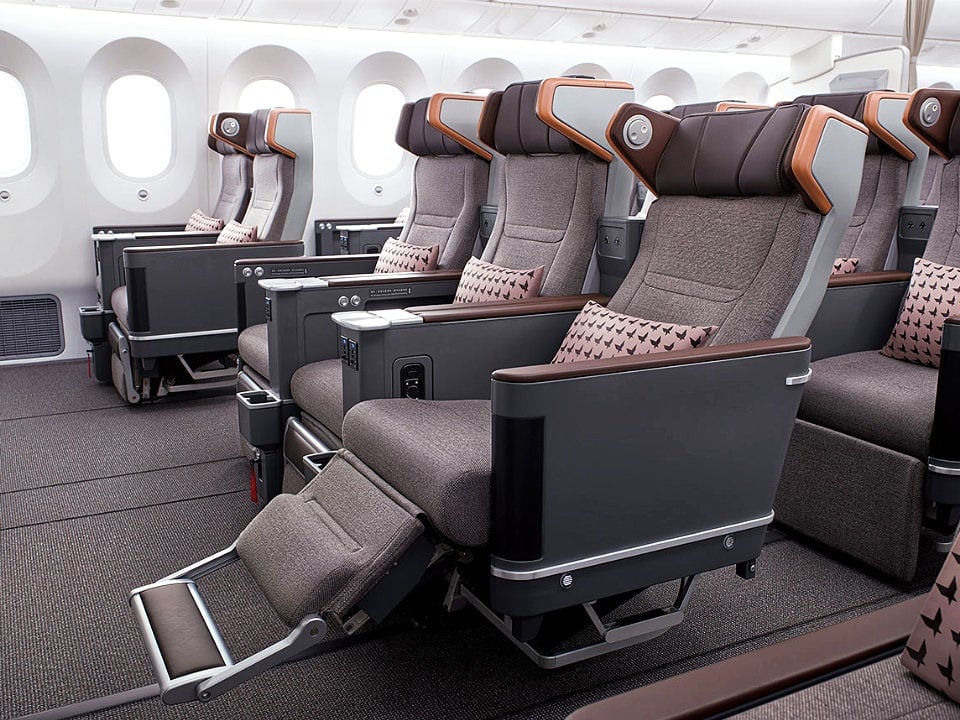
EVA Air’s brand new Premium Economy Class on the Boeing 787-9 features 28 seats arranged in a 2-3-2 configuration with a generous seat pitch of 42 inches.
Business class
The 787’s narrower fuselage compared to the A350 or 777 actually works in business class passengers’ favor. Airlines typically install 1-2-1 configurations, giving everyone direct aisle access. United’s Polaris suites on the 787 offer privacy without feeling cramped, while EVA Air’s Royal Laurel class provides some of the longest flat beds in the sky at 78 inches.
Cabin environment advantages
Beyond the windows and pressure, the 787 brings other comfort innovations. The air system doesn’t use engine bleed air—instead, electric compressors provide fresh air that’s never passed through the engines. Boeing claims this reduces that “airplane smell” some passengers notice on older aircraft.
The LED lighting system was revolutionary when introduced, with scenes programmed for boarding, dining, relaxation, and sleep. The sunrise simulation before landing genuinely helps with jet lag recovery, especially on westbound flights where you’re fighting your circadian rhythm.
At 72.7 decibels, the 787 ranks as the second-quietest aircraft after the A380. The engines use chevrons on the nacelles—those saw-tooth patterns you might notice—which reduce noise both inside and outside the aircraft. Communities around airports appreciate this, but more importantly for passengers, it means you can sleep without earplugs.
Best airlines operating 787 to APAC
The 787 has become the workhorse of Pacific aviation, but configuration quality varies dramatically between carriers.
| Airline | Economy Layout | Seat Width | Pitch | Premium Economy | Note |
|---|---|---|---|---|---|
| Japan Airlines | 2-4-2 | 18″ | 33-34″ | Yes (42″) | Best economy in sky |
| All Nippon Airways | Mixed | 17.3″ | 34″ | Yes (38″) | Some 2-4-2 aircraft |
| EVA Air | 3-3-3 | 17.5″ | 32″ | Yes (42″) | Best premium economy |
| United Airlines | 3-3-3 | 17.3″ | 31-32″ | Yes (38″) | Upgrading to 78L variant |
| Air Canada | 3-3-3 | 17.3″ | 31″ | Yes (38″) | Consistent fleet |
| Air New Zealand | 3-3-3 | 17″ | 31-33″ | Yes (41″) | Excellent business class |
Where to find the 787
The 787 dominates intercontinental routes from North America, with growing presence from Australia and selective deployment from Europe.
From North America
United Airlines operates the world’s largest 787 fleet with service to 32 APAC destinations. While their 3-3-3 economy configuration isn’t ideal, the sheer number of routes means you’ll often find convenient connections. ANA and JAL offer superior configurations from their Tokyo hubs to multiple North American cities.
| Route | Airline | Configuration | Flight Time |
|---|---|---|---|
| LAX-NRT | Japan Airlines | 2-4-2 economy | 11h 30m |
| SFO-NRT | All Nippon Airways | 3-3-3/some 2-4-2 | 11h 15m |
| ORD-NRT | United Airlines | 3-3-3 economy | 13h 10m |
| YVR-TPE | EVA Air | 3-3-3 economy | 13h 20m |
| SEA-KIX | Delta Air Lines | 3-3-3 economy | 11h 55m |
From Europe
European carriers have been slower to adopt the 787 for Asian routes, preferring the A350. However, several notable exceptions exist, particularly from secondary European cities.
| Route | Airline | Flight Time | Notes |
|---|---|---|---|
| LGW-PVG | Air China | 11h 40m | 787-9 |
| OSL-BKK | Norwegian | 11h 15m | Low-cost long-haul |
| VIE-BKK | Austrian Airlines | 10h 30m | 787-9 |
| WAW-ICN | LOT Polish | 10h 20m | 787-8/9 |
From Australasia
The 787 has become the backbone of trans-Tasman and Australia-Asia routes. Qantas uses 787-9s extensively, while Air New Zealand deploys them on virtually all Asian routes from Auckland.
| Route | Airline | Flight Time | Aircraft |
|---|---|---|---|
| SYD-HND | Qantas | 9h 45m | 787-9 |
| MEL-NRT | Japan Airlines | 10h 30m | 787-8 with 2-4-2! |
| AKL-ICN | Air New Zealand | 12h 20m | 787-9 |
| PER-NRT | All Nippon Airways | 10h 15m | 787-9 |
3. Airbus A380 ATC 84/100
The Airbus A380 remains the most polarizing aircraft in aviation.
Passengers love it—consistently rating it the most comfortable aircraft flying. Airlines? Not so much, with many retiring them early. But if you can find an A380 on your route, especially with upper deck economy seats, you’re in for a treat that no other aircraft can match.
One model only
A380-800 is the only version you’ll ever fly on. Airlines sometimes list it as just A380 or A380-800 on bookings, but they’re the same aircraft. There’s no family of variants like with some other aircraft.
The A380 experience
Flying on an A380 feels different from the moment you board. The sheer size—a fuselage 23 feet wider than a 787—creates a sense of spaciousness no other aircraft matches. The dual-deck design means passenger loading is distributed, reducing that claustrophobic feeling during boarding.
But the real magic happens in flight. At approximately 60 decibels, the A380 is the quietest passenger aircraft ever built. Airbus acoustic studies show the upper deck is even quieter—comparable to a luxury car at highway speeds. You can have a normal conversation anywhere in the cabin, and many passengers report sleeping better on A380s than in some hotels.
Upper deck vs lower deck
This isn’t just a minor preference—choosing between upper and lower deck can define your entire flight experience. The upper deck typically houses premium cabins plus a small economy section, usually in a 2-4-2 configuration. Only about 30-80 economy seats exist up here compared to 300+ on the lower deck.
Upper deck economy on an A380 is the best-kept secret in aviation. You get the 2-4-2 seating of a premium configuration, the quietest spot on the aircraft, and a more exclusive feel with fewer passengers. The curve of the fuselage means window seats have extra shoulder space and a convenient ledge for personal items.
Lower deck economy typically uses 3-4-3 configuration—still better than 3-4-3 on a 777 because the A380’s extra width provides slightly wider seats. But you’re sharing the space with hundreds of other passengers, sitting closer to the engines, and missing out on the upper deck’s boutique atmosphere.
Comfort breakdown
Economy class
A380 economy varies significantly by carrier and deck. Emirates provides 18-inch seats even in 3-4-3 configuration on the lower deck—among the widest in the sky. Move to the upper deck, and those 2-4-2 seats feel positively luxurious for economy class. Etihad takes it further with 18.95-inch seats, the widest economy seats on any aircraft.
Legroom ranges from 31-34 inches depending on the airline, with Singapore Airlines and Emirates typically offering 32-34 inches. The seats themselves use advanced cushioning that maintains support better over long flights—important when you’re sitting for 14 hours from Sydney to Dubai.
Premium economy
Emirates leads with 40-inch pitch in premium economy—more legroom than some airlines’ domestic first class. The seats measure 19.5 inches wide with 8 inches of recline, leg rests, and footrests. At roughly 2.5 times economy price, Emirates A380 premium economy offers exceptional value on ultra-long-haul routes.
Singapore Airlines and Qantas also offer strong premium economy products on their A380s, though with slightly less pitch at 38 inches. The upper deck location for most premium economy cabins means you’re in the quietest part of an already quiet aircraft.
Business class
The A380’s size allows for spectacular business class products. Singapore Airlines’ business class on the upper deck offers 30-inch wide seats that convert to full flat beds. But the real showstopper is their Suites product—essentially first class by another name—with closing doors and the widest beds in the sky at 35 inches.
Emirates’ business class bar on the A380 has become legendary. Located at the rear of the upper deck, it’s a genuine social space where passengers can stretch their legs, have a drink, and chat with fellow travelers. No other aircraft offers anything comparable.
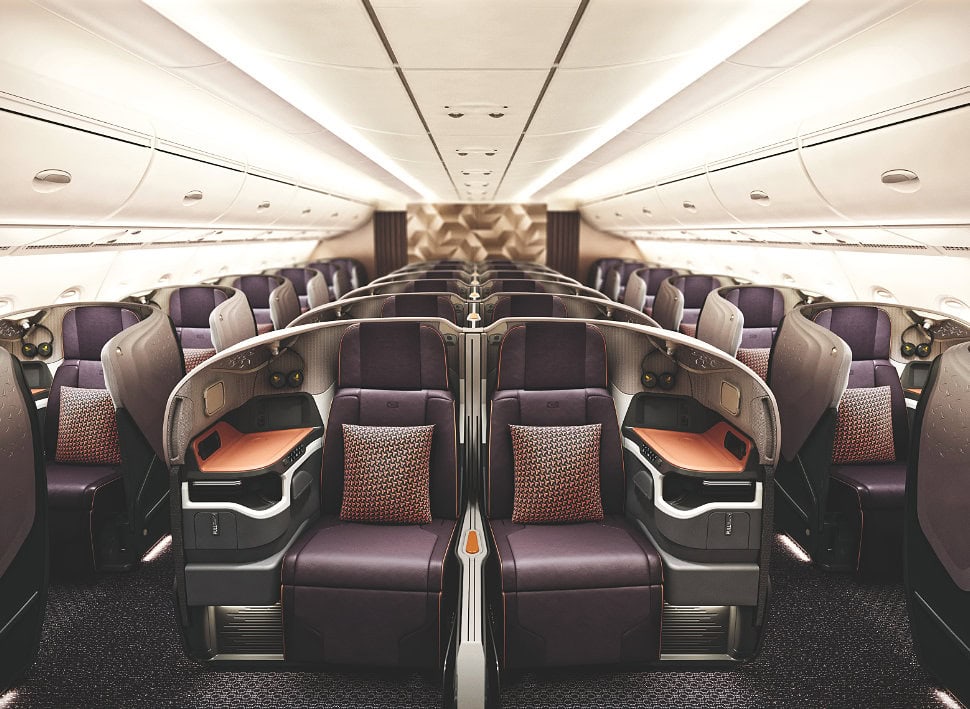
Singapore Airlines’ business class on the upper deck of A380.
Cabin environment advantages
The A380’s four-engine design might seem outdated, but it offers unexpected comfort benefits. The engines are mounted further from the fuselage than on twin-engine aircraft, reducing vibration and noise in the cabin. Combined with extensive sound insulation, this creates the library-quiet environment A380s are famous for.
The cabin pressure altitude of 6,000 feet matches modern aircraft like the A350 and 787. While the humidity levels of 10-15% don’t match the newest composite aircraft, they’re still better than older aluminum aircraft. The air circulation system completely refreshes cabin air every three minutes—faster than most aircraft.
Airlines operating A380 to Asia Pacific
The A380’s future might be limited, but current operators maintain premium service on key routes.
| Airline | Economy Config | Economy Width | Premium Economy | Special Features |
|---|---|---|---|---|
| Singapore Airlines | 3-4-3 lower, 2-4-2 upper | 18″ | Yes (38″) | Suites product |
| Emirates | 3-4-3 | 18″ | Yes (40″) | Upper deck bar |
| Qantas | 3-4-3 lower, 2-4-2 upper | 17.5″ | Yes (38″) | Upper deck economy |
| Korean Air | 3-4-3 | 18″ | Yes (37″) | Seasonal only |
| British Airways | 3-4-3 | 17.5″ | Yes (38″) | Dense configuration |
| Lufthansa | 3-4-3 | 17.7″ | Yes (38″) | Recent refresh |
Where to find the A380
The A380 network has consolidated around hub airports, but remains strong on premium routes.
From North America
Options from North America are limited but excellent where available. Singapore Airlines flies A380s from Los Angeles and San Francisco to Singapore. Korean Air operates seasonal A380 service from Los Angeles and New York to Seoul.
The real gem? Qantas’ A380 from Los Angeles to Sydney—book upper deck economy for a business class experience at economy prices.
| Route | Airline | Frequency | Best Booking |
|---|---|---|---|
| LAX-SIN | Singapore Airlines | Daily | Upper deck economy |
| SFO-SIN | Singapore Airlines | Daily | Premium economy |
| LAX-ICN | Korean Air | Seasonal | Upper deck |
| JFK-ICN | Korean Air | Seasonal | Avoid lower middle seats |
| LAX-SYD | Qantas | Daily | Upper deck economy |
From Europe
Europe offers the most extensive A380 network to Asia, particularly through Middle East hubs. Emirates operates multiple daily A380s from London, Paris, and Frankfurt to Dubai, with onward connections throughout Asia. British Airways flies A380s from London to Hong Kong and Singapore.
| Route | Airline | Frequency | Notes |
|---|---|---|---|
| LHR-SIN | British Airways | 2x daily | Some seasonal variation |
| LHR-DXB | Emirates | 6x daily A380 | Massive capacity |
| FRA-SIN | Lufthansa | Daily | Recently refurbished |
| CDG-DXB | Emirates | 3x daily A380 | All A380 service |
| MUC-HKG | Lufthansa | Daily | Premium heavy config |
From Australasia
Australia remains the A380’s strongest market. Qantas and Emirates dominate with multiple daily services. Singapore Airlines offers excellent A380 connections from both Sydney and Melbourne.
| Route | Airline | Frequency | Notes |
|---|---|---|---|
| SYD-SIN | Singapore Airlines | 2x daily | Best for Suites, miles |
| MEL-SIN | Singapore Airlines | Daily | Great Asia/Europe connections |
| SYD-DXB | Emirates | 2x daily | Strong Europe one‑stop option |
| MEL-DXB | Emirates | 2x daily | Good for Skywards redemptions |
| SYD-HKG | Qantas | Daily | Easy Asia stopover from Oz |
4. Boeing 777-300ER ATC 82/100
The Boeing 777-300ER tells a tale of two aircraft. Configured properly with nine seats across, it’s one of the most comfortable ways to cross the Pacific. Squeezed with ten seats across? It becomes a endurance test. Understanding this distinction could save your sanity on your next long-haul flight.
Understanding 777 variants
The 777 family includes several versions:
- 777-200ER. Smaller variant for around 300 passengers, still operates on some routes.
- 777-200LR. Ultra-long-range version for extreme distances.
- 777-300 non-ER. Rare, limited range, seldom seen on long-haul.
- 777-300ER. Extended range, 350-400 passengers, the most common variant.
- 777-9. Next-generation 777X family aircraft.
When you see “777-300ER” on your booking, you’re getting the current-generation extended-range workhorse that’s dominated long-haul flying since 2004.
Configuration is everything on the 777
Boeing designed the 777 for nine-abreast seating in economy. The math is simple—the cabin is 19 feet 3 inches wide. Divide by nine, account for armrests and aisles, and you get 18-inch seats. This configuration, known as 3-3-3, provides comfort comparable to newer aircraft.
But airline economics pushed many carriers to squeeze in a tenth seat, creating the dreaded 3-4-3 configuration. That extra seat comes at a cost—seat width drops to 17 inches or less. Over a 14-hour flight, that missing inch transforms from a minor annoyance to genuine discomfort.
3-3-3 / 3-4-3
The numbers tell the story. In 3-3-3 configuration, you’re never more than one seat from an aisle. Middle seat passengers have just one person to climb over for bathroom access. The seats themselves measure 18-18.3 inches wide—comparable to premium economy on some airlines.
Switch to 3-4-3, and everything changes. The middle section now has four seats, creating two middle seats with passengers on both sides. Seat width shrinks to 17 inches or even 16.5 inches on some carriers. Passenger comfort studies from Delft University of Technology found that seats under 17.5 inches wide significantly increase passenger stress levels on flights over 8 hours.
Japan Airlines deserves special recognition here. Their 777-300ERs feature 3-3-3 configuration with 19-inch seats—the widest economy seats in the sky on any aircraft. They achieve this through slightly different seat designs and optimized armrest width. It’s a masterclass in putting passenger comfort first.
Where to find 3-3-3 configured 777
The list of airlines maintaining passenger-friendly 3-3-3 configuration continues shrinking, making these carriers increasingly precious. Finding these passenger-friendly configurations requires knowledge and careful booking.
| Configuration | Seat Width | Airlines |
|---|---|---|
| 3-3-3 | 18-19″ | JAL, ANA, Korean Air, Air New Zealand, EVA Air (some) |
| 3-4-3 | 16.5-17″ | United, American, Air Canada, Cathay Pacific, Emirates |
From North America
Japanese carriers lead the way with 3-3-3 configurations from multiple North American cities. Korean Air also maintains this configuration on their 777-300ERs. The key is booking directly with these Asian carriers rather than their American codeshare partners.
| Route | Airline | Seat Width | Premium Economy |
|---|---|---|---|
| LAX-NRT | Japan Airlines | 19″ | Yes (42″) |
| SFO-NRT | All Nippon Airways | 18″ | Yes (40″) |
| LAX-ICN | Korean Air | 18″ | Yes (37″) |
| JFK-ICN | Korean Air | 18″ | Yes (37″) |
| ORD-NRT | All Nippon Airways | 18″ | Yes (40″) |
From Europe
European routes to Asia see fewer 777-300ERs in good configuration, with most carriers having switched to 3-4-3. Your best bets remain Asian carriers flying to European cities.
| Route | Airline | Configuration | Notes |
|---|---|---|---|
| LHR-NRT | Japan Airlines | 3-3-3 | 19″ seats |
| CDG-NRT | Japan Airlines | 3-3-3 | Premium comfort |
| FRA-ICN | Korean Air | 3-3-3 | Consistent quality |
From Australasia
Air New Zealand stands out with their 777-300ERs featuring not just 3-3-3 economy but the world’s best premium economy product.
| Route | Airline | Special Feature |
|---|---|---|
| AKL-HKG | Air New Zealand | 41.5″ premium economy |
| AKL-NRT | Air New Zealand | 3-3-3 economy |
| AKL-SIN | Air New Zealand | Being replaced by 787s |
Comfort breakdown
Economy class
In proper 3-3-3 configuration, the 777-300ER shines. Air New Zealand, Japan Airlines, All Nippon Airways, and Korean Air all maintain this passenger-friendly layout. Seats typically offer 32-34 inches of pitch with 18-inch width. The older cabin pressure altitude of 8,000 feet is the main drawback compared to newer aircraft.
The seats themselves vary by airline and retrofit schedule. Newer installations feature modern amenities like USB charging, larger entertainment screens, and improved cushioning. JAL’s newest 777-300ER seats include adjustable headrests with wings that actually stay in place—a small detail that matters on overnight flights.
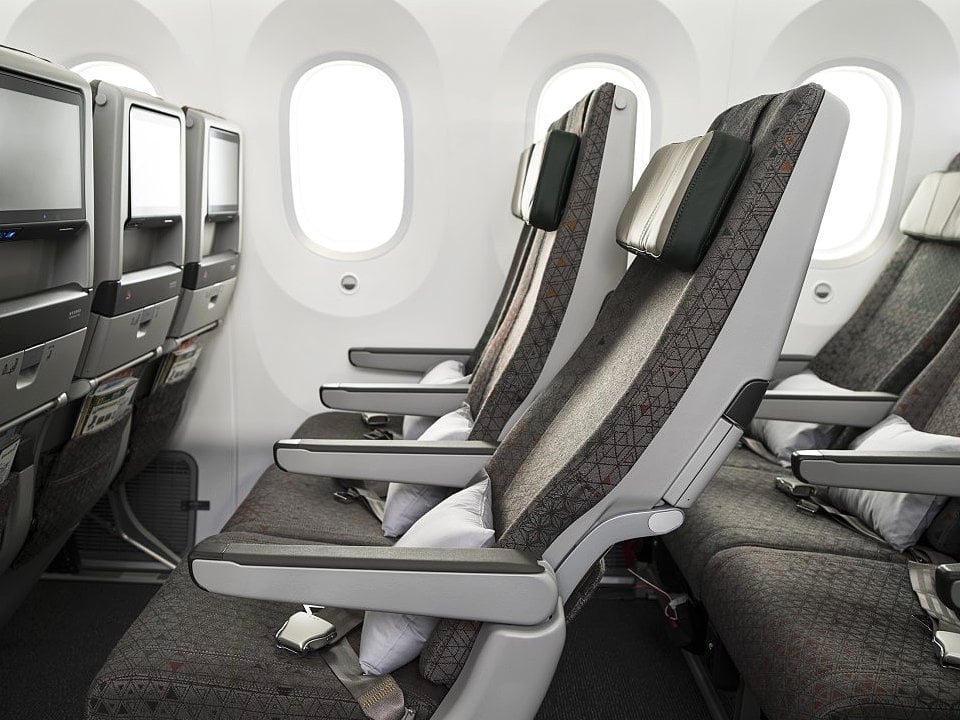
EVA Air’s 777-300ER economy class compensates for the narrow 17-inch width with generous legroom up to 33 inches.
Premium economy
The 777-300ER arguably offers the world’s best premium economy product—on Air New Zealand. Their premium economy provides 41.5 inches of pitch and 20-inch wide seats. For context, that’s more space than some airlines provide in business class on regional routes.
Other strong premium economy offerings include All Nippon Airways with 40 inches of pitch and Emirates with their refurbished 777s offering similar space. The older cabin environment means these seats become even more valuable—the extra space helps compensate for the higher cabin altitude.
Business class
Modern 777-300ER business class products rival anything on newer aircraft. ANA’s The Room stands out—enclosed suites with closing doors, 4K entertainment screens, and among the widest business class seats at 38 inches. It’s arguably the world’s best business class product, regardless of aircraft type.
5. Airbus A330-900neo ATC 80/100
The Airbus A330neo doesn’t get the attention of its flashier cousins, but this quiet achiever delivers comfort that rivals much larger aircraft. Think of it as the A350’s younger sibling—sharing much of the same technology in a smaller, more efficient package.
Understanding A330neo variants
The A330neo (new engine option) family comes in two versions:
- A330-800neo. Smaller variant seating 220-260 passengers, less common.
- A330-900neo. Larger variant seating 260-300 passengers, the primary neo model.
Both share the same modern cabin technology. The A330-900neo is by far the more popular variant, with most major carriers choosing it for medium-to-long-haul routes.
Don’t confuse these with the older A330-200 and A330-300 (pre-neo generation)—the neo variants feature new engines, winglets, and updated cabin systems that deliver better fuel efficiency and passenger comfort.
The new quiet contender
The “neo” stands for “new engine option,” but the improvements go far beyond engines. The A330neo borrows heavily from A350 technology, including those massive Rolls-Royce Trent 7000 engines that produce a distinctive quiet hum rather than the usual jet roar.
At 72 decibels, the A330neo matches the 787 for cabin quietness. The cabin pressure altitude of 6,500 feet splits the difference between older aircraft (8,000 feet) and the newest designs (6,000 feet). It’s a sweet spot that delivers most of the comfort benefits without the complexity of the newest systems.
Comfort breakdown
Economy class
The A330-900neo economy story hinges on a single decision: 2-4-2 or 3-3-3 seating. Malaysia Airlines sets the standard with 2-4-2 configuration featuring 17.5-inch wide Recaro CL3810 seats with 32-inch pitch—the latest-generation design delivers 1.5 inches more knee space than predecessors, paired with 13.3-inch 4K touchscreens.
Delta operates the widest economy seats at 18 inches on transpacific routes from Seattle, with generous 56-seat Comfort+ section offering 34-inch pitch.
Avoid 3-3-3 configurations entirely. Ultra-low-cost operators push density, with Cebu Pacific’s 459-seat all-economy configuration representing the highest-capacity A330 variant globally.
Premium economy
Premium economy remains surprisingly absent on most A330-900neo operators. Malaysia Airlines, Garuda, Starlux, and LCCs all skip this cabin entirely, forcing passengers to jump from economy directly to business class.
Delta Air Lines provides the only consistent premium economy with 28 Premium Select seats at 18.5 inches wide and 38-inch pitch in 2-3-2 configuration. The Collins MiQ seats feature retractable leg and footrests, memory foam cushions, and 13.3-inch touchscreens—6 inches more pitch than main cabin.
Business class
The A330-900neo delivers modern 1-2-1 business class with privacy doors across major operators. Malaysia Airlines leads the region with 28 Collins Elevation seats—the world’s first carrier to feature this product on A330neo.
Delta One suites offer 29 Thompson Vantage XL seats at 22 inches wide with closing doors—consistently rated as possibly the best off-the-shelf business class seat by aviation reviewers. The staggered 1-2-1 layout ensures all passengers receive comparable privacy.
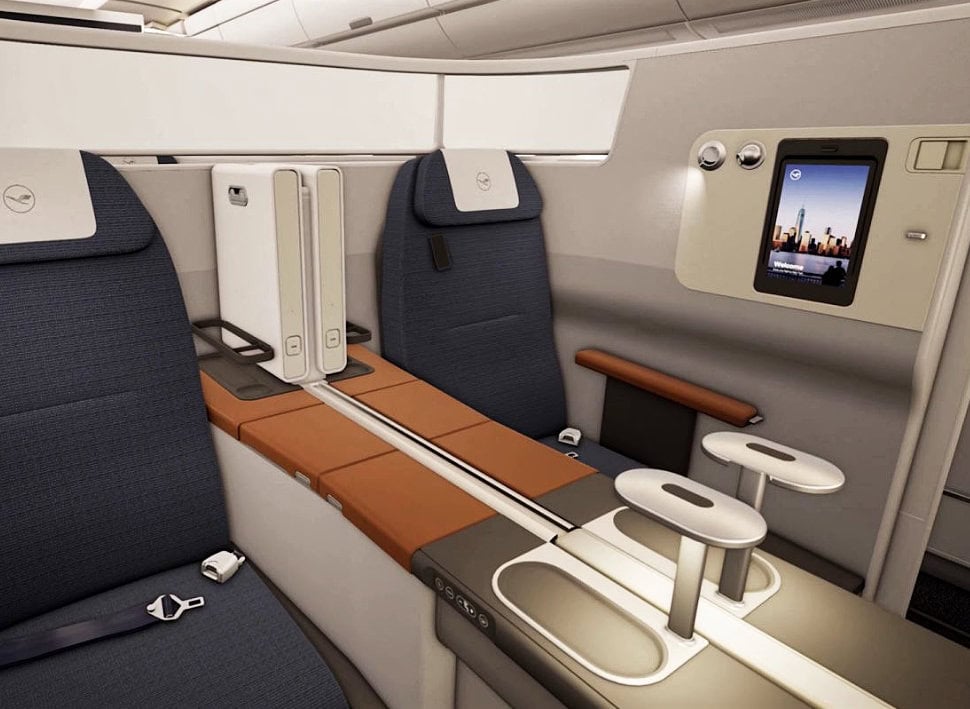
The Lufthansa A330 business class offers a comfortable lie-flat beds.
Where to find the A330neo
The A330-900neo remains relatively rare on long-haul routes compared to its A350 and 787 siblings. For flights to APAC most reliable options are Malaysia Airlines’ Australia routes, Starlux’s premium regional services from Taipei, and Cebu Pacific’s ultra-low-cost operations from Manila.
From North America
Delta’s A330neo transpacific era has ended. The carrier systematically upgraded all Asia routes to A350-900 aircraft, prioritizing premium capacity and cargo economics over the A330neo’s original deployment.
| Route | Airline | Frequency | Notes |
|---|---|---|---|
| SEA-TPE | Delta | Daily | Delta’s primary transpacific A330neo route |
| SEA-PVG | Delta | Daily | Replaces older 767/A330-300s for better efficiency on this long-haul sector |
| MSP-HND | Delta | Daily | Connects the Midwest to Tokyo; exclusively operated by the A330neo |
| LAX-HND | Delta | Daily | High-demand route; A330neo operates alongside A350 services |
From Europe
| Route | Airline | Frequency | Notes |
|---|---|---|---|
| FRA-BKK | Condor | 5x Weekly | Connects Frankfurt to Bangkok |
| FCO-BKK | ITA Airways | 5x Weekly | Rome to Bangkok; ITA’s first dedicated A330neo route to SE Asia |
| FCO-DEL | ITA Airways | Daily/Varies | Rome to New Delhi; operated by mix of A330neo and A350 |
| ORY-MRU | Corsair | Daily | Paris Orly to Mauritius; popular Indian Ocean leisure route |
| PEK-BRU | Hainan Airlines | Planned | Airline received first A330neo in Nov 2025; slated for Europe routes |
From Australasia
| Route | Airline | Frequency | Notes |
|---|---|---|---|
| SYD-KUL | Malaysia Airlines | Daily/2x Daily | Flagship route for MH’s new A330neo fleet; features new business suites |
| AKL-KUL | Malaysia Airlines | 4x Weekly | Provides direct connection from New Zealand to Malaysia |
| SYD-MNL | Cebu Pacific | Daily | High-density configuration (459 seats) |
| SYD-NOU | Aircalin | Varies | Short-haul widebody service connecting Sydney to New Caledonia |
| SYD-DPS | Garuda Indonesia | Daily | Utilizes A330-900neo for high-capacity leisure route to Bali |
How to find and book the most comfortable aircraft
You know what makes a plane comfortable. Here’s how to actually find those configurations when booking.
- Use ITA Matrix and filter by aircraft before you book. This tool shows exact aircraft types for every flight. Search your route, then filter using simple codes. Type “aircraft 350” for only A350s, or “~aircraft 773” to exclude 777-300s.
- Use Google Flights for quick checks. Google Flights now displays aircraft types under each flight option. Use the “Nonstop” filter—airlines typically assign their newest, most comfortable planes to flagship nonstop routes.
- Check the real seat map: AeroLOPA. It shows exact configurations for specific planes, not generic layouts.
- Watch for aircraft swaps. Airlines switch planes more often than you’d think. Check your booking weekly once you’re within a month of departure—most swaps happen 2-4 weeks out. When airlines swap results in a different cabin class (business to economy), you’re entitled to a full refund. For configuration changes within economy (3-3-3 to 3-4-3), policies vary by airline.
$2500 in savings from top travel brands
Discounts on premium services, free hotel stays, free guided tours, big rebates on travel gear, and much more.
Get discounts →
Acceptable aircraft
These planes offer a reliable “middle-ground” experience, featuring decent legroom and standard comfort levels, though they often lack the advanced cabin technology (like higher humidity or lower cabin altitude) found in next-generation jets. They are perfectly adequate for long-haul travel but won’t deliver the “wow” factor of the top-tier options.
6. Airbus A330-300/200 ATC 78/100
If you spot an A330 on your itinerary, you can expect a perfectly acceptable, if slightly dated, flight experience.
The biggest “pro” for this aircraft is its economy cabin layout, which typically uses a 2-4-2 configuration—a favorite for couples who can snag a window pair for privacy without a middle seat neighbor. The main drawbacks are the traditional 8,000-foot cabin altitude and lower humidity levels. These planes are showing their age, so be prepared for a noticeably louder cabin than you’d find on a modern Dreamliner or A350. While you likely won’t have cutting-edge entertainment screens or mood lighting, the comfort of that 2-seat window row often makes up for the lack of new tech.
| Route | Airline | Configuration | Notes |
|---|---|---|---|
| HKG-Regional Asia | Cathay Dragon | 2-4-2 | Being replaced by A330neo |
| TPE-Regional | China Airlines | 2-4-2 | Transitioning to 787 |
| SIN-Regional | Singapore Airlines | 2-4-2 | High-density configs |
7. Boeing 777-200LR ATC 76/100
The Boeing 777-200LR is a solid, if unexciting, choice for ultra-long-haul journeys. Designed for marathon flights, these aircraft often feature slightly better legroom (seat pitch) than standard fleet to make 15-hour treks bearable.
However, you will miss the creature comforts of newer jets; expect a noticeably louder cabin and drier air that can increase jet lag compared to an A350 or Dreamliner. It’s a perfectly acceptable ride for getting from A to B, but don’t expect the fresh, airy feeling of next-generation aviation.
| Route | Airline | Notes |
|---|---|---|
| DEL-SFO | Air India | Nonstop service |
| DOH-AKL | Qatar Airways | Ultra-long-haul |
Aircraft to Avoid
These last two models are generally older or densely configured, often suffering from louder cabins, dated interiors, and painfully cramped seating layouts (such as 10-abreast economy). Travelers on these aircraft should expect a tighter squeeze and a more fatiguing journey compared to modern standards.
8. Boeing 747-8 ATC 75/100
While the Boeing 747-8 is an aviation icon with a unique upper deck, it is generally best avoided in favor of modern twin-jets like the A350 or B787.
The main deck cabin is significantly louder than newer aircraft, and the air pressure and humidity levels remain at older, less comfortable standards that increase jet lag. Unless you secure a seat on the exclusive upper deck, you will likely face a dense, crowded cabin with older entertainment screens and worn interiors.
Its rapid retirement means airlines are investing less in upkeep, often resulting in broken seats or non-functional power outlets.
| Route | Airline | Frequency | Retirement Date |
|---|---|---|---|
| FRA-HND | Lufthansa | Daily | Continuing with updates |
| FRA-SIN | Lufthansa | 4x weekly | Continuing |
| ICN-LAX | Korean Air | Seasonal | By 2031 |
9. Boeing 777-300ER ATC 68/100
The Boeing 777-300ER, while a long-haul workhorse, is increasingly becoming a passenger nightmare due to the widespread shift to “high-density” 10-abreast seating in 3-4-3 layout. This configuration painfully reduces seat width to a cramped ~17 inches, leaving virtually no shoulder room for adult passengers compared to the spacious 9-abreast layouts of the past.
Additionally, its older cabin technology results in higher noise levels and drier air than modern rivals like the A350, significantly increasing fatigue on long journeys. Unless you can confirm a rare 9-abreast layout, this aircraft often guarantees a “sardine can” experience.
Unfortunately, the list of airlines using 3-4-3 on the 777-300ER keeps growing.
| Route | Airline | Seat Width | Notes |
|---|---|---|---|
| HKG-ALL | Cathay Pacific | 17.2″ | Virtually entire 777 fleet is 3-4-3; disappointing for a premium carrier |
| SFO-HKG | United Airlines | 17.1″ | High-density Polaris aircraft; often packed |
| SFO-TPE | United Airlines | 17.1″ | 13+ hour flight with minimal seat pitch and width |
| EWR-NRT | United Airlines | 17.1″ | Replaces LAX-NRT which is now primarily 787-10 |
| PVG-LAX | China Eastern | 17.0″ | Standard 10-abreast configuration for MU’s long-haul fleet |
| PVG-YYZ | China Eastern | 17.0″ | Long-haul flight with tight seating standards |
| TPE-LAX | EVA Air | 17.0″ | EVA Air uses 3-4-3 economy on their 777 fleet |
| TPE-JFK | EVA Air | 17.0″ | Ultra-long haul with 10-abreast seating |
| ICN-ATL | Korean Air | 17.2″ | US routes frequently see the 3-4-3 “Cosmo” config |
| YYZ-HKG | Air Canada | 17.0″ | One of the longest flights in AC network, flown in high-density |
| DXB-ALL | Emirates | 17.1″ | Extensive network; dense seating despite high service levels |
Why 3-4-3 ruins long-haul flights
The math is unforgiving. That tenth seat reduces width from 18 inches to 17 inches or less. MIT’s International Center for Air Transportation found that seats under 18 inches wide significantly increase passenger anxiety and reduce sleep quality on overnight flights.
The four-seat middle section creates two interior middle seats—arguably the worst spots in aviation. You’re trapped between strangers with no easy bathroom access. The narrow seats mean constant shoulder contact with neighbors.
If you’re stuck with a 3-4-3 configured 777, damage control becomes essential. Book aisle or window seats—never middle. Consider upgrading to premium economy, which maintains reasonable width. Noise-canceling headphones help block out the closer proximity to other passengers. A good neck pillow compensates for limited seat width. Consider mild sleep aids for overnight sectors—you won’t sleep naturally in 17-inch seats.
Best aircraft by departure city
From North American cities
- Los Angeles. LAX offers perhaps the best variety in North America. Singapore Airlines’ A350-900ULR provides nonstop service to Singapore. Japan Airlines operates both 787s (including some rare 2-4-2 configurations) and properly configured 777-300ERs to Tokyo. Korean Air maintains 3-3-3 on their 777s to Seoul. Even Qantas brings their A380 for Sydney service.
- San Francisco. SFO rivals LAX for premium aircraft availability. Singapore Airlines operates the A350-900ULR to Singapore. United bases many of their newer 787-9s here for Asian service. ANA and JAL offer excellent configurations to Tokyo. The proximity to Silicon Valley means airlines often deploy their best products to attract high-yield business traffic.
- New York. JFK and Newark offer surprising variety despite the longer distances. Singapore Airlines flies the ultra-long-range A350-900ULR nonstop from both airports. Korean Air occasionally brings the A380 to JFK. JAL’s new A350-1000 will serve JFK starting in 2025. The challenge? Most other options require connections, often through less comfortable aircraft.
- Vancouver. YVR punches above its weight for Asian connections. Air Canada deploys 787s on most Asian routes. Cathay Pacific brings their A350s for Hong Kong service. JAL maintains quality 787 service to Tokyo. The airport’s position makes it ideal for connections, though beware of Air Canada’s dense configurations.
- Chicago. ORD offers solid options despite being further inland. ANA operates 777-300ERs in comfortable 3-3-3 configuration to Tokyo. United bases many 787s here for Asian connections. JAL provides 787 service. The challenge is most comfortable options require connections through Tokyo.
| City | Best Aircraft | Airlines to Seek | Airlines to Avoid |
|---|---|---|---|
| Houston | 787, 777-300ER | EVA Air, ANA | United (older 777s) |
| Toronto | 787, A350 | EVA Air, Korean Air | Air Canada (High Density) |
| Boston | A350-1000, 787 | JAL, Cathay Pacific | Old 777 configurations |
| Washington DC | 787, 777-300ER | ANA, United (Polaris) | Air India (older interiors) |
| Atlanta | A350, 747-8i | Korean Air, Delta | Older 767 connections |
From European cities
- London. Heathrow provides outstanding options. British Airways flies A380s to Singapore and Hong Kong. Singapore Airlines operates multiple daily A350s and A380s. Virgin Atlantic deploys new A350-1000s to India. The variety means you can almost always find comfortable aircraft.
- Frankfurt. Lufthansa’s hub offers A380s to Bangkok and Singapore, plus A350s to multiple Asian cities. Singapore Airlines brings their A380. All Nippon Airways operates 777s in good configuration. As a major Star Alliance hub, connections offer additional variety.
- Paris. CDG sees excellent aircraft from Asian carriers. Singapore Airlines operates A380s. Air France deploys A350s on Asian routes. Japanese carriers bring quality 787s and 777s. The airport layout can be challenging, but aircraft quality compensates.
- Helsinki. Finnair deserves special mention—they operate their entire Asian network exclusively with A350s. Whether flying to Tokyo, Seoul, Bangkok, Singapore, or Hong Kong, you’re guaranteed an A350. It’s the most consistent quality in Europe.
- Amsterdam. KLM deploys 787s and some A350s to Asia. Singapore Airlines brings A350s. The airport’s efficiency makes connections pleasant, though KLM’s configurations don’t match Asian carriers’ quality.
| City | Best aircraft | Airline to seek | Airlines to avoid |
|---|---|---|---|
| Munich | A350-900, 787-9 | Lufthansa, Cathay Pacific | Older Lufthansa A340s |
| Zurich | 777-300ER, A350 | SWISS, Cathay Pacific | Edelweiss (older cabins) |
| Istanbul | A350, 787-9 | Turkish Airlines (new fleet) | Turkish Airlines (old 777 3-3-3) |
| Rome | A350, A330neo | Cathay Pacific, ITA Airways | Old A330-200s |
| Amsterdam | 787-10, A350 | KLM, Singapore Airlines | KLM 777 (3-4-3 economy) |
From Australasian cities
- Sydney. Sydney sees exceptional aircraft variety. Qantas deploys A380s to Singapore and Hong Kong. Singapore Airlines operates multiple daily A350s and A380s. Japan Airlines brings the coveted 787-8 in 2-4-2 configuration to Tokyo. Even United has improved their aircraft quality on Sydney routes.
- Melbourne. Melbourne nearly matches Sydney for quality. Singapore Airlines provides daily A380 service. Cathay Pacific brings A350s. Japan Airlines operates the 2-4-2 configured 787-8. The competition keeps aircraft quality high across all carriers.
- Auckland. Air New Zealand’s hub showcases their excellent fleet. Their 777-300ERs feature the world’s best premium economy. The 787-9 fleet offers consistent quality to Asia. The airline’s commitment to passenger comfort shows in every configuration choice.
- Brisbane. Brisbane sees slightly less variety but maintains quality. Singapore Airlines operates 787-10s and some A350s. Cathay brings A330s and A350s. Eva Air deploys 787s. The routes might be less frequent, but aircraft quality remains strong.
| City | Best aircraft | Airline to seek | Airlines to avoid |
|---|---|---|---|
| Perth | A350, 787-10 | Qantas, Singapore Airlines | Batik Air (older narrowbodies) |
| Adelaide | A350-900 | Singapore Airlines, Cathay Pacific | Jetstar (narrowbody to Bali) |
| Christchurch | A350-900 | Singapore Airlines, Cathay Pacific | Qantas (737 to Oz connections) |
| Gold Coast | A330, A321neo | Hong Kong Airlines | Older Jetstar A320s |
| Cairns | A330 | Jetstar (787 to Osaka) | AirAsia (dense A320) |
Complete aircraft specifications
For the data-driven traveler, the following table consolidates key comfort metrics across all major widebody aircraft types. By comparing seat width, pitch, and cabin environment specs side-by-side, you can instantly see why an aircraft scored highly or poorly.
Use this data to spot the specific differences—like humidity levels or cabin noise—that define your inflight experience.
| Aircraft | Seat width | Pitch | Config | Cabin alt | Humidity | Noise |
|---|---|---|---|---|---|---|
| A350-900/1000 | 18″ | 32-34″ | 3-3-3 | 6,000ft | 20% | 57dB |
| 787-8/9/10 | 17-18″ | 31-34″ | 3-3-3 | 6,000ft | 15% | 72dB |
| A380 | 18″ | 31-34″ | 3-4-3 | 6,000ft | 10-15% | 60dB |
| 777-300ER (3-3-3) | 18-19″ | 31-34″ | 3-3-3 | 8,000ft | 5-10% | 74dB |
| A330neo | 18″ | 31-33″ | 2-4-2 | 6,500ft | 12% | 72dB |
| A330-300/200 | 18″ | 31-32″ | 2-4-2 | 8,000ft | 5-10% | 75dB |
| 777-200LR | 18″ | 32″ | 3-3-3 | 8,000ft | 5-10% | 74dB |
| 747-8 | 17.2″ | 31″ | 3-4-3 | 8,000ft | 5-10% | 73dB |
| 777-300ER (3-4-3) | 17″ | 31″ | 3-4-3 | 8,000ft | 5-10% | 74dB |
| 777-200ER | 17-18″ | 31″ | Varies | 8,000ft | 5-10% | 75dB |
| 767-300ER | 17.5″ | 31″ | 2-3-2 | 8,000ft | 5% | 76dB |
The bottom line
Your journey across the ocean doesn’t have to be an endurance test. Armed with this knowledge, you can seek out those Japan Airlines 787s with their spacious 2-4-2 seating, find Singapore’s A350s with superior cabin environment, or score upper deck economy seats on an Emirates A380 for a business class experience at economy prices.
The aircraft you choose matters more than the airline brand on the fuselage. A premium airline operating a cramped 777 in 3-4-3 configuration will leave you more exhausted than a standard carrier with a properly configured A350. Use the tools we’ve outlined—ITA Matrix for searching, AeroLOPA for verification, ExpertFlyer for monitoring—to ensure you’re booking comfort, not just a brand name.
Remember the key numbers: 18 inches for seat width, 6,000 feet for cabin altitude, and never more than nine seats across on a 777. These simple metrics will guide you toward arrivals where you feel refreshed rather than wrecked. The Pacific is vast, the flights are long, but with the right aircraft, the journey becomes part of the adventure rather than something to endure. Safe travels, and may you always find yourself on an upper deck A380 or a JAL 787 when crossing the Pacific.
Questions? Answers.
Which is more comfortable: 787 or A350?
The A350 edges ahead overall, but the margin is surprisingly narrow. The A350 offers 20% cabin humidity versus the 787’s 15%—noticeable on ultra-long-haul flights. The A350’s standard 18-inch economy seats beat the 787’s typical 17-17.5 inches. However, the 787’s massive windows and slightly quieter cabin (72.7 vs 74.9 decibels) provide unique advantages.
Does cabin pressure altitude actually matter?Absolutely.
The New England Journal of Medicine published research showing that 6,000-foot cabin altitude (787, A350, A380) versus 8,000 feet (older aircraft) increases blood oxygen saturation by 4% and reduces fatigue markers by 20%. On flights over 12 hours, this translates to noticeably better sleep and less jet lag. At 8,000 feet cabin altitude, your body works harder to oxygenate blood, like mild altitude sickness.
Which aircraft should I absolutely avoid?
Avoid any 777 in 3-4-3 configuration for flights over 8 hours. The 17-inch seats create genuine discomfort that worsens exponentially with flight length. Specific combinations to avoid: United or American 777-300ERs to Asia, Air Canada 777s, and surprisingly, Cathay Pacific 777s despite their premium reputation.
Also avoid high-density A330s in 3-3-3 configuration (like TAP Air Portugal), offering just 16.5-inch seats. The discomfort rivals low-cost carriers despite mainline pricing.
Are newer aircraft always better?
Not necessarily. Age matters less than configuration and maintenance. Air New Zealand’s 15-year-old 777-300ERs with 3-3-3 economy and world-class premium economy beat American’s factory-fresh 777-300ERs in 3-4-3 configuration. Similarly, a well-maintained A330 with 2-4-2 seating beats a new 787 squeezed into dense configuration.
Focus on three factors: seat configuration, cabin pressure altitude, and recent refurbishment. A five-year-old aircraft with recent cabin refresh often beats brand-new planes with dated interiors.
Which airlines have the best configurations?
Japan Airlines leads globally with 2-4-2 economy on 787s and 19-inch seats on 777s. All Nippon Airways follows closely with consistent 3-3-3 on 777s and excellent premium products. Singapore Airlines maintains quality across their fleet, though they’re not immune to density creep. Air New Zealand deserves recognition for maintaining passenger comfort despite economic pressure. Korean Air keeps 3-3-3 on all 777s. Among American carriers, Delta leads with their A350 investment and avoiding the worst density configurations.
Does aircraft type matter for window vs aisle?
Aircraft type dramatically impacts the window versus aisle decision. The 787’s huge electrochromic windows make window seats genuinely special—you can see out even when dimmed, and the view is spectacular. The A380 upper deck windows include convenient storage ledges and extra shoulder room from fuselage curve. In 2-4-2 configurations, window pairs eliminate middle seat issues. In 3-4-3 layouts, avoid everything except windows and aisles—those inner middle seats represent aviation’s worst real estate. For 3-3-3, the difference diminishes since you’re maximum one seat from the aisle regardless.
Which aircraft are being phased out?
The 747-8 passenger version faces extinction by 2031, with Korean Air the last major operator to Asia. Older A330-200/300s are being replaced by A330neos and 787s, though refurbished examples remain comfortable. The 777-200 variants are disappearing rapidly, replaced by 787s and A350s. The 777-300ER will fly for another decade or more—it’s too economically successful to retire early. The A380’s future looked dire, but Emirates and Singapore Airlines extended their commitment through the early 2030s. The newest A350s and 787s will dominate Pacific aviation through the 2040s.