Summary
- Choosing the right US departure hub can unlock big savings on flights to Asia-Pacific destinations.
- West Coast hubs (LAX, SFO, SEA) offer the most frequent, cheapest transpacific routes to Asia.
- East Coast travelers can save by flying east through Europe/Middle East hubs instead of backtracking west.
- Don’t assume your local airport is cheapest—positioning flights to major hubs often save hundreds of dollars.
- Aircraft type matters significantly on 10-13 hour flights; widebody planes offer superior long-haul comfort.
Listen to the podcast version of this article:
Why your hub choice actually matters
Your flight to Asia shouldn’t feel like a game of chance. Yet for many, it is. One flight offers a fair price and a comfortable journey, while another comes with a dreadful layover and a cramped seat. The secret most travelers miss is simple: your starting airport is your single most important decision.
This guide will show you how to use the right US airport hub to unlock massive savings and a better flight to Asia. We’ll walk you through America’s power hubs and a few under-the-radar gems, teaching you the smart hacks frequent flyers use to make long-haul trips feel less long.
Remember that there isn’t a single “best” hub. Be flexible about origin, check aircraft types, and watch sales—win on price, comfort, or both. Subscribe to fare alerts if you want the deals to come to you.
Major U.S. hubs (and what they’re best at)
These seven hubs are your smartest springboards from the U.S. to Asia-Pacific. Each card highlights where the hub shines, what you’ll likely fly, key pros/cons, and “Stopover sweet spots” to help you save money or add a mini-trip—so you can pick the right gateway for your route, budget, and comfort level.
1. Los Angeles LAX
West Coast heavyweight with deep schedules into Northeast and Southeast Asia, plus Australia/NZ via APAC hubs. Big alliance presence and frequent promos if you’re flexible by a day or two.
- Best for: Tokyo, Osaka, Seoul, Taipei, Hong Kong, Singapore, Manila, Bangkok, Sydney/Melbourne (via APAC hubs).
- Airlines & aircraft: ANA, JAL, Korean, Asiana, EVA, China Airlines, Cathay, Singapore, Philippine (A350/787/777/A380 depending on carrier); U.S. majors to key APAC points.
- Why choose LAX: Maximum choice on the West Coast; many dailies to Japan/Korea/Taiwan; strong premium-cabin competition.
- Watch-outs: Peak-hour queues; build margin for TBIT security/immigration on tight connections.
Stopover sweet spots
- HND/NRT (Tokyo): Dense Japan domestic and NE Asia links.
- ICN (Seoul): Ultra-efficient hub with wide dispersion across Asia.
- TPE (Taipei): Excellent Southeast Asia connectivity and often-sharp pricing.
- SIN (Singapore): Smooth onward options into Indonesia, Malaysia, Australia/NZ. Offers free city tours during layovers.
- MNL (Manila): Handy jumping-off point for the Philippines archipelago.
Pick if: you want choice and frequent departures.
Skip if: you hate mega-airport crowds or need ultra-tight connections.
| Route | Avg OTA price | Avg ATC price |
|---|---|---|
| LAX → Tokyo | $1,020 | $357 (65% off) |
| LAX → Seoul | $940 | $489 (48% off) |
| LAX → Taipei | $910 | $500 (45% off) |
| LAX → Singapore | $1,080 | $346 (68% off) |
| LAX → Manila | $980 | $461 (53% off) |
Notice the dramatic price differences? These ‘Avg ATC prices’ represent Superdeals—AI-found fare drops that save 40-80% compared to regular fares.
2. San Francisco SFO
United’s Pacific launchpad and a favorite for Japan/Korea/Taiwan, with strong Star Alliance depth and punctual operations.
- Best for: Tokyo, Osaka, Seoul, Taipei, Singapore, Hong Kong.
- Airlines & aircraft: United, ANA, Singapore, EVA (+ partners) on A350/787/777.
- Why choose SFO: Star Alliance connectivity, multiple banked departures, solid upgrade/miles angles.
- Watch-outs: Morning fog can ripple delays; mind MCTs if mixing tickets.
Stopover sweet spots
- HND/NRT (Tokyo): ANA bridge to Japan domestic and beyond.
- ICN (Seoul): Easy onward to Japan/China/SE Asia.
- TPE (Taipei): Great Southeast Asia reach with EVA/partners.
- SIN (Singapore): Premium transfer platform for SE Asia/Australasia.
- HKG (Hong Kong): Handy for South China/Taiwan when schedules fit.
Pick if: you value *A depth and predictable ops.
Skip if: your dates require late-night connections that cut buffers too fine.
| Route | Avg OTA price | Avg ATC price |
|---|---|---|
| SFO → Tokyo | $995 | $478 (52% off) |
| SFO → Seoul | $930 | $446 (52% off) |
| SFO → Taipei | $900 | $459 (49% off) |
| SFO → Singapore | $1,090 | $349 (68% off) |
| SFO → Hong Kong | $970 | $504 (48% off) |
3. Seattle/Tacoma SEA
Compact, efficient West Coast hub with strong Japan/Korea links and increasingly competitive Southeast Asia options via partner hubs.
- Best for: Tokyo, Seoul, Taipei; Southeast Asia via ICN/TPE/NRT/HND.
- Airlines & aircraft: Delta, Korean, ANA, JAL, EVA (mix of A350/787/777).
- Why choose SEA: Shorter walks than LAX/SFO; good on-time record; frequent sales in shoulder seasons.
- Watch-outs: Fewer daily frequencies than LAX/SFO—be flexible on days/times.
Stopover sweet spots
- ICN (Seoul): Fast connections across NE/SE Asia.
- HND/NRT (Tokyo): Dense Japan feed; onward Asia options.
- TPE (Taipei): Consistently good Southeast Asia dispersion.
- HKG/SIN: Alternate gateways when schedules align.
Pick if: you want a calmer West Coast connection.
Skip if: you need multiple time-of-day choices to a specific city.
| Route | Avg OTA price | Avg ATC price |
|---|---|---|
| SEA → Tokyo | $960 | $326 (66% off) |
| SEA → Seoul | $910 | $291 (68% off) |
| SEA → Taipei | $890 | $240 (73% off) |
| SEA → Singapore | $1,060 | $403 (62% off) |
| SEA → Bangkok | $980 | $519 (47% off) |
Flights to Asia for half-price. Thanks, AI.
Our custom AI finds rare deals that save 40–80% compared to regular fares. Why overpay?
See how it works →
4. New York–JFK JFK
East Coast titan with breadth across alliances; great for nonstop Japan/Korea and one-stops into Southeast Asia via partner hubs.
- Best for: Tokyo, Seoul, Singapore (nonstop/one-stop), Bangkok, Ho Chi Minh City, Manila (via hubs).
- Airlines & aircraft: JAL, ANA, Korean, Asiana, Singapore, Cathay (+ U.S. majors/partners) on A350/787/777/A380.
- Why choose JFK: Sheer frequency, alliance choices, premium-cabin depth.
- Watch-outs: Terminal hops add time—aim for same-terminal connections when possible; NYC peak-hour security lines.
Stopover sweet spots
- DOH/DXB: One-stop dispersion across South/Southeast Asia and Australasia.
- HND/NRT (Tokyo): Strong for Japan + onward Asia.
- ICN (Seoul): Very efficient for SE Asia.
- HKG/TPE: Good coverage into China/SE Asia.
- SIN (Singapore): Smooth onward links into Indonesia/Malaysia/Thailand and Australasia.
Pick if: you want maximum East Coast options and premium availability.
Skip if: you prefer smaller airports or have tight layovers across terminals.
| Route | Avg OTA price | Avg ATC price |
|---|---|---|
| JFK → Tokyo | $1,090 | $403 (63% off) |
| JFK → Seoul | $1,020 | $285 (72% off) |
| JFK → Singapore | $1,180 | $413 (65% off) |
| JFK → Bangkok | $1,050 | $420 (60% off) |
| JFK → Manila | $1,120 | $554 (51% off) |
5. Chicago O’Hare ORD
Centrally located Star/SkyTeam crossroads with solid nonstop Japan/Korea and plentiful one-stop Southeast Asia options via partner hubs.
- Best for: Tokyo, Seoul, Taipei; Southeast Asia via NRT/HND/ICN/TPE.
- Airlines & aircraft: United, ANA, JAL, Korean, EVA (+ partners) on A350/787/777.
- Why choose ORD: Good availability year-round, strong mileage plays, wide U.S. domestic feed.
- Watch-outs: Winter weather buffers; long walks between some piers.
Stopover sweet spots
- HND/NRT (Tokyo) & ICN (Seoul): Gateways for NE Asia and beyond.
- TPE (Taipei): Southeast Asia dispersion with competitive fares.
- HKG/SIN: Alternate hubs when schedules/prices align.
Pick if: you’re starting in the Midwest or connecting from smaller cities.
Skip if: you need West Coast-level frequency to secondary Asian cities.
| Route | Avg OTA price | Avg ATC price |
|---|---|---|
| ORD → Tokyo | $980 | $441 (55% off) |
| ORD → Seoul | $940 | $480 (49% off) |
| ORD → Taipei | $920 | $239 (74% off) |
| ORD → Singapore | $1,120 | $459 (59% off) |
| ORD → Bangkok | $1,000 | $430 (57% off) |
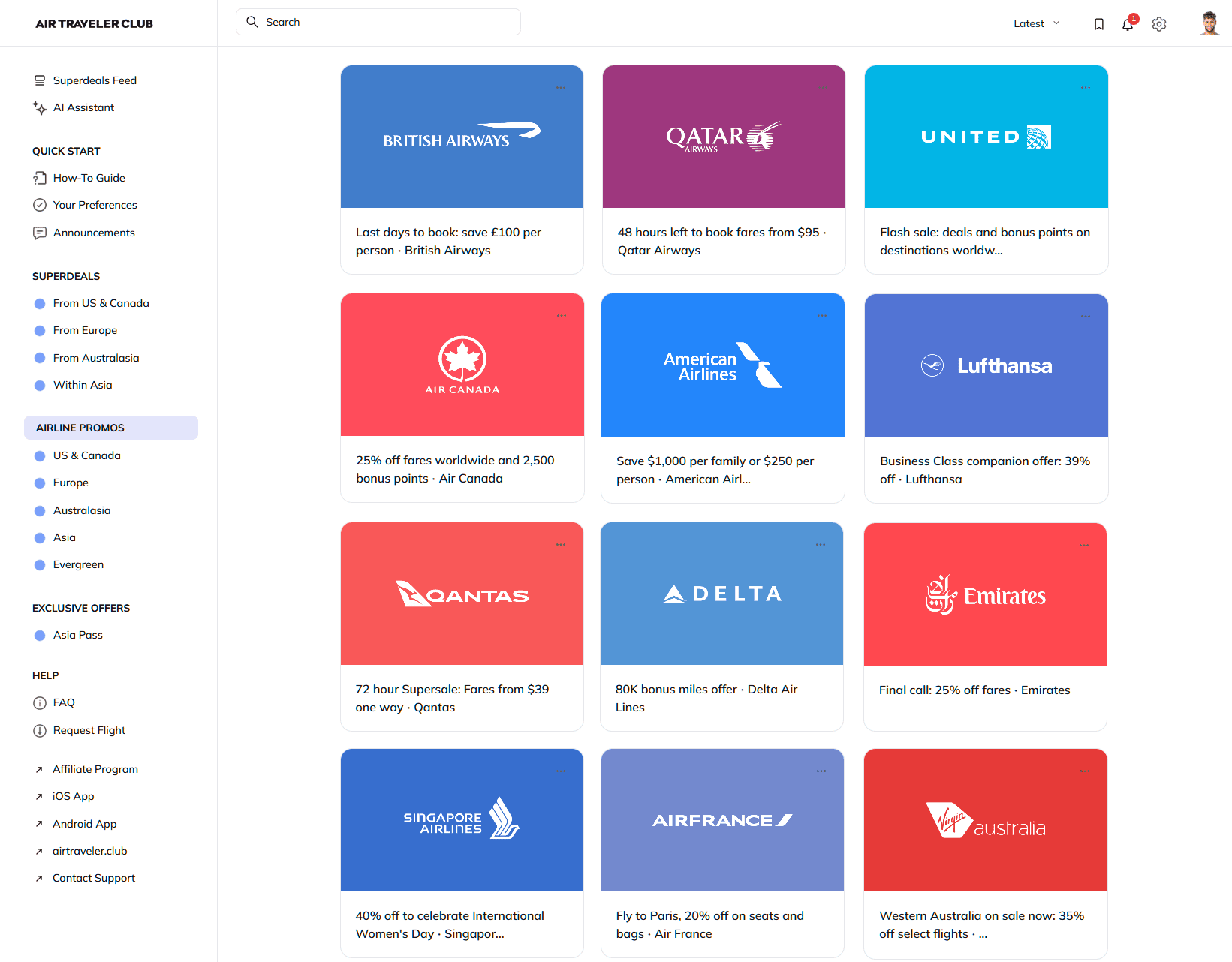
Our AI detects sales and promotions from 150+ airlines
- Genuine gems—vetted by travel experts
- Browse all active promos on our platform
- Never miss a new promo with real-time alerts
Common mistakes.
How to avoid costly pitfalls that can ruin your travels.
Flying long-haul to Asia-Pacific through U.S. hubs can save money and open better routes—but it’s also where many travelers trip up. Here are 10 common mistakes and how to dodge them:
- Assuming your local airport is always cheapest. Many travelers book from the closest airport without checking alternatives. A $50–$100 hop to a bigger hub can unlock $300+ savings on the long-haul.
- Ignoring West Coast gateways when starting in the East. Positioning to LAX/SFO/SEA often shortens the transpacific segment and lowers fares—especially to Japan/Korea/Taiwan.
- Not checking flight deal sites. Skipping specialized deal platforms can cost you hundreds. Air Traveler Club and similar services surface deals up to 80% off regular fares. Why pay sticker price when these discounts exist?
- Booking tight connections across terminals. At sprawling hubs like JFK or LAX, a layover can be a gamble. Build in buffer time, especially if changing terminals.
- Ignoring aircraft type and cabin layout. Not all 787s or A350s are created equal—seat pitch, width, and comfort vary by airline. Check before booking, or risk in a dense 3-4-3 layout.
- Mixing separate tickets with no safety margin. Positioning with low-cost/domestic carriers can save money—but only if you allow between flights. A delay could leave you stranded.
6. Dallas/Fort Worth DFW
AA’s long-haul stronghold with wide domestic feed; good one-stops into Southeast Asia via Tokyo/Seoul/Doha.
- Best for: Japan/Korea nonstops and Southeast Asia via HND/NRT/ICN/DOH.
- Airlines & aircraft: American, JAL, Qatar (A350/787/777).
- Why choose DFW: Massive connectivity from across the U.S.; frequent promos on transpacific JV routes.
- Watch-outs: Summer storms; build buffers if on separate tickets.
Stopover sweet spots
- HND/NRT (Tokyo): AA/JAL bridge into Japan + onward Asia.
- ICN (Seoul): Smooth connections to SE Asia.
- DOH (Doha): Broad web to South & Southeast Asia with frequent banks.
Pick if: you’re in AA world and want simple connections.
Skip if: you need multiple daily nonstops to secondary Southeast Asian cities.
| Route | Avg OTA price | Avg ATC price |
|---|---|---|
| DFW → Tokyo | $1,020 | $357 (65% off) |
| DFW → Seoul | $980 | $431 (56% off) |
| DFW → Singapore | $1,180 | $413 (65% off) |
| DFW → Bangkok | $1,060 | $275 (74% off) |
| DFW → Manila | $1,120 | $470 (58% off) |
7. Newark EWR
United’s East Coast counterpart to SFO with nonstop Japan/Korea/Taiwan and strong one-stop access to Southeast Asia via partner hubs.
- Best for: Tokyo, Seoul, Taipei; Southeast Asia via HND/ICN/TPE/SIN.
- Airlines & aircraft: United, ANA, EVA, Singapore (A350/787/777).
- Why choose EWR: Excellent for Northeast origins; Star depth + plentiful domestic feed.
- Watch-outs: Congestion and weather can stretch taxi/arrival times—use healthy layovers.
Stopover sweet spots
- HND/NRT (Tokyo) & ICN (Seoul): Reliable NE Asia gateways.
- TPE (Taipei)/SIN (Singapore): Efficient Southeast Asia dispersion.
- HKG: Alternative routing when inventory aligns.
Pick if: you’re in the NYC metro but want to avoid JFK.
Skip if: your itinerary involves tight inter-terminal/connectivity windows.
| Route | Avg OTA price | Avg ATC price |
|---|---|---|
| EWR → Tokyo | $1,050 | $262 (75% off) |
| EWR → Seoul | $1,000 | $510 (49% off) |
| EWR → Taipei | $960 | $278 (71% off) |
| EWR → Singapore | $1,190 | $440 (63% off) |
| EWR → Bangkok | $1,070 | $374 (65% off) |
8. Houston IAH
Gateway for the South/Central U.S. with strong Star Alliance reach; good pricing windows into Southeast Asia via partner hubs.
- Best for: Tokyo, Taipei; Southeast Asia via HND/ICN/TPE/SIN.
- Airlines & aircraft: United, ANA, EVA, Singapore (mix of A350/787/777).
- Why choose IAH: Huge domestic feed and competitive sale periods.
- Watch-outs: Summer thunderstorms; allow buffers on separate tickets.
Stopover sweet spots
- HND/NRT (Tokyo) & ICN (Seoul): NE Asia gateways with frequent banks.
- TPE/SIN: Broad Southeast Asia options.
- HKG: Useful alternate when schedules line up.
Pick if: you’re in Texas/Gulf states and want one-stop Asia.
Skip if: you need many daily nonstops to secondary cities.
| Route | Avg OTA price | Avg ATC price |
|---|---|---|
| IAH → Tokyo | $1,010 | $253 (75% off) |
| IAH → Taipei | $980 | $245 (75% off) |
| IAH → Singapore | $1,170 | $444 (62% off) |
| IAH → Bangkok | $1,060 | $414 (61% off) |
| IAH → Manila | $1,090 | $523 (52% off) |
Should You Fly West or East from the U.S. to Asia?
One of the biggest puzzles for U.S. travelers is direction: should you cross the Pacific westward, or fly east through Europe or the Middle East? The answer depends heavily on where you start.
East Coast Travelers
For flyers out of New York, Boston, or Washington, the “eastward” path often makes more sense than people realize. Instead of backtracking to Los Angeles or San Francisco for a Pacific nonstop, you can connect through European and Middle Eastern hubs like London, Istanbul, or Doha. The distance is longer, but the pricing can be sharp—especially in premium cabins where Gulf carriers and Europe-based airlines undercut U.S.–Asia fares by 30–60%. Add in the chance to stop over in Europe or the Middle East and the detour can feel like a bonus.
West Coast Travelers
From Los Angeles, San Francisco, or Seattle, the picture flips. Flying west is almost always shorter, cheaper, and backed by huge capacity on Japan, Korea, and Taiwan routes. Going east would mean first flying cross-country to an East Coast hub, then onward across the Atlantic—two extra flights with no time or cost advantage. The only scenarios where this pays off are limited: chasing a mistake fare, redeeming points on a Middle Eastern carrier, or deliberately adding a European stopover.
Other Factors
- Competition & pricing: The Pacific has denser schedules and sharper fares; Europe/Middle East shines when promos drop. Look for fifth freedom flights for occasional better pricing.
- Stopovers: Westbound offers Tokyo, Seoul, Taipei. Eastbound unlocks London, Istanbul, Dubai.
- Jet lag & time zones: Both directions carry long hauls and heavy time jumps; recovery strategy often matters more than the compass.
Bottom line: For West Coasters, west is the natural direction—eastbound only works in niche situations. For East Coasters, going east via Europe or the Middle East is not just logical, it can be the smarter, cheaper, and sometimes more enjoyable choice.