Quick summary
A double partial amputee flying United Airlines business class from Los Angeles to Newark on May 24 was initially told by a gate agent to wait for Group 1 boarding despite having a disability assistance request on file. The passenger, who uses a cane and whose amputation is not visible when clothed, had to challenge the decision with a second agent before being permitted to preboard. Under 14 CFR § 382.93, airlines must allow any passenger who self-identifies a disability need to board before all other passengers — including first class.
United confirmed the passenger did board before general boarding began. The incident exposes a systemic gap: gate agents increasingly skeptical of fraudulent wheelchair requests are now applying that skepticism to legitimate ones.
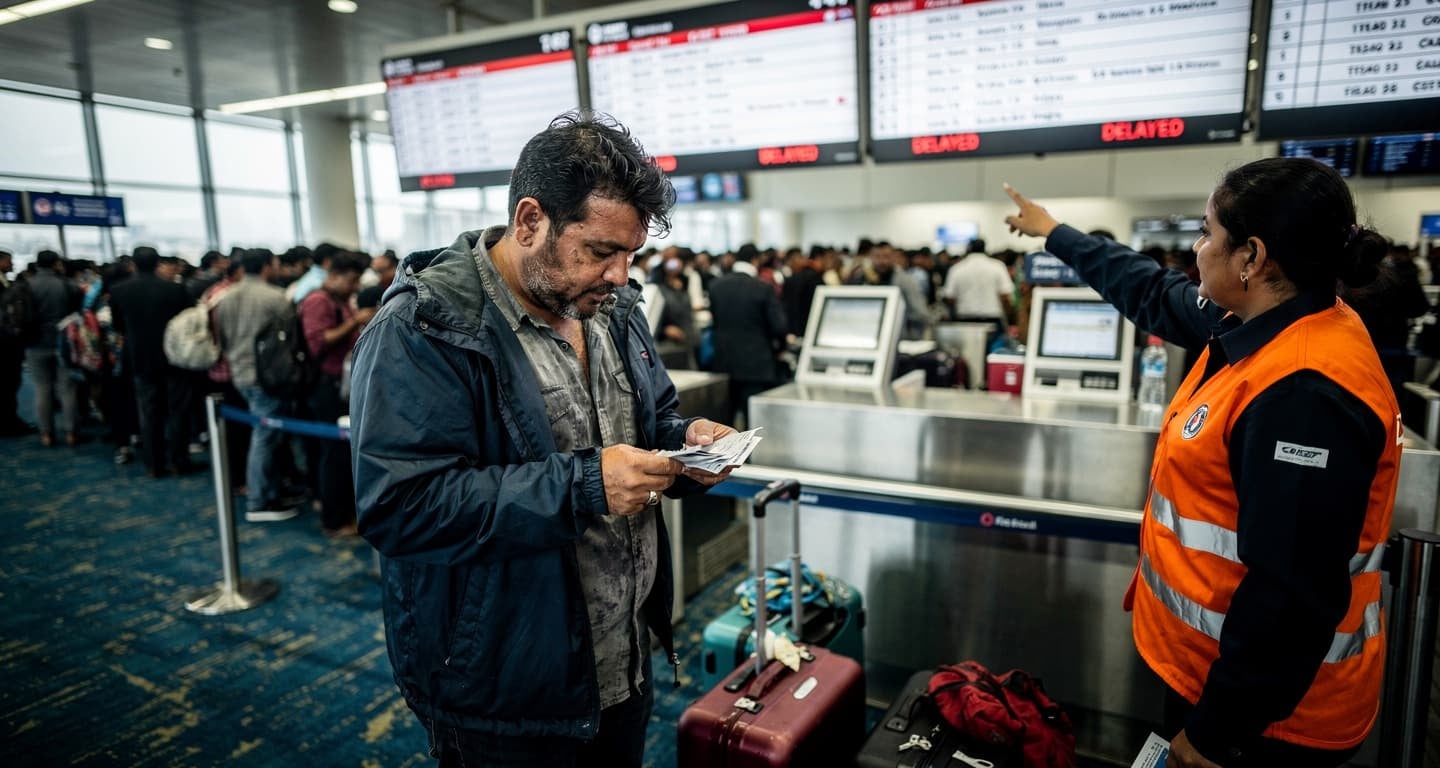
The passenger had done everything right. He had a disability assistance request on record, arrived at the gate in a wheelchair, and identified himself for preboarding on a May 24 United Airlines flight from Los Angeles International to Newark Liberty. A gate agent told him to wait for Group 1.
He pushed back. A second agent allowed him through. United’s own records later confirmed he boarded before general boarding began — which is precisely what federal law requires.
So the system worked, eventually. That’s the problem.
The passenger is a double partial amputee who uses a cane and cannot walk long distances. His disability is not visible unless he’s barefoot or wearing shorts. He had stood up from his wheelchair to walk the jet bridge independently, allowing the wheelchair attendant to assist another passenger — a considerate act that may have contributed to the gate agent’s skepticism. Under the Air Carrier Access Act and DOT regulations at 14 CFR § 382.93, none of that should matter: a passenger who states they need additional time or assistance to board is entitled to preboard before every other passenger on the aircraft, full stop.
What this incident makes visible is a compliance failure hiding inside a procedural success. The passenger got his preboarding. He also had to argue for a federal right in front of a boarding gate crowd, on a bad leg, while a clock ticked.
What federal law actually requires — and where United fell short
The Air Carrier Access Act is not ambiguous on this point. DOT’s wheelchair and guided assistance guidance states that passengers with disabilities must self-identify their need at the gate — and once they do, preboarding is mandatory, not discretionary. The gate agent’s initial refusal was not a judgment call. It was a compliance failure.
United’s boarding sequence places customers with disabilities in preboarding, ahead of Group 1 and all elite tiers. The passenger held MileagePlus Premier status and was seated in business class — neither of which is relevant to the disability preboarding entitlement, but both of which underscore that this was not a case of an inexperienced traveler misunderstanding the process.
The airline’s response to the passenger’s complaint advised him to request a Complaints Resolution Official (CRO) if the situation recurs. That advice is legally correct. It is also a telling indicator of where United places the burden: on the disabled traveler to escalate, rather than on gate staff to comply.
| Factor | What DOT rules require | What occurred |
|---|---|---|
| Preboarding trigger | Passenger self-identifies disability need at gate | Passenger self-identified; first agent refused |
| Boarding order | Before all other passengers, including first class | Initially directed to wait for Group 1 |
| Visible disability requirement | None — self-identification is sufficient | Non-visible disability appeared to trigger skepticism |
| Resolution path | Immediate compliance; CRO available if disputed | Resolved only after passenger challenged with second agent |
| Final outcome | Preboard before general boarding | Confirmed by United: boarded before general boarding |
This incident is not isolated. A June 15, 2026 case involving British Airways at JFK — where a wheelchair-using disability rights campaigner was denied boarding entirely on grounds that cabin crew could not assist with lavatory access — illustrates that disability accommodation failures are occurring across carriers and airports simultaneously.
Flight deals
most people never see
Our AI monitors 150+ airlines for pricing anomalies that traditional search engines miss. Air Traveler Club members save $650 per trip per person on average: see how it works.
Each deal saves 40–80% vs. regular fares:

The fraud problem that is now everyone’s problem
Fake wheelchair requests are not a myth. Passengers who use airport wheelchairs to skip queues and then walk briskly to baggage claim are a documented phenomenon — common enough to have generated viral videos and a nickname among airline staff. The effect on legitimate users is twofold and compounding.
First, fraudulent requests consume wheelchair resources that should be allocated to passengers who actually need them, creating delays and shortfalls at busy gates. Second — and this is the mechanism at work in the United incident — repeated exposure to fake requests trains gate agents to be skeptical by default. That skepticism is not applied to wheelchair users who remain seated and visibly dependent on the chair. It is applied to passengers who stand up, walk, or whose disability is internal or non-obvious.
The DOT’s Airline Passengers with Disabilities Bill of Rights prohibits discrimination based on disability and requires airlines to provide information about available services on request. It does not require passengers to prove their disability. The gap between what the law says and what a stressed gate agent does in a 20-minute boarding window is where legitimate passengers get caught.
Airlines have not yet developed standardized scripts or training protocols that separate fraud screening from disability accommodation. Until they do, the burden of proof — legally nonexistent — lands informally on the traveler.
How to protect your preboarding rights at the gate
Gate agents at major U.S. hubs are applying informal fraud filters to preboarding requests — and passengers with non-visible disabilities are the ones absorbing the compliance failures that result.
- Add a preboarding note before you fly: Call United’s Accessibility Desk at 1-800-228-2744 or update your booking via “My Trips” to include a specific preboarding and assistance request. A note in the passenger name record gives gate agents a system confirmation to reference.
- Self-identify explicitly at the gate: Do not assume the reservation note will trigger preboarding automatically. Walk up and state: “I have a disability and need preboarding for additional time to board.” DOT rules require this self-identification — it is also your clearest legal trigger.
- Request a CRO immediately if challenged: If a gate agent refuses or delays, do not argue with the front-line staff. Ask by name for the airline’s Complaints Resolution Official. Carriers must provide one. Note the agent’s name, the time, and the flight number on your phone.
- Document and file after travel: A gate interaction that resolves in your favor still warrants a complaint if your rights were initially denied. File with DOT’s Aviation Consumer Protection Division — documented complaints build the enforcement record that drives policy change.
- Know the law, not just the policy: 14 CFR § 382.93 is federal regulation, not airline preference. “Our policy” from a gate agent does not override it. Citing the regulation by number, calmly, changes the dynamic.
Watch: United Airlines’ accessibility and preboarding guidance pages over the next three to six months — any update to agent scripts or escalation procedures will signal whether the airline is responding to this pattern proactively. If no update appears while complaints continue to surface, expect DOT’s Office of Aviation Consumer Protection to move toward targeted enforcement action under the Air Carrier Access Act.

Questions? Answers.
Does a disability note in my reservation guarantee preboarding on United?
No. A reservation note helps, but DOT rules require passengers to self-identify their need at the boarding gate each time they fly. Gate agents may not proactively check reservation notes during a busy boarding sequence. Always approach gate staff directly and state your need explicitly — “I have a disability and need preboarding for additional time to board” — regardless of what is recorded in your booking.
What is a Complaints Resolution Official and how do I get one?
A Complaints Resolution Official (CRO) is a designated airline representative trained in DOT disability regulations. Under federal law, carriers must make a CRO available in person or by phone at every airport during operations. If a gate agent denies or delays your preboarding request, ask by name for the CRO — do not accept a supervisor who is not specifically designated as one. The CRO has authority to override front-line staff decisions on disability accommodation.
Can I get compensation if United wrongly denies my preboarding request?
Not in the form of cash payouts. The Air Carrier Access Act does not provide for the kind of automatic compensation available under EU261 for delays or cancellations. Remedies are complaint-based: file with the airline’s CRO during travel, then follow up with DOT’s Aviation Consumer Protection Division via transportation.gov. DOT can investigate and take enforcement action against carriers with documented patterns of non-compliance, but individual monetary awards are not a standard outcome.
Does this apply to other U.S. airlines, or only United?
The Air Carrier Access Act and 14 CFR § 382.93 apply to all U.S. carriers and all foreign carriers operating flights to or from the United States. The preboarding entitlement, the self-identification requirement, and the CRO obligation are universal across airlines. The United incident reflects an industry-wide training gap, not a United-specific policy failure.