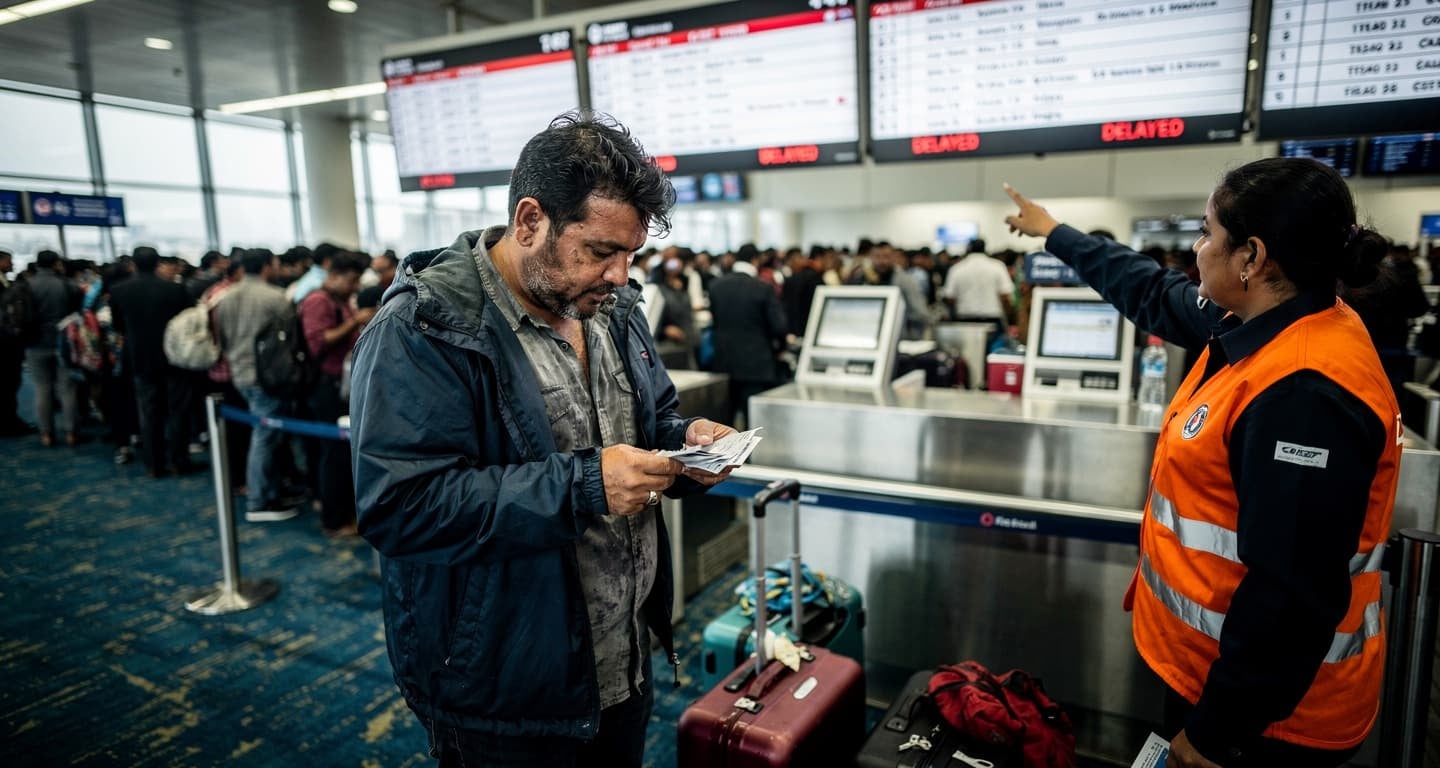
Quick summary
UK airlines have formally requested the Civil Aviation Authority suspend compensation rules for flight cancellations notified up to 14 days before departure, citing jet fuel shortages as Europe’s reserves drop to six weeks following the seven-week closure of the Strait of Hormuz. British Airways, TUI, and easyJet face heightened cancellation risks on Spain and Portugal routes from late May through summer 2026, with fares already up 40–75% as jet fuel prices have doubled since early March.
Travelers with existing bookings after May 25 face elevated risk — airlines would still provide full refunds under the proposed rule change, but the standard £220–£520 compensation for short-notice cancellations would be suspended. The International Energy Agency warns stockpiles could trigger emergency rationing if the strait remains closed beyond late May.
Airlines seek regulatory relief as fuel crisis escalates
Airlines UK, representing the UK’s major carriers, sent ministers and the Civil Aviation Authority a dossier on April 22 requesting suspension of UK261 compensation rules for cancellations announced within two weeks of departure. The move signals the industry expects significant disruption as Europe’s jet fuel buffer — currently at six weeks according to the International Energy Agency — continues to shrink with no resolution to the Strait of Hormuz blockade.
Iran closed the strait seven weeks ago in retaliation for US and Israeli strikes on nuclear facilities, cutting off 20% of global oil transit including the crude feedstock for 70% of Europe’s jet fuel. Refineries across the continent have been drawing down strategic reserves since early March, with UK facilities at Stanlow and Lindsey operating at reduced jet fuel output.
The compensation suspension request is part of a broader package that includes relief from Air Passenger Departure Duty and sustainable aviation fuel mandates. Under current UK261 rules, passengers receive £220–£520 depending on flight distance when cancellations occur fewer than 14 days before departure, unless airlines can prove extraordinary circumstances. The CAA has authority to declare the fuel shortage qualifies as such a circumstance, which would eliminate compensation obligations while maintaining the requirement for full refunds.
Scandinavian Airlines became the first major European carrier to announce capacity cuts in late March, citing doubled jet fuel costs. UK carriers have been protected by fuel hedging contracts secured before the crisis, but those hedges are exhausting as spot market prices reach $2.20 per litre — more than double the $1.05 rate from February.
A Government spokesman confirmed UK airlines “are not currently seeing a shortage of jet fuel” but acknowledged contingency planning is underway with fuel suppliers and international counterparts. The messaging contrasts sharply with warnings from the European Union, where Energy Commissioner Dan Jørgensen told media that “many people’s holidays will be affected, either by flight cancellations or very, very expensive tickets.”
| Route | Typical fare | Current fare | Increase |
|---|---|---|---|
| LGW–MAD (economy RT, June 10–17) | £89 | £156 | +75% |
| MAN–FAO (economy RT, June 10–17) | £142 | £245 | +73% |
| LHR–LIS (business RT, June 10–17) | £620 | £892 | +44% |
Flight deals
most people never see
Our AI monitors 150+ airlines for pricing anomalies that traditional search engines miss. Air Traveler Club members save $650 per trip per person on average: see how it works.
Each deal saves 40–80% vs. regular fares:

How the geopolitical standoff translates to flight disruptions
Iran’s closure of the Strait of Hormuz on March 5, 2026 blocked 21 million barrels per day of oil and tanker traffic — a fifth of global supply — in retaliation for coordinated US and Israeli strikes on Iranian nuclear sites. The action represents an escalation of 2025 tensions but stops short of full-scale war, leaving European airspace unaffected while severing the crude oil pipeline that feeds continental refineries.
Europe has no alternative feedstock source that scales quickly enough to replace 30% of its jet fuel crude. UK refineries at Stanlow and Lindsey are projected to reach 85% reduction in jet fuel output by June if the blockade continues. The International Energy Agency has indicated that emergency rationing would prioritize long-haul flights over short-haul European routes, as short-haul operations burn the most fuel per kilogram of payload.
Spain and Portugal routes face the highest cancellation risk because they represent the UK’s highest-frequency short-haul markets — easyJet operates 28 weekly flights from London Gatwick to Palma alone, while British Airways runs 21 weekly to Madrid. The fuel math forces airlines to cut these high-burn, lower-yield routes first to preserve long-haul networks that generate more revenue per litre consumed.
No bilateral aviation agreements have been broken, but the practical impact shows in current pricing: UK-Europe fares have risen 40% on average as airlines pass through an estimated £1.2 billion in additional fuel costs. Historical precedent from 2019 tanker attacks in the same strait — which raised European jet fuel prices 25% for three months — suggests normalization takes at least a quarter after the waterway reopens, assuming it does.
What to do if you have a summer booking
The window for proactive action closes rapidly as airlines finalize summer schedules and the CAA considers the compensation suspension request.
- Contact your airline immediately if your departure is after May 25. Request a free booking hold or upgrade to a refundable fare tier, citing the fuel crisis. British Airways, easyJet, and TUI have customer service lines and app-based chat — use whichever gets you through fastest.
- Monitor the CAA passenger rights page at caa.co.uk/passenger-rights daily for updates on the UK261 suspension. If approved, you lose compensation rights but retain full refund eligibility.
- Consider continental hub routing for new bookings. KLM via Amsterdam and Air France via Paris have different fuel reserve positions and lower exposure to UK refinery constraints. The extra £100–£200 in fare costs buys material risk reduction.
- Check package operator crisis pages if you booked through TUI or Jet2. Both have published guidance on credit conversions and rebooking windows — act before those windows close.
Watch: The International Energy Agency’s supply update on May 7, 2026 will reveal whether stockpiles have dropped below four weeks — the threshold that triggers EU emergency fuel rationing and forces 30%+ capacity cuts on UK-Europe routes.

Questions? Answers.
Will I still get a refund if my flight is cancelled under the proposed rule change?
Yes. The Airlines UK request seeks to suspend compensation payments (currently £220–£520 depending on distance) for cancellations notified up to 14 days before departure, but full refunds remain mandatory under both UK and EU law. You would receive your ticket cost back but lose the additional compensation that normally applies to short-notice cancellations.
Which routes face the highest cancellation risk?
UK-Spain and UK-Portugal routes carry the highest risk because they represent the UK’s most frequent short-haul markets and burn the most fuel per passenger relative to revenue. easyJet operates 28 weekly flights from London Gatwick to Palma, while British Airways runs 21 weekly to Madrid — these high-frequency, lower-yield routes are first to be cut when fuel becomes scarce.
How long will elevated fares last if the Strait of Hormuz reopens?
Historical precedent from 2019 tanker attacks in the same waterway suggests normalization takes at least three months after the strait reopens. Jet fuel prices rose 25% during that crisis and required a full quarter to return to baseline. Current price increases of 40–75% on UK-Europe routes indicate a longer recovery period — likely four to six months from the date of reopening.
Are flights from other European countries safer than UK departures?
Flights via Amsterdam, Paris, and Frankfurt hubs carry lower cancellation risk because Dutch, French, and German carriers have different fuel reserve positions and refinery access. KLM and Air France have not yet announced capacity cuts, while UK carriers are actively seeking regulatory relief. Booking through continental hubs adds £100–£200 but materially reduces disruption exposure for summer travel.