Quick summary
RECARO Aircraft Seating demonstrated AI-powered voice control for its R7 Horizon business class seat at the Aircraft Interiors Expo on April 18, 2026, allowing passengers to adjust seat positions using natural language commands in over 90 languages. The system responds to phrases like “I need to go to the bathroom” by moving the seat to upright position, addressing the growing complexity of premium seat controls that confuse even experienced travelers.
No airlines have confirmed orders yet — this remains a technology demonstrator. The R7 seat is reportedly compatible with Airbus A350, Boeing 787, and Airbus A330 aircraft.
Voice commands replace touchscreen fumbling on premium seats
Premium business class seats have become so complex that even aviation journalists struggle to adjust them. RECARO’s solution: let passengers talk to the seat instead of hunting through touchscreen menus or deciphering capacitive buttons that provide no physical feedback.
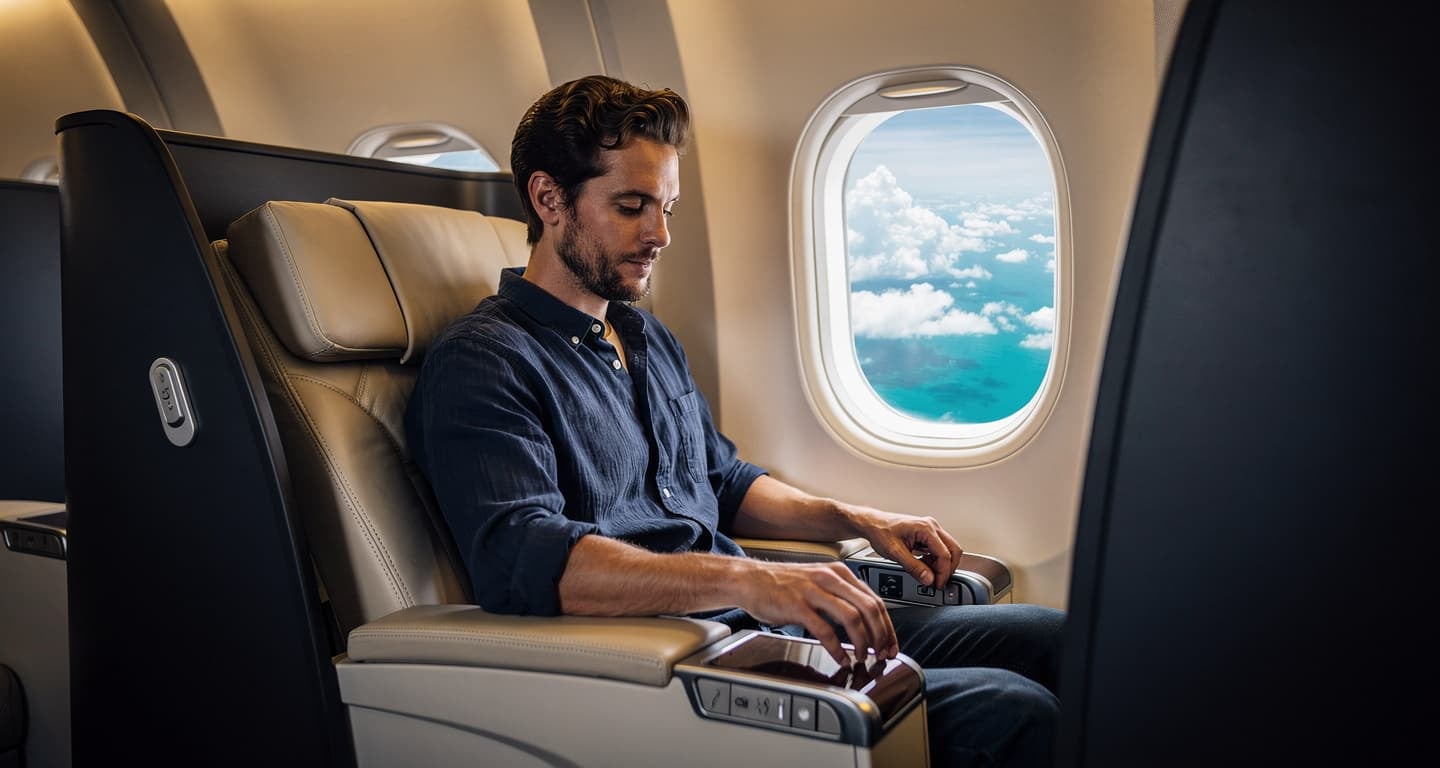
The R7 Horizon demonstrator unveiled at AIX features a dedicated button passengers press and hold while speaking. Seat accent lighting turns blue to indicate the system is listening. Once the passenger releases the button, the seat parses the command and moves accordingly.
Industry demonstrations showed the system understanding requests like “I want to watch a movie now” — moving the seat to a relaxed recline position — and “recline seat fully” for the flat-bed configuration. The microphone in the seat control panel handled background noise on the busy show floor without issue.
RECARO claims 90+ language support, though testing revealed mixed results with certain languages. The company has integrated the interface directly into the seat control panel rather than requiring passengers to download an app or connect their own devices.
A production version would need expanded feedback — potentially through the IFE system or voice confirmation — to verify the seat understood the request correctly. The current demonstrator provides no audio or visual confirmation beyond the seat’s physical movement.
The R7 seat itself converts to a 78-inch flat bed with privacy doors and dividers, reportedly compatible with widebody aircraft including the A350, 787, and A330. RECARO states the seat is 20% lighter than comparable business class products, though specific weight figures were not disclosed at the demonstration.
Access-IQ, an inclusive technology specialist, demonstrated a competing approach at the Unum booth — offloading voice control to passengers’ smartphones or connected watches rather than building it into the seat itself. That system required manual mapping of commands to seat positions, whereas RECARO’s AI interprets natural language requests without pre-programming.
The accessibility angle emerged as the most compelling use case during demonstrations. Passengers with low or no vision face significant challenges adjusting premium seats that rely on touchscreens or unmarked capacitive buttons. Voice control eliminates the need to locate and interpret visual controls entirely.
RECARO’s official press materials focused on convenience rather than accessibility, but the company’s AIX announcement positions the R7 Horizon as part of a broader push toward intuitive cabin technology.
| Feature | Specification | Status |
|---|---|---|
| Language support | 90+ languages | Demonstrated at AIX |
| Aircraft compatibility | A350, 787, A330 | Reported by industry sources |
| Bed length | 78 inches | Confirmed by RECARO |
| Airline orders | None confirmed | Technology demonstrator only |
Flight deals
most people never see
Our AI monitors 150+ airlines for pricing anomalies that traditional search engines miss. Air Traveler Club members save $650 per trip per person on average: see how it works.
Each deal saves 40–80% vs. regular fares:

Why voice control solves a real problem premium cabins created
Premium seat manufacturers have spent two decades adding features — privacy dividers, adjustable lumbar support, massage functions, reading lights with multiple brightness levels, USB ports in six locations. Each addition required another button, another menu layer, another touchscreen swipe.
The result: seats that require a manual to operate. Passengers boarding overnight flights from Sydney to Tokyo spend the first 20 minutes figuring out how to recline, then give up on adjusting the footrest because they can’t find the right icon.
RECARO’s voice system doesn’t add complexity — it removes the interface entirely. “Make the seat flat” works regardless of whether the passenger knows the difference between “bed mode” and “full recline” in the touchscreen menu.
The competitive picture remains unclear. RECARO has not disclosed which airlines are evaluating the R7 Horizon, and no carriers have announced orders. The seat targets widebody routes where business class generates the highest per-passenger revenue — think Singapore Airlines on the Kangaroo Route or Emirates on Dubai–Los Angeles.
For context, Japan Airlines operates the only 787 fleet with 8-abreast economy seating flying from Australia, offering roughly 48cm of seat width versus the standard 43cm — a significant comfort upgrade that influences booking decisions when fares are within $100–200 AUD. Premium cabin differentiation works the same way: airlines that deploy genuinely better seats can command higher fares or stronger loyalty.
ATC views RECARO’s AI voice control as a practical fix for premium seat complexity, unlike gimmicky AI elsewhere, and predicts 2–3 major airlines will certify it for A350/787 suites by mid-2027. Adoption accelerates if Lumina Sync jetlag tech pairs with it, pressuring rivals like Safran or Zodiac to match. Expect 20–30% of new business class installs to include voice by 2028, prioritizing non-touch interfaces.
What to do
The R7 Horizon remains a demonstrator with no confirmed airline orders, so no immediate booking decisions are required.
- Track future announcements: Visit RECARO’s R7 product page for updates on airline partnerships and certification timelines.
- Prioritize accessibility features: When booking premium cabins, ask airlines whether seats include voice control or other accessibility enhancements — particularly relevant for travelers with vision or mobility limitations.
- Monitor widebody retrofits: Airlines typically announce premium cabin upgrades 12–18 months before installation. Watch for A350, 787, and A330 fleet announcements from carriers operating Asia-Pacific routes.
- Compare seat specs: Use SeatGuru or airline seat maps to identify which aircraft in a carrier’s fleet have newer business class products — voice control will likely debut on flagship routes first.
Watch: Future airline orders of the R7 Horizon, potentially at major air shows, which would signal a commercial rollout.

Questions? Answers.
Which airlines have ordered the RECARO R7 with voice control?
None as of April 2026. The R7 Horizon is a technology demonstrator shown at AIX with no confirmed airline customers or installation timeline.
Does voice control work in all languages?
RECARO claims support for over 90 languages, though testing at AIX showed mixed accuracy with certain languages. The system interprets natural language commands rather than requiring specific phrases.
Can passengers opt out of voice control?
Privacy details have not been disclosed. The system requires pressing a button to activate, so passengers can choose not to use it and rely on traditional seat controls instead.
Which aircraft types can install the R7 seat?
The R7 is reportedly compatible with Airbus A350, Boeing 787, and Airbus A330 widebody aircraft, though RECARO has not published official certification documentation.