Quick summary
JetBlue has filed an exemption request with the FAA seeking a 12-month extension — through July 31, 2027 — on the requirement to install Installed Physical Secondary Barriers (IPSBs) on its Airbus A220 fleet. Airbus has confirmed it will not complete A220 IPSB certification until sometime between July and September 2026, missing the federal July 31, 2026 deadline. JetBlue operates around 62 A220s, and without the exemption, those aircraft face potential grounding.
The FAA exemption decision is expected in late June 2026. Passengers with A220 bookings after July 31 should verify their aircraft type now — the window to rebook fee-free is open, but it won’t stay that way.
JetBlue is asking the FAA for a full year’s relief from a federal cockpit security mandate after Airbus confirmed it cannot certify the required anti-terror barrier for the A220 before the July 31, 2026 deadline. The carrier’s exemption petition, filed with the Department of Transportation, requests an extension through July 31, 2027 — or until compliant IPSBs are installed across the affected fleet, whichever comes first.
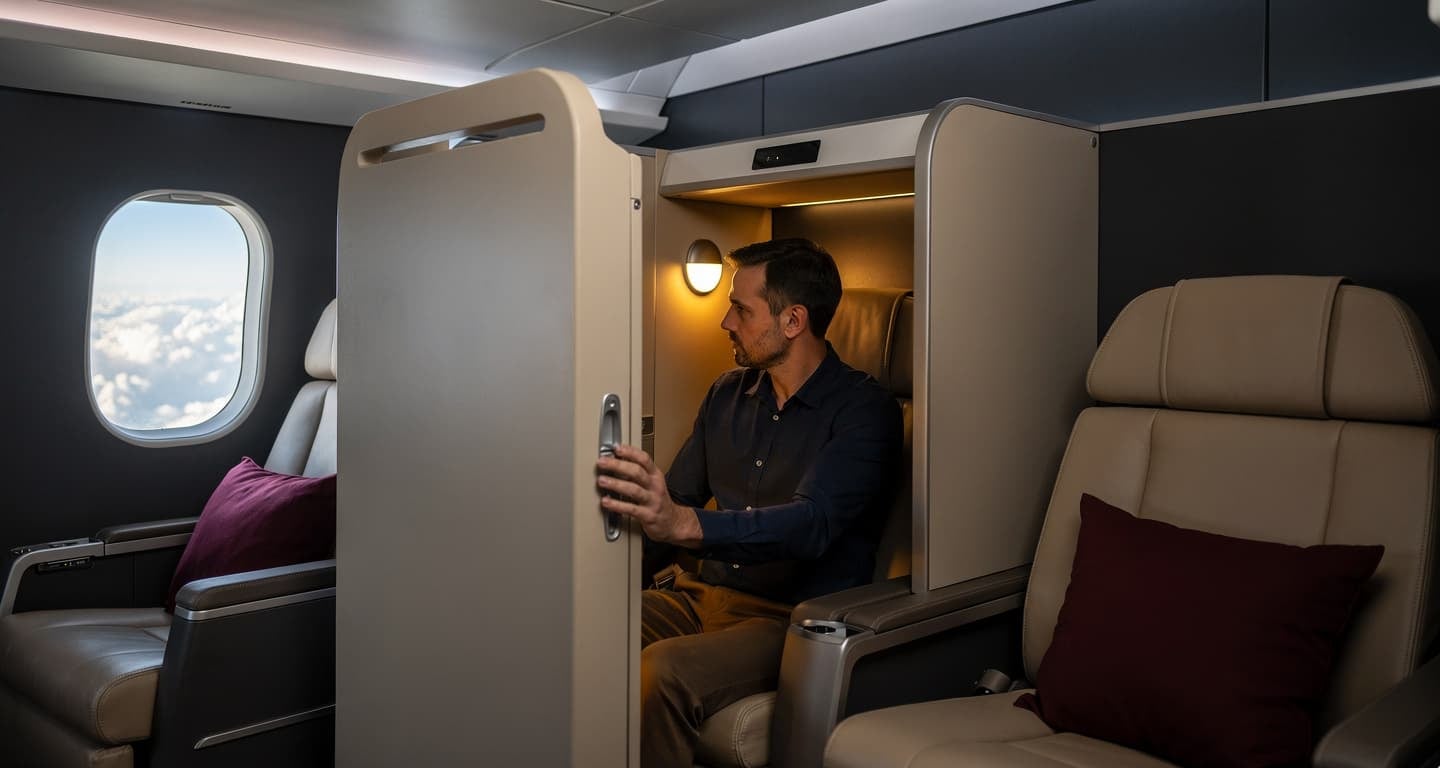
The regulation at issue, codified under 14 CFR §25.795, requires all new passenger aircraft delivered to U.S. carriers after August 25, 2025 to have an IPSB installed by the July deadline. The IPSB is a lightweight deployable barrier positioned between the forward galley and the primary cockpit door, designed to prevent unauthorized access during the brief window when pilots open that door in flight — to use the lavatory, for instance. It is not bulletproof or blast-resistant; it buys seconds, not minutes. But those seconds are the point.
JetBlue’s problem is not regulatory reluctance. Airbus has cited “unforeseen delays” in certification testing and significant supply chain constraints affecting IPSB components for both new-production and in-service A220s. The specialized lightweight alloy required for the barrier has faced sourcing problems that have forced Airbus to seek new suppliers entirely.
In the interim, JetBlue says it will continue using an Improvised Non-Installed Secondary Barrier (INSB) — the industry’s formal term for a beverage cart positioned in front of the cockpit door. That has been standard U.S. practice for years, and the FAA has accepted it as a temporary compliance measure while the IPSB mandate rolls out.
The FAA decision is expected in late June 2026. If the exemption is denied, JetBlue faces grounding its A220 fleet — a scenario that would remove significant capacity from Northeast and Florida markets at the height of summer travel.
What the certification delay actually means for JetBlue’s schedule
Airbus Canada now projects A220 IPSB certification will land somewhere between July and September 2026. Even if that timeline holds at the optimistic end, the installation process cannot begin immediately after approval. Because the post-certification installation period runs approximately 210 days, JetBlue cannot realistically complete fleet-wide compliance until early 2027 — and that is only if the exemption is granted and certification arrives on schedule. Full fleet compliance, if the process proceeds without further delays, is a projected outcome for mid-2027 at the earliest.
The immediate crisis is simpler: the July 31 deadline arrives before certification does. JetBlue cannot install a device that hasn’t been certified. That is the core of the exemption argument, and it is the same argument that Delta Air Lines and Breeze Airways — the other two U.S. operators of the A220 — are likely navigating as well. JetBlue’s petition covers only its own fleet, but the underlying Airbus certification problem affects every U.S. A220 operator equally.
Regulatory filings and industry reporting confirm that the supply chain constraints are not a JetBlue-specific issue — they are an Airbus-level problem that has cascaded down to every carrier operating the type.
| Date | Event | Impact on travelers |
|---|---|---|
| August 25, 2025 | FAA IPSB mandate takes effect for new aircraft deliveries | All A220s delivered from this date require IPSB by July 31, 2026 |
| July 31, 2026 | FAA installation deadline | Non-compliant A220s face grounding if exemption denied |
| Late June 2026 | FAA exemption decision expected | Approval = no disruption; denial = potential A220 groundings Q3 2026 |
| July–September 2026 | Airbus projects A220 IPSB certification | Earliest point at which factory installations can begin |
| Early 2027 | Post-certification installation period (~210 days) concludes | New-production A220s compliant; retrofit schedule follows |
| Mid-2027 | Projected full JetBlue fleet compliance (if exemption granted) | All affected A220s compliant; normal operations resume |
Flight deals
most people never see
Our AI monitors 150+ airlines for pricing anomalies that traditional search engines miss. Air Traveler Club members save $650 per trip per person on average: see how it works.
Each deal saves 40–80% vs. regular fares:

Why the IPSB mandate took 25 years — and why the deadline still bites
The push for secondary cockpit barriers traces directly to the September 11, 2001 attacks. Congress authorized the requirement in the 2018 FAA Authorization Act, but rulemaking stalled for years under industry pressure. The FAA finally issued the compliance order in 2023, giving airlines a two-year runway — then extended it by 11 months after lobbying from carriers and aviation groups. The result is a July 31, 2026 hard stop that arrived before the hardware did.
That gap between regulatory deadline and supply chain reality is the story here. Southwest Airlines became the first U.S. carrier to operate with an IPSB installed when it took delivery of a Boeing 737 MAX with the barrier fitted at the factory in August 2025 — and notably began using it immediately rather than waiting for the exemption period to expire. Boeing’s IPSB certification was completed ahead of schedule. Airbus’s was not.
The A220’s smaller fuselage cross-section creates genuine engineering constraints that larger narrowbodies don’t face — the barrier must fit within tighter galley geometry while meeting the same structural standards. That is not an excuse; it is the mechanism explaining why the Boeing solution didn’t translate directly to the Airbus program.
Steps to protect your JetBlue booking before the deadline
The FAA decision arrives in late June 2026 — roughly six weeks before the July 31 compliance deadline — leaving almost no time to rebook if the exemption is denied and groundings begin.
- Check your aircraft type now: Visit jetblue.com/manage-flights and look up your flight equipment. A220 operations typically show the aircraft type in booking details. If your flight is post-July 31 and operates on an A220, you are in the affected window.
- Request fee-free rebooking proactively: JetBlue’s current policy allows fee-free changes when operational uncertainty is documented. Call 1-800-JETBLUE or use the app — do not wait for a cancellation notice, because rebooking options narrow fast when capacity is pulled.
- Price alternatives on competing carriers: For Northeast–Florida routes, Delta and American Airlines both operate the corridor. Use Google Flights to compare — fares on those carriers could rise if JetBlue capacity disappears, so locking in now costs less than waiting. Note that EU261 protections do not apply on U.S. domestic routes, but DOT rules do mandate full refunds for cancelled flights.
- Monitor the FAA decision directly: The FAA publishes exemption decisions at faa.gov/regulations_policies. A denial will be public record before JetBlue communicates it to passengers.
Watch: The FAA exemption ruling in late June 2026 is the single most important signal. If granted, no action required. If denied, expect JetBlue to announce a mitigation plan within days — and expect competing carriers to fill seats quickly.

Questions? Answers.
What is an IPSB and why does it matter for cockpit security?
An Installed Physical Secondary Barrier is a lightweight deployable barrier positioned between the forward galley and the primary cockpit door. It is deployed whenever the cockpit door opens in flight — typically when a pilot needs to use the lavatory — to prevent unauthorized access during that brief window. It is not bulletproof or blast-resistant; its purpose is to delay an intruder for the seconds needed to resecure the primary door. The current alternative, a beverage cart, serves the same function but is less structurally reliable.
Will JetBlue flights actually be grounded if the exemption is denied?
Only A220s delivered after August 25, 2025 are subject to the mandate — not JetBlue’s entire fleet. However, JetBlue operates around 62 A220s, and those delivered in the post-August 2025 window would be non-compliant without an exemption. The FAA could impose fines, restrict operations, or require grounding of affected aircraft. JetBlue has stated it will continue using beverage carts as an interim measure, but whether the FAA accepts that as sufficient compliance after July 31 depends entirely on the exemption decision.
Are Delta and Breeze Airways facing the same problem?
Yes. Both Delta Air Lines and Breeze Airways operate the Airbus A220 in the United States, and the Airbus certification delay affects all A220 operators equally. JetBlue’s exemption petition covers only its own fleet — Delta and Breeze would need to file separately. Industry observers expect similar petitions from both carriers, given that the underlying supply chain constraint is an Airbus-level issue, not carrier-specific.
Does this affect JetBlue’s international routes?
The IPSB mandate under 14 CFR §25.795 applies to U.S.-registered commercial passenger aircraft. JetBlue’s A220s primarily serve domestic U.S. routes — Northeast corridors and Florida markets — rather than transatlantic or Caribbean long-haul operations, which use different aircraft types. The disruption risk is concentrated on domestic routes, particularly Boston, New York, Fort Lauderdale, Miami, and Orlando connections.