Quick summary
A Houston man, Abdulrahman Oluwatumike Oriyomi, 25, has been charged with a Texas felony after allegedly using a fake boarding pass to pass through the TSA checkpoint at George Bush Intercontinental Airport (IAH) and board United Airlines Flight 469 to Los Angeles on May 18, 2026 — without a ticket, without a scannable QR code, and without being stopped until a flight attendant noticed he had no assigned seat after the aircraft was already taxiing. The plane returned to the gate, all passengers were deplaned, and airport police, an explosives unit, and the FBI responded. The delay ran approximately three hours.
The fake boarding pass recovered from his phone was missing key data fields and had no QR code — yet he still cleared a federal checkpoint and two gate attempts. That is the part that should concern every traveler transiting IAH.
This is not a story about one man slipping through a crack. It is a story about a system failing at three separate checkpoints in sequence — and a flight attendant being the last line of defense at 30 knots on a taxiway.
On May 18, 2026, Oriyomi approached the Terminal C TSA checkpoint at IAH with a boarding pass that was already causing problems. Agents flagged the document, then let him through anyway. Inside the sterile area, he spent time observing how gate agents scanned boarding passes, attempted to board at least one other Los Angeles-bound flight, was turned away after the barcode failed to scan, argued with United Airlines staff — and still was not removed from the airport.
He then moved to a second gate, waited for a moment of distraction, and walked onto United Flight 469.
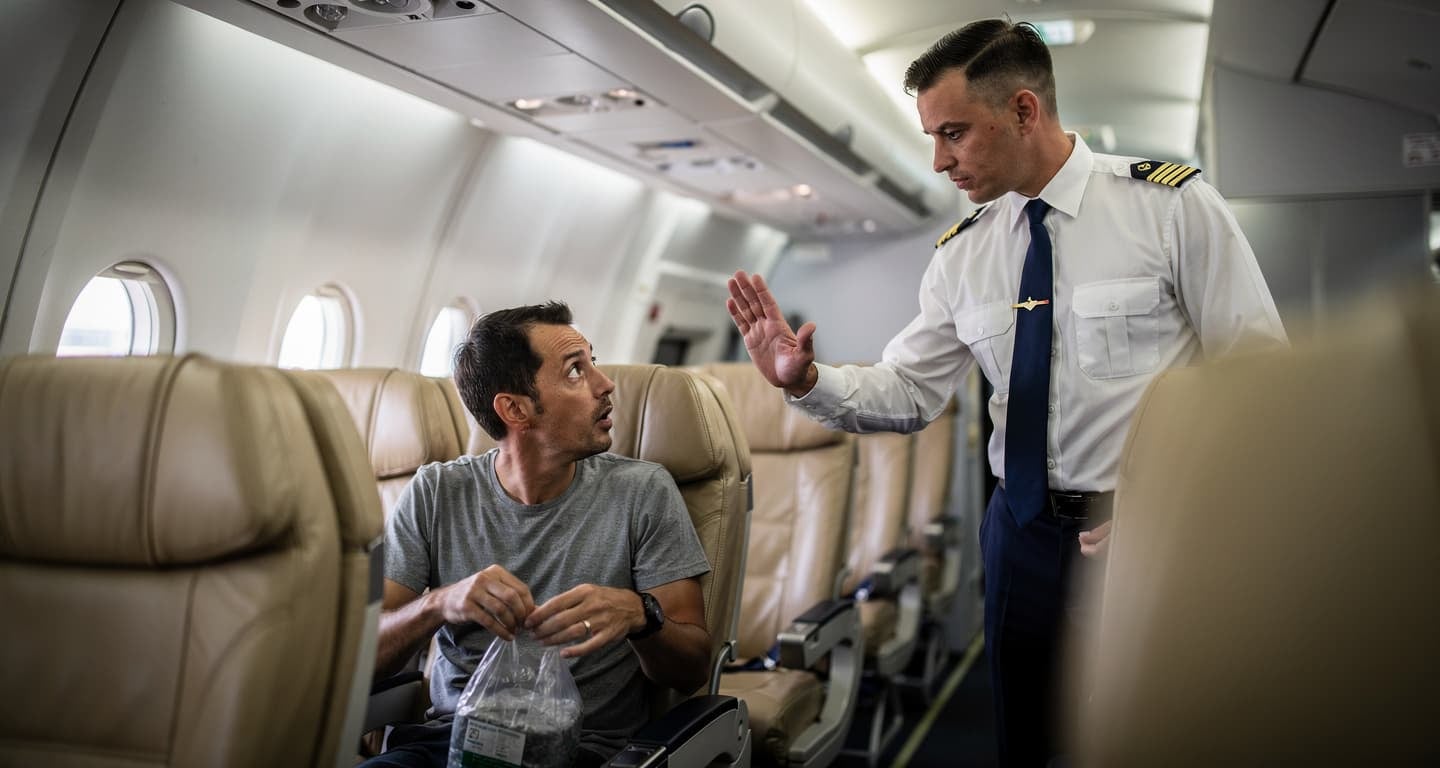
Once aboard, he hid in the aircraft lavatory and moved between restrooms. A fellow passenger alerted crew. When a flight attendant checked the manifest and found no record of him — every seat was taken and he had asked about sitting in a jumpseat — the captain turned the aircraft around. Houston Police, an explosives unit, and the FBI met the plane at the gate. Oriyomi now faces a felony charge of impairing or interrupting the operation of a critical infrastructure facility under Texas law. Prosecutors have sought surrender of his travel documents, a ban from airports, and possible electronic monitoring.
How a document with no QR code cleared federal screening
The boarding pass recovered from Oriyomi’s phone was, by any technical standard, obviously fraudulent. Criminal records confirm it lacked key information fields and had no QR code — the machine-readable element that gate scanners and TSA document-check systems are specifically designed to verify. A valid United Airlines mobile boarding pass generates a scannable Aztec or QR barcode tied to the passenger name record in the airline’s departure control system. Without it, the document cannot be authenticated electronically.
Yet it cleared a federal checkpoint.
Media reports confirm the flight delay ran approximately three hours and triggered a multi-agency response involving Houston Police, airport authorities, an explosives unit, and the FBI — a cascade that a single document verification failure set in motion. For the passengers on Flight 469, that meant full deplaning, a security sweep of the cabin and all baggage, and the kind of disruption that can blow connecting flights at LAX and beyond. You can review TSA‘s official checkpoint screening requirements to understand what federal standards actually demand at document check.
This incident follows a separate United Airlines security event on May 30, 2026, when a passenger attempted to breach the cockpit on a Chicago–Minneapolis flight, prompting a Level 4 threat declaration and immediate diversion — the highest classification in aviation’s unruly-passenger framework. Two serious security failures on United within two weeks is a pattern regulators will not ignore.
| Stage | What happened | System that failed |
|---|---|---|
| TSA checkpoint, Terminal C | Oriyomi flagged for boarding pass issues; allowed into sterile area | Federal document verification |
| First gate attempt (LAX-bound) | Fake boarding pass failed to scan; Oriyomi argued with staff, was turned away | Gate agent follow-through (not escorted out) |
| Second gate — Flight 469 | Oriyomi observed agent patterns, boarded during distraction | Gate boarding control |
| Onboard — taxiway | Hid in lavatory; fellow passenger alerted crew; manifest check confirmed no record | Pre-departure headcount / manifest reconciliation |
| Aircraft return to gate | Full deplaning, explosives sweep, FBI response; ~3-hour delay | N/A — system caught failure here |
Flight deals
most people never see
Our AI monitors 150+ airlines for pricing anomalies that traditional search engines miss. Air Traveler Club members save $650 per trip per person on average: see how it works.
Each deal saves 40–80% vs. regular fares:

What the regulatory framework requires — and where it broke down
TSA, operating under the Department of Homeland Security and 49 CFR Parts 1500–1699, is required to verify that every passenger entering a sterile area holds a valid, scannable boarding pass matched to acceptable ID. That is not a guideline — it is a federal standard with civil penalty exposure for airports and carriers that fail to maintain compliant security programs. The FAA, under 14 CFR Part 139, certifies airports for commercial service and coordinates with TSA on airport security programs; failures like this one can trigger mandated corrective actions, additional inspections, and, in repeated cases, changes to the airport’s approved security plan.
What the IAH incident exposed is the gap between what the standard requires and what human operators actually execute under real-world gate pressure. Oriyomi’s document failed electronically at one gate. Staff turned him away but did not remove him from the secure area — a procedural step that TSA’s own standard operating procedures require. That omission gave him the time and access to study gate patterns and try again.
The traveler mistakes that compound these situations are predictable. Passengers with legitimately non-scanning mobile passes sometimes insist on repeated scan attempts rather than going immediately to a kiosk for a reprint — drawing scrutiny and slowing boarding. Others leave the gate area during a security hold without confirming reboarding requirements, missing re-screening windows and forfeiting seats. And travelers who rebook independently on another carrier during a security delay often find carriers deny reimbursement; the correct move is to work through United’s app or gate agents so any new itinerary stays within the original ticket record.
Steps to protect your IAH departure right now
Post-incident tightening at IAH is already underway informally, and formal TSA corrective measures are expected — meaning document scrutiny at Terminal C checkpoints and United gates is higher than normal and will likely stay elevated for weeks.
- Arrive earlier than usual at IAH: Build in an extra 30–60 minutes beyond your normal buffer for the next several days. Secondary screening and additional ID checks are running longer at Terminal C checkpoints following the incident.
- Verify your boarding pass barcode before leaving home: Open the United app, confirm the Aztec barcode renders clearly, and screenshot it as a backup. If the code appears distorted or fails to scan at the checkpoint, go directly to a United kiosk or counter for a reprint — do not insist on repeated scan attempts, which draws additional scrutiny.
- Stay in the gate area during any security hold: If your aircraft returns to the gate or boarding is suspended for a security check, remain near the gate and keep your ID and boarding pass accessible. Leaving the secure area can require full re-screening and may cause you to miss updated boarding times.
- Use same-ticket itineraries when connecting through IAH: If a security-related delay causes a misconnect, same-ticket bookings on United or Star Alliance partners allow gate agents to reprotect you automatically. Separate tickets leave you exposed.
- Rebook through United channels only during disruptions: If your flight is held or cancelled due to a security event, use the United app, 1-800-864-8331, or gate agents — not a competing carrier’s website. Independent rebooking during a security hold is routinely denied for reimbursement.
Watch: An official TSA or Department of Homeland Security statement specifically referencing checkpoint procedural changes at IAH — expected in the coming weeks. If it appears, formal corrective measures are in place and queue times will increase. If it does not, expect quieter, airline-driven tightening at United gates without public timelines. Watch also for any United internal memo on enhanced boarding-pass verification at IAH; if published, front-line staff will apply stricter controls and may deny boarding when names or barcodes do not match exactly.
Questions? Answers.
How did Oriyomi get through TSA with a fake boarding pass that had no QR code?
Criminal records confirm the document lacked key data fields and a QR code. TSA agents flagged the pass at the Terminal C checkpoint but allowed him into the sterile area anyway — a human override of the electronic verification process. TSA’s standard operating procedures require removal from the sterile area when a document cannot be authenticated; that step did not occur.
What charge does Oriyomi face, and how serious is it?
He faces a Texas state felony charge of impairing or interrupting the operation of a critical infrastructure facility. Prosecutors have sought bond conditions including surrender of travel documents, a ban from airports, and possible electronic monitoring. Federal charges have not been publicly confirmed as of the date of this report.
Will this incident affect other United flights at IAH beyond Flight 469?
Yes, indirectly. The three-hour delay affected the Flight 469 aircraft’s subsequent rotations, and tighter post-incident document checks at Terminal C gates are slowing boarding across departures. Travelers connecting through IAH on United or Star Alliance partners should build additional connection buffer and monitor flight status via the United app.
What should I do if my legitimate boarding pass won’t scan at IAH right now?
Go immediately to a United kiosk or staffed counter for a reprinted boarding pass — do not insist on repeated scan attempts at the gate. With post-incident scrutiny elevated, a non-scanning barcode will draw additional secondary screening. A fresh printed pass resolves the issue faster and avoids the appearance of a document problem.
Is IAH considered a high-risk airport after this incident?
No formal elevated threat designation has been issued for IAH. However, the multi-agency response — Houston Police, explosives unit, FBI — confirms the incident was treated as a serious security breach. TSA and the airport operator are reviewing CCTV, checkpoint logs, and gate procedures. Corrective actions, if mandated, will be communicated through official TSA or DHS channels.