Quick summary
Bhutan’s 5% Goods and Services Tax (GST) on all tourism services takes effect January 1, 2026, raising the base cost of mandatory tour packages for every international visitor. The tax applies to hotels, guides, transport, and meals. The USD 100/night Sustainable Development Fee and USD 40 visa fee are exempt. Net cost impact is estimated at 2–4% per trip, not the full 5%, because the GST replaces a prior 10% sales tax on accommodation and food.
The real risk isn’t the tax itself — it’s operators who bury it inside a lump-sum quote. Travelers booking 2026 Bhutan trips need itemized quotes before paying a deposit.
Every international tourist entering Bhutan in 2026 will pay more — not because the government raised its headline fees, but because a new tax layer now sits on top of every service inside your mandatory tour package. Bhutan’s GST Amendment Law 2025 replaces a fragmented sales tax structure with a flat 5% GST on hotels, private guides, ground transport, and meals, effective January 1, 2026. The old system taxed accommodation and restaurants at 10% while leaving guide and transport fees largely untaxed. The net effect is mixed: lodging and food costs may actually fall slightly, while guide and transport fees rise. Operator estimates put the overall trip cost increase at 2–4%, not 5%. That’s manageable. What isn’t manageable is receiving a quote that hides the GST inside a single total — because then you have no way to verify you’re being charged correctly, or at all.
Flight deals
most people never see
Our AI monitors 150+ airlines for pricing anomalies that traditional search engines miss. Air Traveler Club members save $650 per trip per person on average: see how it works.
Each deal saves 40–80% vs. regular fares:

What the GST actually covers — and what it doesn’t
The 5% rate applies to all in-country tourism services: hotel accommodation, licensed guides, private vehicles, and included meals. It does not apply to international airfare on Drukair or Bhutan Airlines. The USD 100/night Sustainable Development Fee remains fully exempt, as does the USD 40 visa fee. These two charges, which represent the largest fixed costs for most visitors, are untouched.
Bhutanese tour operators above Nu. 5 million annual turnover are required to register for GST and collect it from clients. Operators between Nu. 2.5 million and Nu. 5 million may register voluntarily. Every registered operator must itemize GST separately on invoices — it cannot legally be absorbed into a bundled price without disclosure. If your quote shows a single all-inclusive figure with no GST line, that’s a compliance red flag, not a bargain.
There are no GST refunds for tourists on services consumed inside Bhutan. This is not a VAT refund scheme like those in the EU or Australia. What you pay stays paid. Late payment penalties for operators run at 15% annually, which means compliant operators have strong incentive to collect correctly — and pass that cost to you transparently.
For travelers whose 2026 trip straddles the January 1 cutover — arriving in late December and departing in January — operators must apply the old sales tax to pre-January services and GST to post-January services, with a clear split on the invoice. Verify this before you travel, not after.
KPMG’s full analysis of Bhutan’s GST regime covers operator registration obligations, nonresident rules, and penalty structures in detail.
Why this matters beyond the extra line item
Bhutan has always been an expensive destination by design. The SDF alone costs USD 100 per person per night — a deliberate policy to limit visitor numbers and fund conservation. A 2–4% GST increase on top of that is not going to price out travelers who were already committed to the destination. The real issue is transparency and trust.
Bhutan’s tourism market is small, relationship-driven, and largely opaque to outside comparison. Unlike booking a hotel in Bangkok where you can cross-check rates on a dozen platforms, Bhutan packages are quoted directly by licensed operators with limited external benchmarking. That opacity makes it easy for a non-itemized quote to obscure whether GST has been correctly applied, over-applied, or quietly pocketed. Insisting on a line-by-line breakdown isn’t being difficult — it’s the only way to know what you’re actually paying for.
The GST also signals Bhutan’s broader economic modernization. The new Bhutan Integrated Tax System (BITS) platform, which operators use to file and remit GST, aligns the country with standard VAT frameworks used across Asia. For travelers, that means more formal invoicing and better paper trails — useful if disputes arise.
What to do before booking a 2026 Bhutan trip
- Request a fully itemized 2026 quote from your Bhutanese operator — the GST must appear as a separate line, not folded into a package total. If it isn’t there, ask explicitly before paying any deposit.
- Verify your operator’s GST registration status before transferring funds. Registered operators are legally required to issue compliant invoices; unregistered operators collecting GST anyway are a compliance risk that could create payment disputes.
- If your trip crosses January 1, 2026, confirm in writing how the operator will split pre- and post-GST services on your invoice.
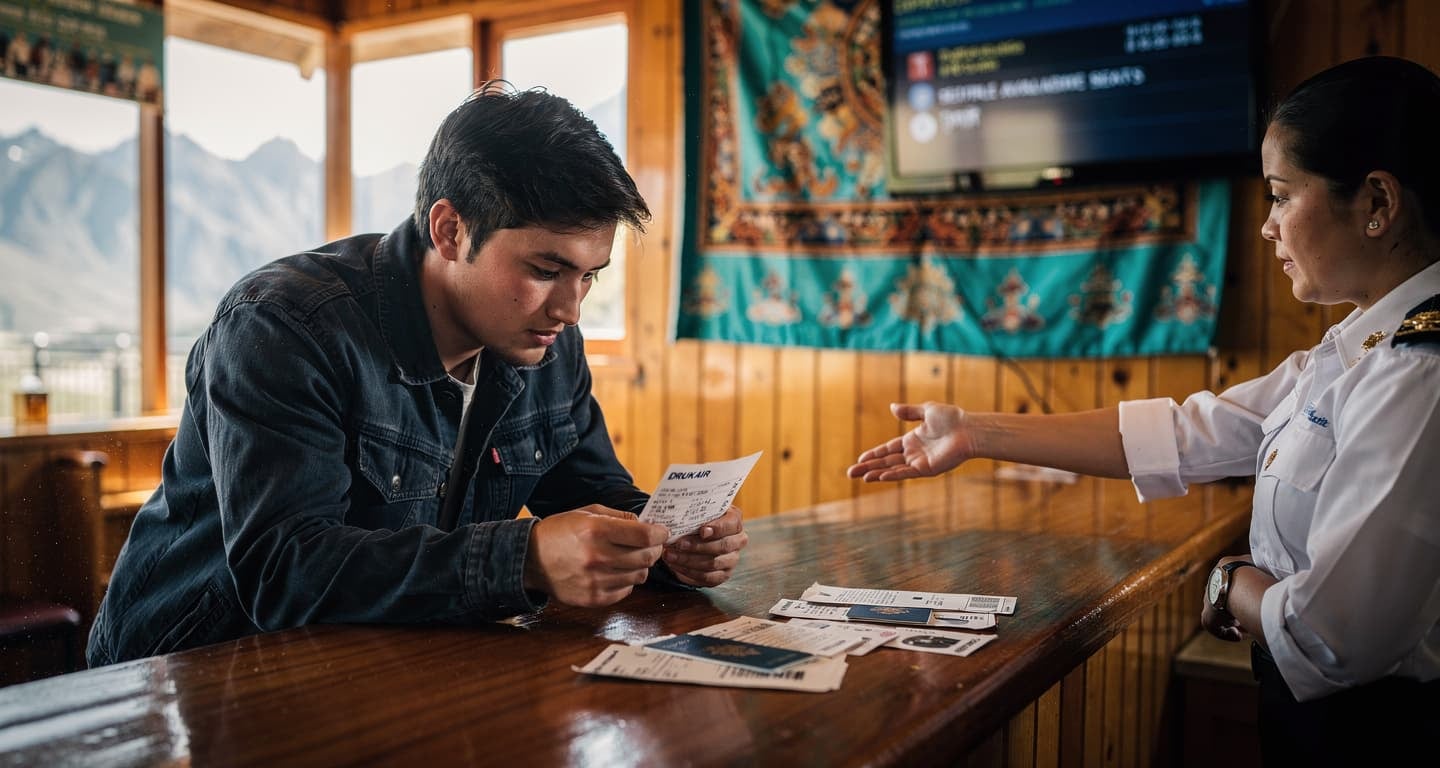
- Confirm international airfare on Drukair or Bhutan Airlines is quoted separately and GST-exempt — it should be, but verify.
Questions? Answers.
Will the GST push my total Bhutan trip cost up by exactly 5%?
No. The GST replaces a prior 10% sales tax that applied to hotels and restaurants. Accommodation and food costs may actually decrease slightly under the new rate, while guide and transport fees — previously untaxed — will rise. Operator estimates put the net increase at 2–4% depending on your itinerary. Longer trips with more guide-intensive days will sit toward the higher end.
Do Indian nationals or regional travelers face the same GST?
Yes, GST applies to in-country tourism services for all international visitors regardless of nationality. Indian nationals retain their existing exemptions from the SDF and visa fee, but the 5% GST on package services applies equally. The GST is a consumption tax on services rendered inside Bhutan, not an entry fee.
My trip starts before January 1 but ends after. How is GST applied?
Services delivered before January 1, 2026 fall under the old sales tax rules. Services from January 1 onward are subject to the new 5% GST. Your operator is required to itemize the split clearly on your invoice. If they present a single blended total without this breakdown, request a corrected invoice before departure.
Can I get a GST refund when I leave Bhutan?
No. Bhutan does not operate a tourist VAT refund scheme. GST paid on services consumed inside the country is non-refundable. This is standard for service-based taxes globally — VAT refunds typically apply only to goods exported, not services used in-country.