Quick summary
India’s DigiYatra biometric system now accepts foreign nationals at Delhi and Bengaluru airports, cutting immigration wait times from 60-90 minutes to under 5 minutes. The e-passport pilot uses automated kiosks before the immigration hall — enroll on arrival, scan your chip passport, proceed to e-gates. As of February 2026, the system has processed 77 million journeys across 24 airports, with 19 million active users.
The catch: you need an e-passport with a functioning chip, and the pilot is currently limited to Delhi (DEL) and Bengaluru (BLR) for international arrivals. Six additional airports activated biometric boarding in February 2026, but foreign arrival enrollment remains in final testing. Your biometric template deletes automatically after 24 hours.
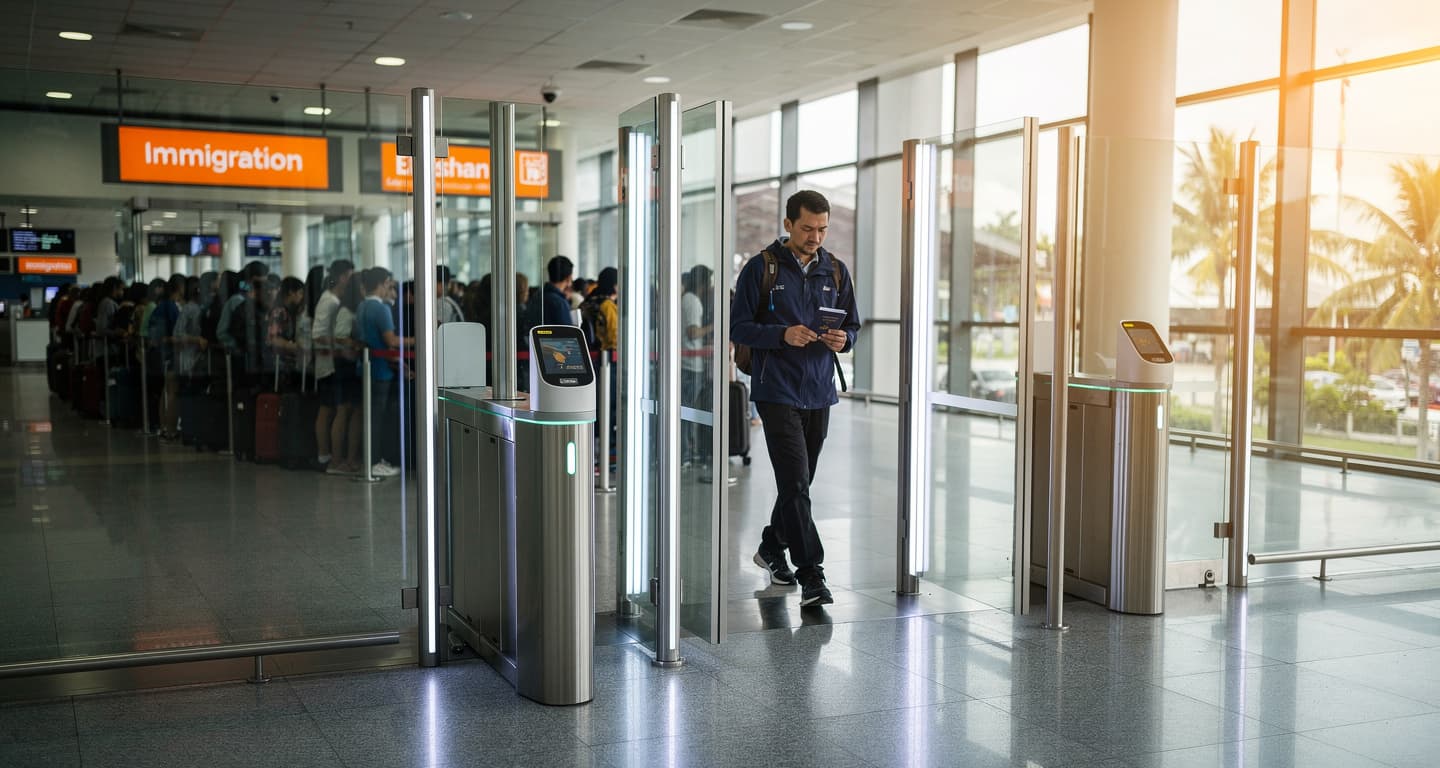
Foreign passport holders arriving at Delhi or Bengaluru can now bypass India’s notoriously slow manual immigration queues using DigiYatra’s automated e-gates. The system saves 55-85 minutes per arrival during peak morning banks when manual counters routinely back up to 90-minute waits. Look for enrollment kiosks on the arrival level before you reach the immigration hall — the entire process takes 3-4 minutes.
Air Traveler Club’s February 2026 analysis of India’s biometric expansion shows the e-passport pilot is now processing international arrivals at two hubs, with six additional airports activating domestic biometric boarding on February 21, 2026: Surat (STV), Vijayawada (VGA), Mangaluru (IXE), Thiruvananthapuram (TRV), Navi Mumbai (NMIA), and Nagpur (NAG). Foreign enrollment at these new sites awaits final Home Ministry data-sharing approval, expected within 3-6 months.
The system works identically to Australia’s SmartGate or the US Mobile Passport Control — scan your e-passport chip at a kiosk, capture a facial biometric, receive a printed ticket, then proceed to dedicated automated gates. No pre-registration required. No app download mandatory for the arrival process, though the DigiYatra mobile app streamlines domestic connections if you’re continuing within India.
How the enrollment process works at Delhi and Bengaluru
DigiYatra kiosks sit in the arrival corridor between your aircraft gate and the immigration hall. You’ll see signage directing e-passport holders to the automated enrollment area — it’s separate from the manual queue lines. The kiosk reads your passport’s RFID chip, captures a live facial scan, and prints a ticket with a QR code. Total time: 2-3 minutes.
Walk to the e-gates section with your printed ticket and passport. The gate scans your QR code, verifies your face against the biometric you just enrolled, checks your passport chip a second time, and opens. No officer interaction required. Your biometric template stores in India’s DigiLocker system for 24 hours, then auto-deletes — this isn’t a permanent enrollment like Global Entry or Registered Traveler programs.
If you’re connecting to a domestic Indian flight on the same trip, download the DigiYatra app before departure. Upload your international boarding pass PDF and your onward domestic ticket. The app generates a single QR code that works at security checkpoints and domestic boarding gates at all 24 participating airports. IndiGo and Air India passengers can link boarding passes directly through their carrier apps, skipping the manual upload step.
Which airports support foreign enrollment right now
Only Delhi (DEL) and Bengaluru (BLR) currently process international arrivals through DigiYatra e-gates. The February 2026 expansion to six additional airports — Surat, Vijayawada, Mangaluru, Thiruvananthapuram, Navi Mumbai, and Nagpur — activated biometric boarding for domestic flights only. Foreign nationals can use those airports for domestic connections after enrolling at DEL or BLR, but you cannot enroll at arrival immigration at the six new sites yet.
The system is live at 24 total airports for domestic operations, covering 19 million users and 77 million journeys as of February 2026. The Ministry of Civil Aviation targets 40 airports by mid-2026 and 80% adoption across all Tier-1 and Tier-2 cities by 2028. International arrival enrollment will expand to Mumbai (BOM), Hyderabad (HYD), and Chennai (MAA) once the Bureau of Immigration completes data-sharing protocols with the e-passport pilot infrastructure.
| Airport | Code | Foreign Arrival Enrollment | Domestic Connection Use | Est. Time Saved |
|---|---|---|---|---|
| Delhi | DEL | Live now | Yes | 60-90 min |
| Bengaluru | BLR | Live now | Yes | 60-90 min |
| Surat | STV | Pending (Q2 2026) | Yes | 25% dwell reduction |
| Vijayawada | VGA | Pending (Q2 2026) | Yes | 25% dwell reduction |
| Navi Mumbai | NMIA | Pending (Q2 2026) | Yes | 25% dwell reduction |
| Mangaluru | IXE | Pending (Q2 2026) | Yes | 25% dwell reduction |

Flight deals
most people never see
Our AI monitors 150+ airlines for pricing anomalies that traditional search engines miss. Air Traveler Club members save $650 per trip per person on average: see how it works.
Each deal saves 40–80% vs. regular fares:

Why this system exists and how it scales
India processes over 100 million international arrivals annually, with Delhi and Mumbai each handling 15-20 million. Manual immigration infrastructure hasn’t kept pace — the Bureau of Immigration added officers, but physical counter space and terminal layouts create bottlenecks that staffing alone can’t solve. DigiYatra’s biometric automation offloads 30-40% of arrival volume to e-gates, freeing manual counters for passengers without e-passports or those requiring secondary inspection.
The system integrates with India’s existing DigiLocker identity framework, which already stores Aadhaar biometrics for 1.3 billion residents. Extending that infrastructure to foreign e-passports required ICAO compliance testing and data-sharing agreements with the Home Ministry — that’s why the pilot launched at only two airports initially. The 24-hour biometric deletion window addresses privacy concerns while maintaining operational efficiency: you re-enroll on each arrival, but the system recognizes your passport number and expedites the second enrollment to under 60 seconds.
The Ministry of Civil Aviation is piloting IATA OneID integration, which would allow pre-enrollment before departure and seamless biometric handoffs between airlines and immigration. That’s 12-18 months out. For now, the on-arrival kiosk enrollment is the only path for foreign nationals.
What the 24-hour deletion window actually means
Your facial biometric and passport data store in DigiLocker’s encrypted system for 24 hours after enrollment, then auto-delete. This isn’t a retention policy you can opt out of — it’s the technical architecture. The system doesn’t build a long-term biometric database of foreign travelers. Each arrival is a fresh enrollment.
If you’re transiting through India on a multi-city itinerary — say, London to Delhi to Bangkok, then Bangkok to Delhi to London a week later — you’ll enroll twice. The system won’t recognize you on the return leg because your first enrollment deleted 6 days earlier. This adds 2-3 minutes to your return arrival, but you still skip the manual queue.
CCTV footage from immigration areas is separate and governed by CISF (Central Industrial Security Force) retention policies, which vary by airport. The biometric template itself — the mathematical representation of your face used for matching — is what deletes after 24 hours. Video surveillance is unrelated to DigiYatra’s data handling.
When this system doesn’t work
You need an e-passport with a functioning RFID chip. If your passport is damaged, the chip is demagnetized, or you’re traveling on an emergency travel document, the kiosk won’t read it. Manual immigration is your only option. There’s no manual override or officer-assisted enrollment for non-e-passports.
The pilot is in final user acceptance testing (UAT) as of February 2026, which means occasional system outages or kiosk malfunctions are possible. If the e-gate section is closed when you arrive, you revert to the manual queue — no priority lane, no expedited processing. The system is voluntary, and airports maintain full manual capacity as backup.
Visa-on-arrival and e-Visa holders are eligible, but the kiosk requires you to upload your flight boarding pass PDF after enrollment. If you don’t have a digital copy or can’t access your email at the kiosk, the system may flag your enrollment as incomplete. Carry a screenshot or printed boarding pass as backup.
Children under 18 can enroll, but the facial recognition accuracy drops for passengers under 12 due to rapid facial development. If the system can’t match a child’s face to their passport photo, a gate officer manually verifies and waves them through — this adds 30-60 seconds but doesn’t require rejoining the manual queue.
How to prepare before your India arrival
Check your passport’s chip functionality before departure. Most smartphones with NFC can read e-passport chips using free apps like “ReadID” or “NFC TagInfo.” If your phone can’t read the chip, the DigiYatra kiosk won’t either. Replace your passport if the chip is dead — this isn’t fixable at the airport.
Download the DigiYatra app if you’re connecting to a domestic Indian flight. The app is optional for international arrivals but mandatory for domestic biometric boarding. It’s available on iOS and Android, with beta support for 6 regional languages (expanding to 22 by mid-2026). Upload your international boarding pass and domestic ticket PDFs before you land — airport Wi-Fi is unreliable.
If you’re traveling with family, enroll together. The kiosks process one passenger at a time, but you can stay grouped and proceed to the e-gates as a unit. The system doesn’t separate families or require individual processing through different lanes.
Carry your phone and a backup power bank. The kiosk prints a ticket, but if you need to troubleshoot or access your boarding pass upload, a dead phone creates delays. Gate officers can manually verify your enrollment using your passport number, but it’s slower.
What to do now
The Delhi and Bengaluru e-passport pilot is live today, and the six February 2026 airport expansions will add foreign arrival enrollment within 3-6 months once Home Ministry approvals finalize.
- Verify your e-passport chip using an NFC-enabled smartphone and a free passport reader app before booking India flights — if the chip is dead, replace your passport now to avoid manual queue fallback.
- Route through Delhi or Bengaluru if you’re booking Europe-to-India or North America-to-India flights in 2026 — these are the only two airports processing foreign arrivals via DigiYatra e-gates, saving 60-90 minutes during peak morning banks.
- Download the DigiYatra app if you’re connecting to domestic Indian flights after your international arrival — upload your boarding pass PDFs before departure to generate the QR code for security and boarding gates at all 24 participating airports.
- Look for kiosks immediately after exiting your aircraft — they’re in the arrival corridor before the immigration hall, and the flow is one-way, so you can’t backtrack if you miss them and join the manual queue.

Questions? Answers.
Does DigiYatra work for visa-on-arrival or e-Visa holders?
Yes. The e-passport pilot uses your passport’s RFID chip for enrollment, regardless of visa type. After enrolling at the kiosk, upload your flight boarding pass PDF to complete the process. Visa-on-arrival and e-Visa holders follow the same steps as visa-exempt travelers.
What if my connecting flight isn’t on IndiGo or Air India?
The DigiYatra app accepts boarding passes from any airline. Upload your PDF manually, and the app generates a QR code for security and boarding gates. If your carrier doesn’t provide a digital boarding pass, use the manual QR scan fallback at the gate — officers can verify your ticket and passport manually.
Is my biometric data shared with other countries or airlines?
No. DigiLocker isolates your biometric template within India’s domestic identity system. The IATA OneID pilot, which would enable international biometric sharing, is still in testing and requires separate data-sharing agreements. Your template deletes 24 hours after enrollment and isn’t transmitted outside India’s immigration infrastructure.
Can I use DigiYatra at all Delhi immigration gates or just specific ones?
Dedicated e-gates are located in a separate section before the manual immigration hall. Look for kiosks on the arrival level immediately after exiting your aircraft — signage directs e-passport holders to the automated area. You cannot use manual counters if you’ve enrolled via kiosk; the system routes you to e-gates only.
What phones and operating systems support the DigiYatra app?
iOS and Android devices both support the app. The current version includes beta support for 6 regional Indian languages, with expansion to 22 languages planned by mid-2026. NFC functionality is required if you want to verify your e-passport chip before departure, but the app itself doesn’t require NFC for boarding pass uploads or QR code generation.
What happens if the e-gate system is down when I arrive?
You revert to the manual immigration queue. DigiYatra is voluntary, and airports maintain full manual processing capacity as backup. There’s no priority lane or expedited processing if the e-gate section is closed — you wait in the standard queue like passengers without e-passports.
How does DigiYatra compare to Australia’s SmartGate or US Mobile Passport Control?
The enrollment and gate process is nearly identical: scan your e-passport chip, capture a facial biometric, proceed to automated gates. The key difference is deletion timing — DigiYatra deletes your template after 24 hours, while SmartGate and Mobile Passport Control retain biometrics for longer periods. DigiYatra also requires on-arrival enrollment; you cannot pre-register before departure like you can with Mobile Passport Control.