The pricing gap that shouldn’t exist
Current Royal Brunei business class fares from Heathrow tell an interesting story. Manila prices at £3,260 return, Kota Kinabalu at £3,530, and Brunei itself at £3,762. These are published promotional fares—not error fares or hidden deals.
Compare this to Singapore Airlines premium economy on similar routes. A London-Singapore-Manila routing in premium economy runs £2,800-£3,000 return. You’re paying roughly the same money for a 38-inch recliner seat versus a full-flat bed with 11% more sleeping surface than most competitors.
The value equation becomes stark when you list what Royal Brunei business includes: lie-flat beds on the Dreamliner, lounge access at both Heathrow and Dubai, priority fast-track security, 40kg checked baggage allowance, and gourmet dining. Premium economy on legacy carriers offers none of these.
The state-owned advantage
Royal Brunei is wholly owned by the Brunei government, insulating it from the profit pressures that force competitors to maximize yield. This explains why fares have remained stable despite fuel volatility—the airline operates as national infrastructure rather than a pure commercial venture, enabling pricing that undercuts market rates.
Why does this gap exist? Royal Brunei flies a thin route with limited frequency, making it invisible to most travelers. The airline doesn’t compete on marketing budgets or alliance visibility. It simply offers a quality product at prices that reflect its niche position rather than premium cabin market rates.
What you actually get on the Dreamliner
Royal Brunei operates Boeing 787-8 Dreamliners on the London route, not the older Airbus aircraft that still serve some regional sectors. This distinction matters because the Airbus variant has angled lie-flat seats with 42-inch pitch—comfortable but not fully horizontal.
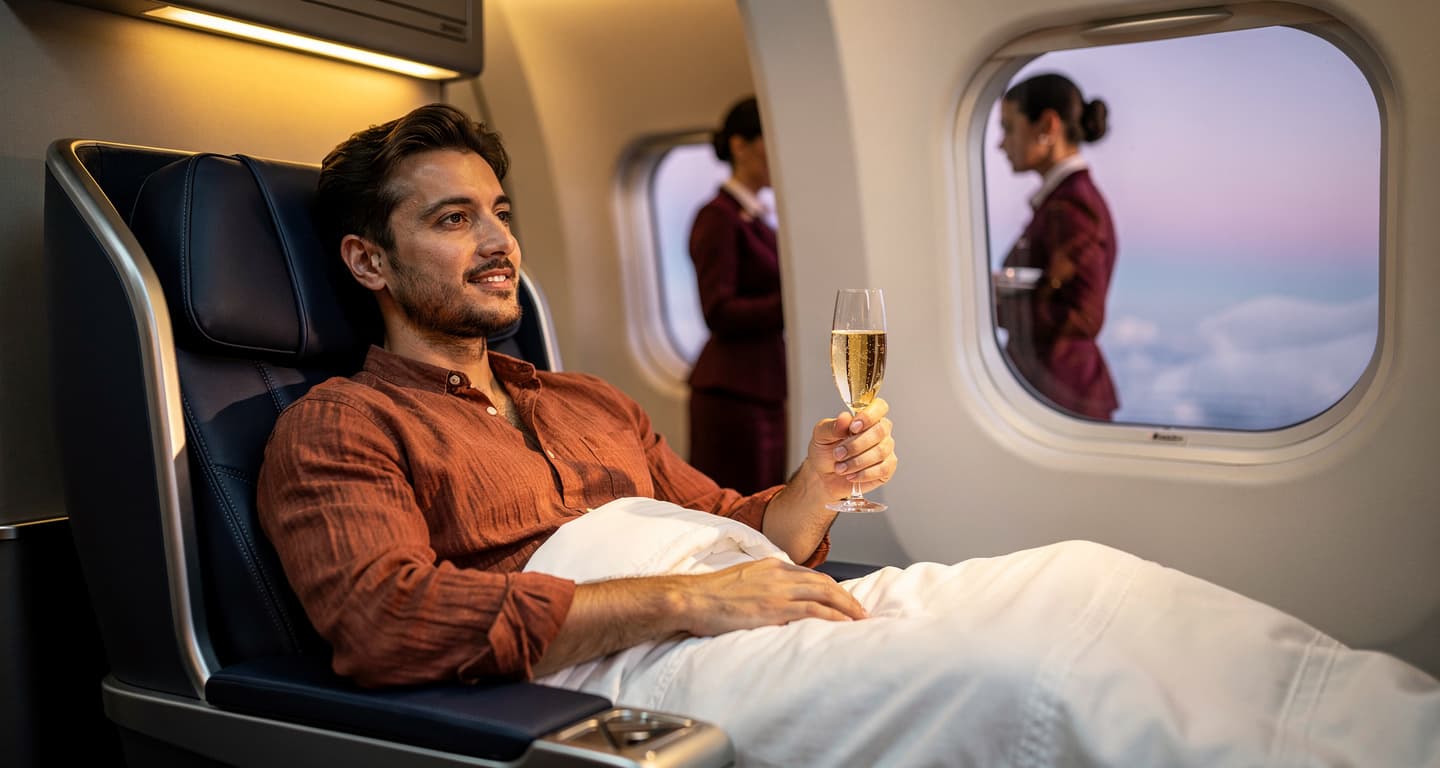
The Dreamliner business cabin delivers the real product: full-flat beds that convert to sleeping surfaces 11% larger than industry standard, 15.4-inch touchscreen entertainment, and direct aisle access from every seat. The cabin configuration mirrors what you’d find on Emirates or Qatar in the same class.
Ground services include priority check-in and boarding at Heathrow, fast-track security where available, and lounge access at both London and Dubai. The 40kg baggage allowance doubles the economy saver allocation of 25kg—meaningful if you’re packing for an extended Southeast Asia trip.
Flight deals
most people never see
Our AI monitors 150+ airlines for pricing anomalies that traditional search engines miss. Air Traveler Club members save $650 per trip per person on average: see how it works.
Each deal saves 40–80% vs. regular fares:

The 90-minute Dubai question
Every London-Brunei flight stops in Dubai for approximately 90 minutes. This isn’t a connection—it’s a technical stop for refueling and crew changes. You remain on the same aircraft, though you’ll typically deplane briefly.
The stop adds time but creates an opportunity. Royal Brunei permits free stopovers in Dubai on the outbound or return, turning your routing into a twin-centre trip at no additional airfare. Spend three nights in Dubai, continue to Brunei or beyond, and you’ve extracted extra value from the technical stop.
Total journey time from London to Brunei runs approximately 15-16 hours including the Dubai stop. A theoretical nonstop would be 13 hours—so you’re adding 2-3 hours for the stopover. Against the £500-800 you’re saving versus comparable business class fares, the math favors patience.
Booking tactics: the 60-90 day window
The £2,200 fares mentioned in travel circles represent saver business inventory—discounted seats released through yield management systems. These don’t appear on every search. Understanding when they drop is the difference between paying £2,200 and £3,762.
Royal Brunei’s yield management typically releases saver business inventory 60-90 days before departure. This is the sweet spot: close enough that the airline wants to fill remaining premium seats, far enough that they haven’t switched to last-minute pricing.
Three practical tactics:
- Monitor specific dates: Set fare alerts for the Sunday, Wednesday, and Friday departures (the only three weekly LHR slots). Saver inventory appears on specific flights, not across all dates.
- Book shoulder season: Peak periods like February school holidays see saver fares vanish entirely, with business jumping above £4,000. January, March, and September offer better saver availability.
- Consider the upgrade bid: Royal Brunei’s RB Upgrades program lets you bid for business class starting 10 days before departure. You’ll know 96-6 hours before the flight if successful—no charge if you lose.
The upgrade bid works as a hedge. Book economy or economy flexi (30kg baggage), submit a bid, and you might land business class for a fraction of the published fare. Minimum bids apply, but unsuccessful bids cost nothing.
When this strategy breaks down
The Royal Brunei arbitrage has real limitations that can eliminate the value proposition entirely.
Schedule inflexibility: With only three weekly departures from Heathrow—Sunday, Wednesday, and Friday—you’re locked into specific travel days. If your trip requires Tuesday arrival in Brunei, you’re either repositioning a day early or choosing a different airline.
Peak date pricing: During high-demand periods, saver inventory simply doesn’t exist. The February 12-25 window in 2026, for example, shows business fares exceeding £4,000 with no saver availability. The arbitrage is seasonal.
Wrong aircraft: Some Royal Brunei routes operate Airbus equipment with angled lie-flat seats rather than the Dreamliner’s full-flat beds. Always verify aircraft type when booking—the product difference is substantial.
Fast-track limitations: Priority security is offered at selected airports only. Heathrow and Dubai are confirmed, but not every Southeast Asian destination includes this perk. Check specifics for your routing.
Route comparison: where the value peaks
Not all Royal Brunei destinations offer equal arbitrage. The savings vary by route, and some pairings make more sense than others.
| Destination | BI Business (Return) | SIA PE Benchmark | Value Gain | Dubai Stop |
|---|---|---|---|---|
| Manila (MNL) | £3,260 | £2,800 | Lie-flat vs recliner | 90 min |
| Kota Kinabalu (BKI) | £3,530 | £2,900 | 22% more bed space | Via Brunei |
| Brunei (BWN) | £3,762 | £3,200 | Lounge + fast-track | 90 min |
| Dubai (DXB) | £2,799 | N/A | Entry to lie-flat | None |
Manila offers the strongest case: £3,260 for lie-flat versus £2,800 for a recliner represents a modest premium for dramatically better sleep on a 14-hour journey. Kota Kinabalu appeals to Borneo-bound travelers who’d otherwise connect through Singapore or Kuala Lumpur.
The Dubai-only fare at £2,799 serves a different purpose—an entry point to Royal Brunei’s business product for travelers who want to test the experience before committing to longer routes.
The bottom line on Royal Brunei
This isn’t a universal hack. It’s a specific opportunity for flexible travelers heading to Brunei, the Philippines, or Borneo who can work around a three-day-a-week schedule and book in the 60-90 day window.
The product is genuine: lie-flat Dreamliner seats, proper lounge access, and premium ground services. The pricing reflects Royal Brunei’s position as a small, state-backed carrier rather than a premium cabin market leader. That gap creates real value for those who know where to look.
Monitor the Sunday, Wednesday, and Friday departures. Set fare alerts for your target dates. And if saver inventory doesn’t materialize, the upgrade bid offers a second chance at business class without the upfront commitment.
Questions? Answers.
Does Royal Brunei business include Dubai lounge access on the outbound leg?
Yes. Business class tickets include complimentary lounge access at both London Heathrow and Dubai International, regardless of whether Dubai is your final destination or a technical stop. Priority fast-track security is also included at both airports.
Can I extend the Dubai technical stop into a proper stopover?
Yes. Royal Brunei permits free stopovers in Dubai on either the outbound or return journey. You can break your trip for several days at no additional airfare, effectively creating a twin-centre holiday. Request this when booking or contact the airline to modify an existing reservation.
What happens if my upgrade bid fails?
Nothing—you fly in your originally booked cabin at no extra charge. Bids are submitted from 10 days before departure, and you’re notified 96-6 hours before the flight whether you’ve been successful. There’s no penalty or fee for unsuccessful bids.
How does baggage differ between business and economy saver?
Business class includes 40kg checked baggage. Economy saver allows 25kg, while economy flexi permits 30kg. If you’re traveling with significant luggage, the business class allowance alone can offset £50-100 in potential excess baggage fees.
Are these fares available for travelers connecting from the US or Canada?
The fares quoted are for London Heathrow departures. US and Canadian travelers would need to position to London first, adding £500-800 plus UK Air Passenger Duty. For North American travelers, the arbitrage may not survive the positioning costs—check oneworld partner routings for potential mileage redemptions instead.
Why are current fares higher than the £2,200 sometimes quoted?
The £2,200 figure represents saver business inventory released through yield management, typically 60-90 days before departure. Current published fares of £3,260+ reflect standard promotional pricing. Saver availability fluctuates by date, season, and demand—peak periods may see no saver inventory at all.