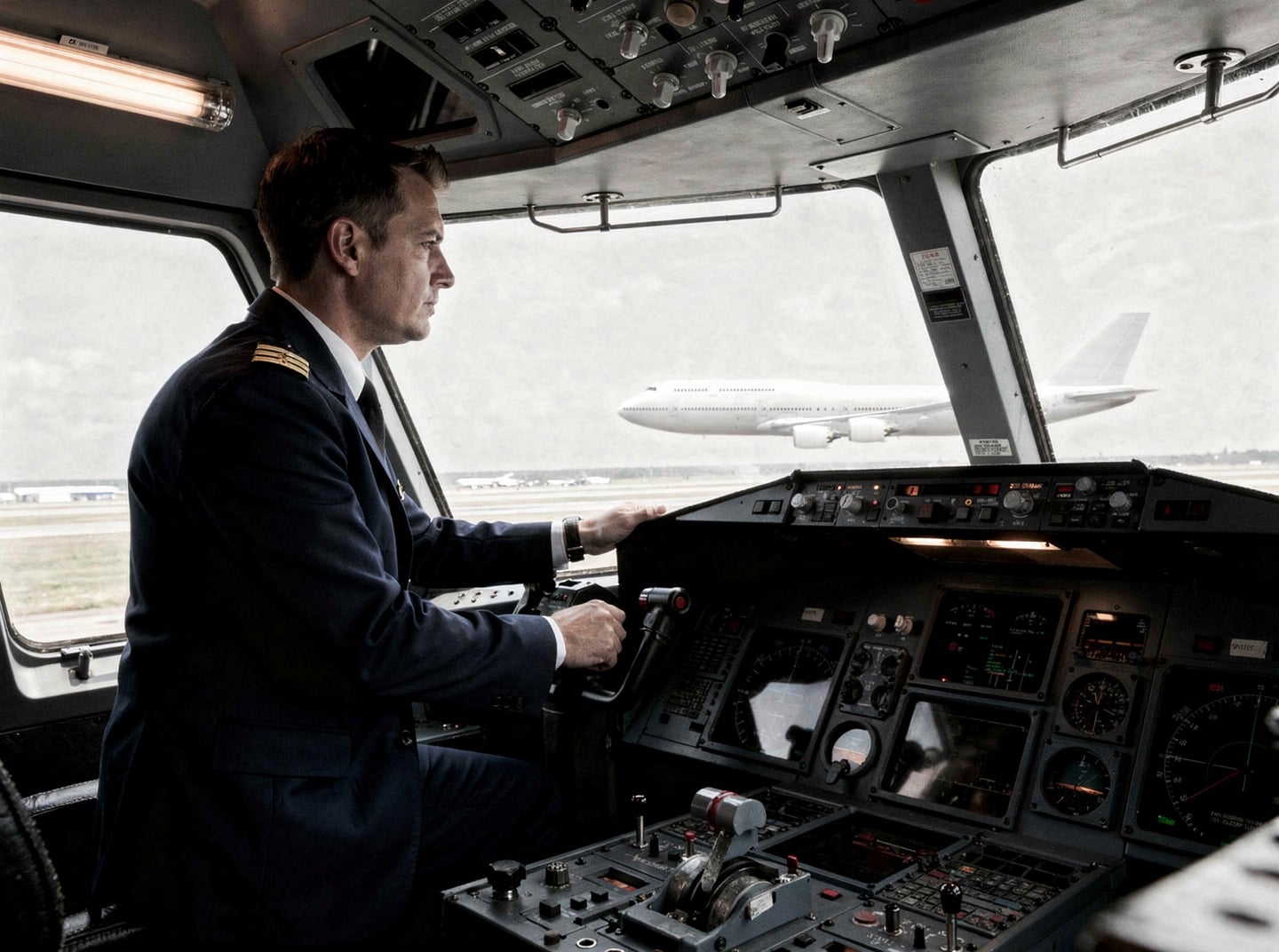
Landing at Tenzing-Hillary Airport in Lukla requires a CAAN-mandated mountain flying standard and prior short takeoff and landing experience. But the exact threshold is not published anywhere travelers can check it.
Widely repeated figures — 100 STOL missions and ten supervised Lukla flights — appear in no public CAAN regulation or aeronautical publication. The regulator also releases no official count of currently authorized pilots.
Ask why a pilot is allowed to land at Tenzing-Hillary Airport and you’ll hear a very specific answer: 100 short takeoff and landing missions and ten supervised flights into Lukla. Trekking companies, news features, and aviation forums repeat it as though it were stamped in a regulation.
It isn’t. No public document from the Civil Aviation Authority of Nepal contains that clause. The gateway for Everest-bound trekkers has an unforgiving runway, a media-crowned “most dangerous” title, and a qualification process travelers cannot actually inspect.
What the regulator publishes is general. What it doesn’t publish — the exact threshold, the pilot headcount, the training split — is where the real story sits. That gap would be a footnote at a flat, wide-strip airport.
At Lukla, where a go-around isn’t an option and weather closes in fast, it becomes the difference between choosing a flight and trusting the system blindly.
The number every article repeats, and the rule that isn’t on paper
Ask where those numbers come from and the trail goes cold.
Secondary accounts — tour blogs, news features, aviation-enthusiast pages — tie the figures to the civil aviation authority or to Nepalese air law. None points to a clause, a regulation number, or an aeronautical publication entry.
The cited provision is absent. CAAN’s personnel licensing rules and Manual of Operating Standards cover the general mechanics: how licences and ratings are issued, what experience and medical evidence is required, and how training devices and programmes are approved. None of those texts mention Lukla by name, and none sets a required number of STOL sorties or Lukla landings.
Nor does any annual report or ICAO audit summary provide a headcount. No public document names how many pilots hold current Lukla clearance. Unsourced estimates range from 20–30 to about 50 worldwide; the spread itself is the best evidence that no verifiable number exists.
A runway that forgives nothing
The airport sits at 2,846 metres between a rock wall and a drop into the valley. The runway is 527 metres long and climbs at an 11.7% gradient, deliberately built for uphill landings and downhill takeoffs.
That layout kills forward speed on arrival and lets gravity assist departure — until the pavement ends.
Because the strip works under Visual Flight Rules only, pilots must keep the runway and surrounding terrain in sight at all times. Weather closes operations quickly. Once the final approach begins, the terrain makes a go-around effectively impossible; there is no realistic way to abandon the landing and climb out.
Accident records name two STOL types repeatedly: the Let L-410 and the De Havilland Canada DHC-6 Twin Otter. Before each departure, aircraft roll downhill toward empty space.
Flight deals
most people never see
Our AI monitors 150+ airlines for pricing anomalies that traditional search engines miss. Air Traveler Club members save $650 per trip per person on average: see how it works.
Each deal saves 40–80% vs. regular fares:

Where the “most dangerous” label actually came from
The “world’s most dangerous airport” label stuck to Lukla in large part because of the History Channel Most Extreme Airports program. That ranking never published a quantitative risk-per-movement method. It was television, not a safety calculation.
The underlying record is real but concentrated. The Aviation Safety Network database lists multiple serious STOL crashes at Lukla since 2000, including fatal Twin Otter and Let L-410 accidents, with cumulative inbound and outbound fatalities above 50. Against that, CAAN’s own profile records more than 20,000 movements in busy years — tens of thousands of flights, most of them uneventful.
Lukla’s accident rate sits above a modern lowland hub. But the data does not support the idea that every approach flirts with catastrophe.
What France publishes instead
France’s aeronautical publication for Courchevel Altiport requires pilots of aeroplanes and motorgliders to hold a mountain-wheel licence or a separate authorization for the field. The same Direction Générale de l’Aviation Civile framework sets a 200 hours minimum prior flight time for candidates starting the mountain-landing qualification.
Courchevel’s rules also include a recency condition: a pilot must have used the altiport as captain within the previous six months to keep the authorization, or repeat a flight test. Those requirements are published in the AIP and ministerial orders.
None of this makes Courchevel easy. It makes it checkable.
| Airport | Regulator | Pilot special-qualification requirement | Publicly documented? |
|---|---|---|---|
| Tenzing-Hillary Airport (Lukla), Nepal | Civil Aviation Authority of Nepal (CAAN) | Special mountain/STOL experience and prior Lukla operations widely described, but no CAAN primary text publicly confirms any exact numeric threshold. | Partially – general licensing rules are public, Lukla-specific numbers are not |
| Courchevel Altiport (LFLJ), France | Direction Générale de l’Aviation Civile (DGAC) | Published AIP and national orders require pilots of aeroplanes and motorgliders to hold a mountain-wheel qualification or a specific authorization, with site-specific training and recency rules. | Yes – detailed conditions set out in AIP and DGAC orders |
| Courchevel Altiport mountain rating training (France, generic) | DGAC / approved training organisations (ATO) | French ministerial orders and training documents describe the mountain rating path, including minimum prior hours, structured theoretical and flight instruction, and the need to demonstrate practical competence before obtaining the rating that unlocks altiport access. | Yes – mountain-rating curriculum and prerequisites are codified in national regulation |
What a written-down mountain rating actually requires
Where the rating is codified, it reads like a training pipeline. France’s mountain rating path combines minimum prior hours with structured theoretical and flight instruction, capped by a practical competence test that unlocks altiport access.
Nepal’s framework has some of the same building blocks. CAAN’s rules give the Director General authority to sign off on ground syllabi, training devices and programmes. Tour companies and operators say Lukla captains attend yearly simulator or pictorial sessions, but those sessions are not set out in any CAAN syllabus.
As a result, the primary rules leave the split between simulator work and in-flight mountain and STOL hours undocumented.
Nepal has a system. It simply hasn’t written down its Lukla threshold, so outsiders cannot see where the line between qualified and unqualified sits.
What this opacity means when you’re booking to Lukla
For a Western traveler, the absence is concrete. There is no public registry, licence lookup, or CAAN document you can consult to confirm that your crew’s mountain qualification is current or that it meets a published threshold. The regulator mandates specialised mountain flying standards, but it does not show you the numbers.
You are left relying on the operator’s safety culture and Nepal’s general licensing oversight. That isn’t nothing — the general framework exists, and most movements pass without incident.
But it isn’t verifiability, and at an airport with no room for a go-around, the distinction carries weight.
During peak trekking months, airlines also move some Kathmandu flights to a lower-altitude airport when weather or traffic demand it, sometimes leaving travelers with a valley bus ride before the mountain sector they booked. The calm answer from an airline desk — that its pilots are “fully qualified” — is true and unverifiable at the same time. Nothing in CAAN’s published material signals a plan to release those thresholds either.

Questions? Answers.
Can I verify my pilot’s Lukla qualification before I fly?
No public CAAN registry or published Lukla-specific threshold exists. The widely quoted numeric requirements appear in no primary regulation, so travelers cannot independently confirm a crew’s qualification.
Is Lukla actually the most dangerous airport in the world?
The label traces most directly to a History Channel program that never published a risk-per-movement methodology. Lukla has recorded serious STOL accidents, but most movements finish safely.
Why doesn’t Nepal publish its Lukla certification numbers?
CAAN publishes general licensing rules but keeps Lukla-specific thresholds, pictorial or simulator syllabi, and pilot-count data out of primary public documents. No official explanation for the choice is public.