US/Canada Bhutan 40–80% OFF
Cheap flights discovered by AI✨
Fly round-trip to Paro for $500, while others pay $1,300+.
Our AI finds Superdeals to Bhutan from all major airports in North America. You book directly with airlines for half the price—or less.
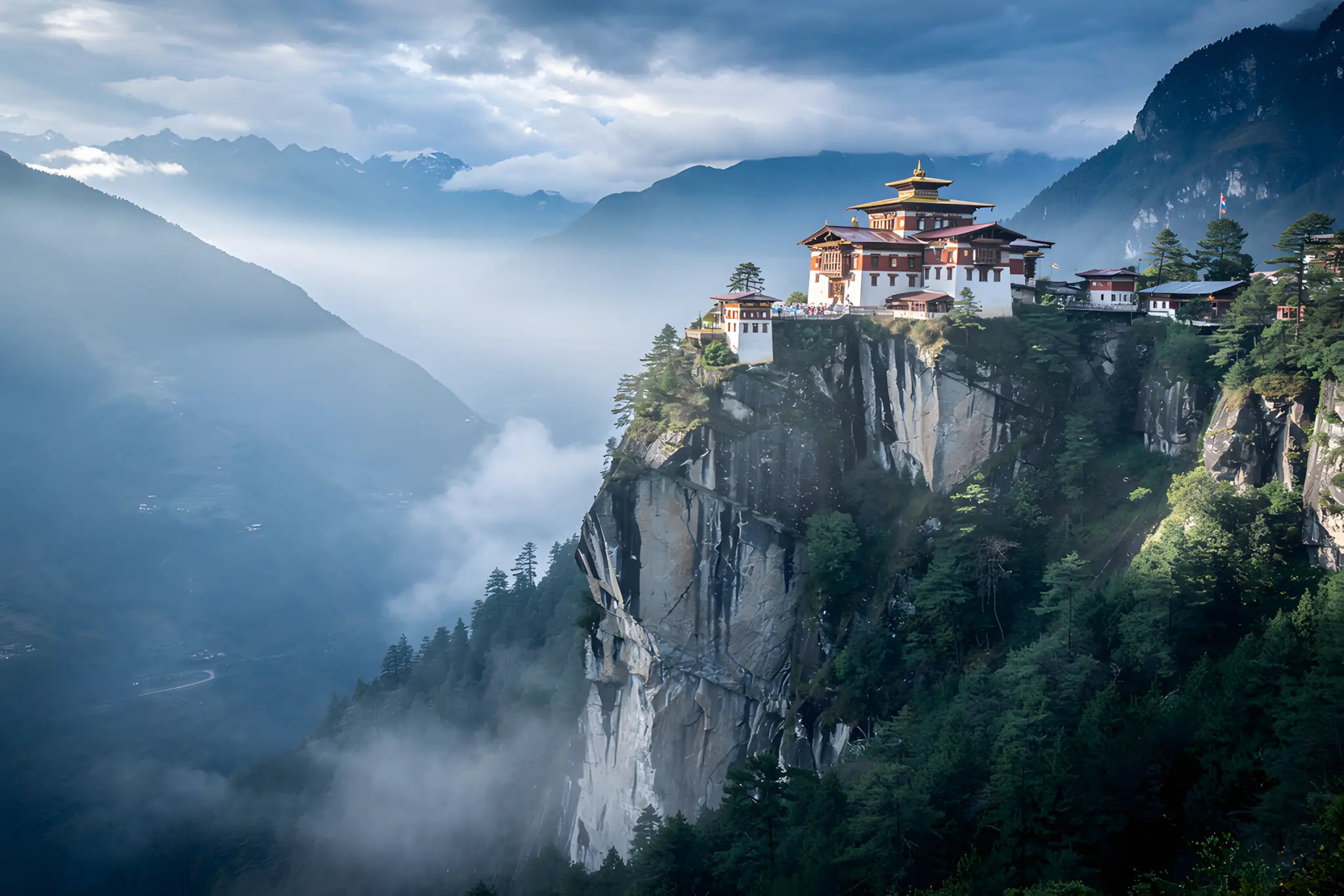

Why are flights to Bhutan so expensive in 2026?
A mix of geography, government rules, and a tiny pool of specially trained pilots keeps seats rare and prices high.
Getting to Bhutan from North America is a two-part journey. First, you fly to a hub like Bangkok or Delhi. Then you catch a short hop to Paro, Bhutan’s only international airport. That short flight is where the sticker shock hits. A round trip from Bangkok to Paro costs around $980 on its own. That’s nearly what you’d pay to cross the Atlantic.
Why so much? Only two airlines fly there: Drukair and Bhutan Airlines. They don’t compete on price the way other carriers do. Bhutan wants fewer tourists who spend more, so fares stay fixed. Add in the first leg on carriers like Qatar Airways or Emirates, and a total trip from New York can run you $2,630 or more in economy.
Paro’s mountain runway is another issue. It’s so tricky that fewer than 25 pilots worldwide are certified to land there. Even if demand spikes, airlines simply can’t add more flights. Planes can only land in daylight, which cuts available seats even further.
Finally, longer flight paths avoiding Russian airspace have pushed up costs on the first leg by 30 to 40 percent compared to a few years ago.
The outlook: Don’t expect relief soon. The pilot shortage and Bhutan’s tourism policy aren’t changing, so fares will likely stay elevated through 2026.
Meet Superdeals
Never overpay for flights again
You can save between 40% and 80% on your flights to Bhutan — and to other Asian countries — with Air Traveler Club Superdeals.
We monitor all major airports in North America for cheap flights to Asia, including:
- Atlanta (ATL) — Georgia, US
- Toronto (YYZ) — Ontario, Canada
- Chicago (ORD) — Illinois, US
- Los Angeles (LAX) — California, US
- Denver (DEN) — Colorado, US
- Montréal (YUL) — Quebec, Canada
- Dallas (DFW) — Texas, US
- New York (JFK) — New York, US
- San Francisco (SFO) — California, US
- Vancouver (YVR) — BC, Canada

Departure airports in North America and destinations in APAC covered by Superdeals.
Superdeals to Bhutan
Fly for half price (or less)
Airlines don't design their pricing systems to offer half-price tickets. However, when algorithms detect demand shortfalls for specific routes, automated systems apply steep discounts to fill planes. Airlines would rather accept losses than fly with empty seats.
ATC monitors thousands of routes from US/Canada 24/7, detecting Superdeals with 40–80% discounts. While a typical return flight from North America to Paro costs $1,300+, with Superdeals you can often grab it for around $500:
Which airlines have promotions to Bhutan right now?
We track and curate genuine offers from 150+ airlines, hand-picking only the most valuable for your wallet.
Which carriers have sales and special offers for flights in September, October, November and beyond? You can now browse the entire collection of active promotions:
Browse promos →Popular airlines with frequent offers from the US and Canada:

Travel hacks and insights
for North America — Bhutan flights
Verified strategies to save money and avoid friction on routes to Bhutan.
Delhi routing saves $400-600 vs Bangkok
Routing flights through New Delhi (DEL) typically saves $400-600 compared to connecting via Bangkok (BKK) or Singapore (SIN) from North America. Major carriers like United and Air Canada offer competitive direct service to Delhi from Newark, San Francisco, and Toronto.
However, this savings comes with a “hassle tax.” Unlike Bangkok, Delhi often requires clearing immigration and collecting bags to transfer to Drukair if booked on separate tickets. You must secure an Indian e-Tourist visa ($10-25) in advance to legally cross the border for this baggage re-check.
Kathmandu connection undercuts major hubs
Connecting through Kathmandu (KTM) offers the shortest flight into Bhutan (under 1 hour) and often the lowest combined fare. Flights from the US to Kathmandu via Middle Eastern carriers (Qatar, Turkish) can be competitively priced during shoulder seasons.
The trade-off is operational reliability. Kathmandu airport suffers frequent fog delays in winter (December-January) that can cause missed connections. Only choose this route if you buffer at least 24 hours in Nepal before your Bhutan departure.
Business class priority outweighs seat comfort
Business class on Bhutan flights costs roughly double economy (+$400-500 one way). The seats are standard recliners, not lie-flat beds. The real value lies in priority processing at chaotic gateway airports like Kathmandu or Delhi.
In Paro, business class bags are offloaded first—a significant advantage when rushing to meet a guide for a long drive to Thimphu. If budget allows, upgrade only one leg (the inbound flight) to ensure you and your bags arrive stress-free.
Visual Flight Rules limit operational hours
Paro Airport operates strictly under Visual Flight Rules (VFR), meaning flights can only land and take off during daylight hours with clear visibility. There are no night flights. This compresses the entire schedule into a 7 AM to 4 PM window.
If you miss a morning connection in Bangkok or Delhi, you are stuck until the next day. Never book a tight connection (under 3 hours) into Paro, as the airline has zero flexibility to “put you on the evening flight”—it doesn’t exist.
Bangkok BKK offers safest transit logistics
Bangkok Suvarnabhumi (BKK) is the most reliable gateway for North American travelers. Even on separate tickets, the transit experience is superior to Delhi or Kathmandu. Drukair’s transfer desk allows you to get boarding passes without entering Thailand.
However, you must stay airside. If you need to exit for any reason, US/Canadian citizens get a 60-day visa exemption. This flexibility makes BKK the lowest-risk hub for misconnections or baggage issues compared to the rigid visa rules of India.
Medical evacuation coverage is non-negotiable
Bhutan has limited medical infrastructure. Serious injuries require helicopter evacuation to Bangkok or Delhi, costing $20,000-50,000 upfront. Most standard US credit card travel insurance has caps or exclusions for high-altitude destinations.
Verify your policy specifically covers “medical evacuation” and does not exclude “adventure activities” if you plan to hike. Global Rescue or similar specialized memberships are recommended over generic travel insurance for this specific route.
What travelers ask most
Expert answers on routing, carriers, timing, and fees
What is the Gelephu Mindfulness City project I keep hearing about?
Gelephu Mindfulness City (GMC) is a massive new “special administrative region” in southern Bhutan announced by the King to drive economic growth. Throughout 2025, this project has generated significant buzz, with new infrastructure being built to connect Gelephu to international markets. For tourists, this means Gelephu is becoming a more viable entry point via land from India (Assam), offering a different landscape from the mountainous north.
While the city itself is a long-term megaproject, early phases opening in late 2025 include a new international airport expansion plan and wellness centers. If you are adventurous, entering via Gelephu allows you to explore the tropical southern foothills before heading north to Thimphu, though road conditions can still be challenging during ongoing construction.
Are there new luxury hotel openings in Bhutan for the 2025 season?
The luxury landscape has expanded in late 2025 with new boutique properties from brands like &Beyond and local luxury chains in the Punakha and Bumthang valleys. These openings are a response to the “high value, low volume” tourism strategy, offering intimate, sustainable lodges that justify the daily SDF cost. Rates for these new 5-star properties typically start at $800+ per night.
Availability remains tight despite new inventory, especially for October and December travel dates. If you plan to visit during the popular festival seasons, booking these newer properties 4-6 months in advance is essential, as the established names like Aman and Six Senses often sell out a year ahead.
Do I strictly need a guide to visit Bhutan?
Technically, the “mandatory guide” rule was relaxed recently, allowing tourists to book hotels and pay the SDF directly, but hiring a guide is still highly recommended and practically necessary. Without one, you cannot arrange transport (no car rentals or Uber exist), and you will be denied entry to most Dzongs and monasteries which require a certified guide to escort you inside.
Navigating the language barrier and logistics in rural areas is nearly impossible for a solo traveler without local support. A guide typically costs an extra $100-150 per day (including driver/vehicle), which is a small price for the access and cultural context they provide.
What is the dress code for visiting Dzongs and monasteries?
Bhutan enforces a strict formal dress code for all religious and administrative buildings (Dzongs). For men, this means wearing a collared shirt tucked into long trousers (no jeans or shorts) and closed shoes. Women must wear long skirts or pants and tops that cover shoulders and chest fully—a large scarf or shawl is useful to drape over yourself.
If you are improperly dressed, police at the entrance will simply deny you entry. Your guide will usually remind you each morning, but packing a “smart casual” outfit specifically for temple days is essential. Hats and sunglasses must also be removed upon entering any Dzong courtyard.
Can I use US dollars for daily spending in Bhutan?
Yes, US Dollars are widely accepted in Thimphu and Paro for souvenir shopping and tips, but you will receive change in local Ngultrum. Carry small denominations ($1, $5, $10) for tipping guides and drivers, and ensure bills are pristine—post-2009 series with no tears or ink marks. Credit cards (Visa/Mastercard) are accepted at luxury hotels and large handicraft shops, but often incur a 3-5% surcharge.
ATMs are available in major towns but are notoriously unreliable for foreign cards. It is smart to bring enough cash ($300-500) to cover your entire trip’s incidental expenses, using your card only as a backup for larger purchases.
Is travel insurance with medical evacuation mandatory?
Yes, proof of travel insurance is technically required for your visa, and having medical evacuation coverage is critical. Bhutan has basic medical facilities, but serious trauma or cardiac issues require helicopter evacuation to Bangkok or Delhi, which can cost $20,000-50,000 upfront.
Ensure your policy specifically covers “high altitude” activities if you plan to trek, as many standard policies exclude incidents above 3,000 meters. Companies like Global Rescue or World Nomads are popular choices for Bhutan travelers because they understand the terrain and evacuation logistics involved.
Is it safe to eat street food or raw vegetables?
Avoid raw vegetables and street snacks unless they are piping hot and cooked in front of you. Tap water is not potable anywhere in Bhutan; stick to bottled or filtered water, and avoid ice in drinks unless you are at a 5-star hotel. Stomach bugs are the most common complaint for travelers here.
Bhutanese food is famously spicy—the national dish, Ema Datshi, is literally chilies in cheese sauce. If you have a sensitive stomach, ask your guide to arrange “tourist standard” meals which are toned down, but be careful with buffet salads which may have been washed in tap water.
How does Air Traveler Club help me save on a trip to Bhutan?
Since flights *into* Bhutan have fixed government pricing ($900+ roundtrip), the only way to save money is by slashing the cost of your long-haul flight to the gateway hub. Air Traveler Club monitors prices from North America to Bangkok, Delhi, and Singapore 24/7. We frequently find Superdeals like New York to Bangkok for $650 (normally $1,200) or Business Class for $2,200 (normally $4,500).
By booking one of our AI-detected deals for the long leg of the journey, you can save enough to cover your entire SDF fee or upgrade your hotel in Bhutan. You book the cheap long-haul flight directly with the major airline, then purchase your separate Drukair ticket to complete the route. Our free newsletter alerts you the moment these gateway deals drop.
Nonstop (direct) vs 1-stop
How much do flights from US/Canada to Bhutan cost?
No nonstop service exists between US/Canada and Bhutan. All routings require at least one connection, with total journey times of about 20-30 hours depending on hub choice.
This is standard for the route—most travelers connect through New Delhi (DEL), Bangkok (BKK), or Singapore (SIN) with minimal hassle. Select connection times of 2.5-4 hours for international-to-international transfers—enough buffer for customs, security, and gate changes without excessive waiting.
All ATC Superdeals are manually verified for optimal connection times and efficient hub routing.
| Route | Airline(s) | Journey Time | Avg Price | Avg ATC Price |
|---|---|---|---|---|
| New York (JFK) → New Delhi (DEL) → Paro (PBH) | Air India / Drukair | 22h 00m | $1,600 | $545 (66% off) |
| Toronto (YYZ) → New Delhi (DEL) → Paro (PBH) | Air Canada / Drukair | 23h 00m | $1,550 | $515 (67% off) |
| Los Angeles (LAX) → Singapore (SIN) → Paro (PBH) | Singapore Airlines / Bhutan Airlines | 25h 30m | $1,700 | $575 (66% off) |
| San Francisco (SFO) → Singapore (SIN) → Paro (PBH) | Singapore Airlines / Drukair | 24h 30m | $1,750 | $585 (67% off) |
| Chicago (ORD) → Bangkok (BKK) → Paro (PBH) | Thai Airways / Drukair | 24h 00m | $1,650 | $555 (66% off) |
| Atlanta (ATL) → New Delhi (DEL) → Paro (PBH) | Delta Air Lines / Drukair | 24h 30m | $1,650 | $555 (66% off) |
| Vancouver (YVR) → New Delhi (DEL) → Paro (PBH) | Air Canada / Drukair | 23h 30m | $1,600 | $545 (66% off) |
| Seattle (SEA) → Bangkok (BKK) → Paro (PBH) | Thai Airways / Bhutan Airlines | 25h 00m | $1,650 | $555 (66% off) |
| Houston (IAH) → Doha (DOH) → Paro (PBH) | Qatar Airways / Drukair | 26h 00m | $1,800 | $610 (66% off) |
| Montreal (YUL) → Bangkok (BKK) → Paro (PBH) | Air Canada / Drukair | 25h 30m | $1,700 | $575 (66% off) |
*Avg ATC Price: Superdeal fare published on our platform (40-80% savings compared to standard market rates). Learn more.
Best stopovers
for US/Canada to Bhutan flights
Not all connections are created equal. When flying from the US/Canada to Bhutan, routing through major airport hubs can deliver lower total fares, better-equipped aircraft, and access to airline stopover programs.
New Delhi DEL
with Air India / United Airlines
- Average savings: 25-35% vs non-stop flights
- Flight segments: ~14h North America-Delhi + ~2h Delhi-Paro
- Typical connection: 3-5 hours (minimum 90 minutes)
- Stopover perks: Modern terminal with premium lounge access
- Visa requirements: India e-visa usually required for North America passports
- Airport rating: 3-Star Skytrax; strong regional hub facilities
- Best for: New York, Toronto, Chicago travelers seeking shortest overall travel time
Singapore SIN
with Singapore Airlines / United Airlines
- Average savings: 30-40% vs non-stop flights
- Flight segments: North America-Singapore (~18h), then Singapore-Paro (~5h via partner)
- Typical connection: 3-6 hours (minimum 60 minutes)
- Stopover perks: Free Singapore stopover package
- Visa requirements: Visa-free short stays for most North America passports
- Airport rating: 5-Star Skytrax; consistently top global ranking
- Best for: Los Angeles, San Francisco, Seattle travelers seeking premium airport experience
Bangkok BKK
with Thai Airways / EVA Air
- Average savings: 30-45% vs non-stop flights
- Flight segments: Split into ~17h North America-Bangkok and ~3.5h Bangkok-Paro legs
- Typical connection: 2-5 hours (minimum 75 minutes)
- Stopover perks: Large hub with varied dining and shopping
- Visa requirements: Visa-free entry or visa-on-arrival for many North America passports
- Airport rating: 4-Star Skytrax; strong transit infrastructure
- Best for: Vancouver, Los Angeles, New York travelers seeking consistently lower fares
Kathmandu KTM
with Qatar Airways / Turkish Airlines
- Average savings: 20-30% vs non-stop flights
- Flight segments: Two-leg journey: ~18-20h North America-Kathmandu, ~1h Kathmandu-Paro
- Typical connection: 3-6 hours (120 min minimum)
- Stopover perks: Compact airport with straightforward transfers
- Visa requirements: Visa-on-arrival for most North America passports
- Airport rating: Basic facilities; limited but improving services
- Best for: New York, Chicago, Toronto travelers seeking Himalayan side-trip options
Get real-time deal alerts
Activate real-time alerts and get notified the instant a new Superdeal to Bhutan has been discovered.
Book these incredible price drops before they’re gone.
Set alerts →
Best airlines and aircraft
for long-haul flights to Bhutan
Most travelers book US/Canada–Bhutan flights by price and schedule—but aircraft choice determines whether you arrive refreshed or wrecked. Cabin pressurization, humidity, seat configuration, and service standards vary dramatically on this route.
Below are carriers we recommend—with superior configurations on flights from the US and Canada to Bhutan.
Air Canada
Boeing 787-9 Dreamliner
Five-time Skytrax winner Air Canada uses the 787-9’s composite structure to boost fuel efficiency and cabin humidity for greater comfort on long-haul routes via Toronto.
- Route: 1-stop Toronto (YYZ) → Paro (PBH) via Delhi (DEL) (~18-20 hrs total)
- Economy: 31″ pitch, 17″ width, 3-3-3 configuration, personal HD touchscreen, USB power
- Business: 1-2-1 reverse herringbone, lie-flat 6’2″, direct aisle access, memory foam cushions
- Standouts: 10.6″ Panasonic eX3 IFE, gate-to-gate Wi-Fi, regional gourmet meals, Maple Leaf lounge access
- Typical Pricing: Economy $1,300-$1,800; Business $5,500-$7,500;
United Airlines
Airbus A350-900
United’s Airbus A350 offers a quieter, lower cabin altitude flying experience with advanced aerodynamics, flying 1-stop via Newark to Bhutan.
- Route: 1-stop Newark (EWR) → Paro (PBH) via Delhi (DEL) (~19 hrs total)
- Economy: 31″ pitch, 18″ width, 3-3-3 layout, seatback screens, USB, power outlets
- Business: 1-2-1 Polaris Suites, lie-flat 6’6″, direct aisle access, ergonomic seats
- Standouts: 16″ HD touchscreen IFE, high-speed Wi-Fi, chef-curated meals, amenity kits by Cole Haan
- Typical Pricing: Economy $1,400-$1,900; Business $6,000-$8,000;
Singapore Airlines
Boeing 777-300ER
Six-time Skytrax “World’s Best Airline” Singapore Airlines flies the 777-300ER with exquisite space and advanced entertainment via Singapore to Bhutan.
- Route: 1-stop New York (JFK) → Paro (PBH) via Singapore (SIN) (~21 hrs total)
- Economy: 32″ pitch, 18″ width, 3-4-3 arrangement, KrisWorld IFE, LED mood lighting
- Business: 1-2-1 staggered seats, lie-flat 6’5”, direct aisle access, “Book the Cook” dining
- Standouts: 18″ touchscreen with 100+ movies, full wifi, regional gourmet meals, excellent service
- Typical Pricing: Economy $1,800-$2,300; Business $7,500-$9,500;
ANA (All Nippon Airways)
Boeing 787-10 Dreamliner
Japan’s ANA is a Skytrax 5-star airline deploying its 787-10 with extra-wide seats and improved cabin pressure, flying 1-stop via Tokyo to Bhutan.
- Route: 1-stop Vancouver (YVR) → Paro (PBH) via Tokyo Narita (NRT) (~21 hrs total)
- Economy: 32″ pitch, 18″ width, 3-3-3 layout, personal touchscreen, AC power
- Business: 1-2-1 layout, lie-flat 6’3″, direct aisle access, adjustable firmness seats
- Standouts: 16″ high-def IFE with latest films, onboard Wi-Fi, Japanese and Western cuisine, attentive service
- Typical Pricing: Economy $1,900-$2,400; Business $6,800-$8,700;
Fly better for less
Travel insights, proven strategies, and insider tips.

The Continental Hop Trick — North American edition

Airline stopover programs. Turn your layover into a bonus vacation.

Best aircraft for long-haul flights