Quick summary
A Chinese national was arrested at Kuala Lumpur International Airport (KLIA) on 16 May 2026 after bypassing a security autogate at Terminal 1 International Departure Gate C without a valid flight ticket, then behaving aggressively toward auxiliary police officers. Malaysia Airports Holdings Berhad (MAHB) auxiliary police detained her at approximately 1.45pm—roughly 10 minutes after she entered the restricted zone. Viral footage shows multiple officers carrying her away, one at each limb, while she screams. She has been remanded under Section 7 of Malaysia’s Protected Areas and Protected Places Act 1959, which carries up to two years’ imprisonment.
Preliminary investigations indicate she entered Malaysia on 30 April for a holiday but ran out of funds for a return ticket. The breach raises pointed questions about autogate logic and mezzanine access controls at one of Southeast Asia’s busiest international hubs.
A woman with no ticket, no money, and apparently no exit plan made it past a security autogate at KLIA Terminal 1 on 16 May—and the video of what happened next has been circulating across Southeast Asian social media ever since.
KLIA police confirmed the incident at 1.35pm at the Terminal 1 International Departure Gate C. The suspect, a Chinese national, had allegedly jumped from a second-floor mezzanine to a lower level before re-entering the restricted departure area without a valid boarding pass. Four auxiliary police officers eventually removed her from the zone, each holding a limb, while she screamed. She was detained by 1.45pm.
Travelers passing through KLIA are unlikely to be directly disrupted at this point—the incident was contained quickly and the airport remained operational. But the footage has landed hard, and the questions it raises about autogate vulnerabilities at a major hub-and-spoke international terminal are not going away quietly.
The woman entered Malaysia on 30 April with a friend, according to KLIA OCPD Assistant Commissioner Ravi Munusamy. By mid-May she had no funds for a return flight. What followed was, by any measure, a desperate and dangerous improvisation—one that exposed at least one gap in the layered security process that KLIA and its regulators will now need to account for.
What the security breach actually revealed about KLIA’s access controls
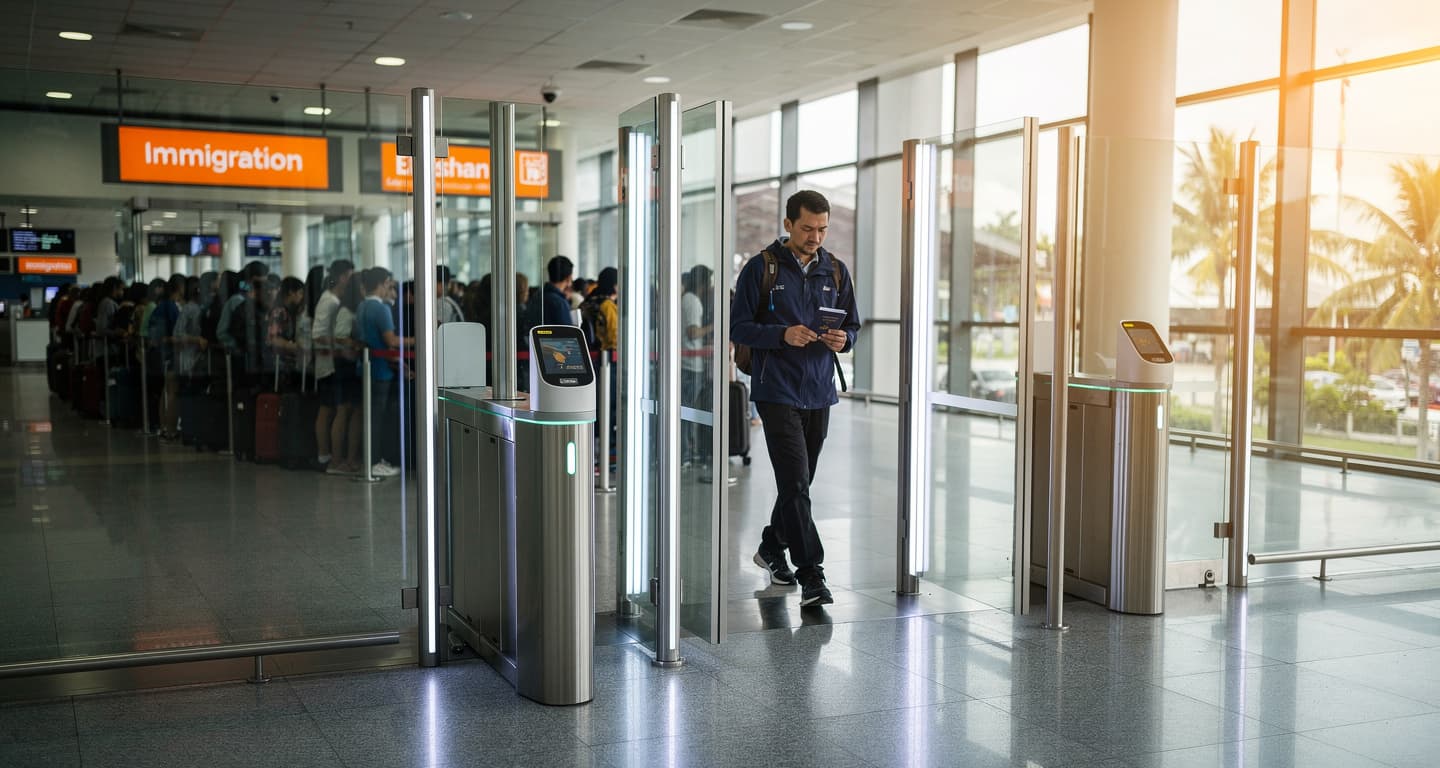
Getting airside at KLIA under normal circumstances requires clearing a boarding pass check at autogate level, then passing exit immigration—either via manual officer or a second autogate that scans your passport—before reaching the security screening point at the gate itself. The woman bypassed the first autogate checkpoint. The mezzanine jump, if confirmed, suggests she used the physical layout of the terminal to skip the boarding pass verification entirely rather than defeating the autogate’s electronic logic.
That distinction matters. It means the vulnerability here may be architectural as much as technological—a sightline or access gap between the public mezzanine level and the restricted departure floor, rather than a failure of the autogate scanner itself. MAHB and CAAM will need to determine which it was.
The suspect was brought before the Sepang Court on 17 May and remanded for further investigation. Official statements describe the breach as contained and isolated. That framing is accurate as far as it goes—she never made it to a boarding gate, and no flight was delayed. But “contained” and “impossible to repeat” are different claims entirely.
This is not an isolated regional pattern. Just three days earlier, on 13 May, a Chinese national destroyed two automated passport control e-gates at Bangkok’s Suvarnabhumi Airport, causing departure delays and resulting in criminal charges—a case covered in detail in ATC’s Suvarnabhumi Airport e-gate destruction report. Two incidents at two major Southeast Asian hubs within the same week, both involving automated gate systems, both caught on video.
| Factor | Detail | Significance |
|---|---|---|
| Incident time | 1.35pm, 16 May 2026 | Peak afternoon departure bank at KLIA T1 |
| Location | Terminal 1, International Departure Gate C | Airside restricted zone past immigration |
| Containment time | Detained at 1.45pm (approx. 10 minutes) | Breach window before auxiliary police response |
| Entry method | Bypassed autogate; alleged mezzanine jump | Possible architectural gap, not just electronic failure |
| Legal charge | Section 7, Protected Areas and Protected Places Act 1959 | Up to 2 years’ imprisonment and/or 1,000 MYR fine |
| Background | Entered Malaysia 30 April; insufficient funds for return ticket | Motive established; no terrorism link indicated |
For travelers connecting through KLIA on Malaysia Airlines, AirAsia, or any of the dozen international carriers using Terminal 1, the practical risk right now is minimal. The operational risk—that a determined individual found a physical workaround in a system designed to be layered—is the part that deserves scrutiny.
Verified incident details are confirmed in the KLIA police statement and preliminary investigation findings.
Flight deals
most people never see
Our AI monitors 150+ airlines for pricing anomalies that traditional search engines miss. Air Traveler Club members save $650 per trip per person on average: see how it works.
Each deal saves 40–80% vs. regular fares:

Why autogates alone cannot close every gap in a complex terminal
KLIA’s departure process is genuinely layered. Boarding pass autogates, exit immigration, gate-level security screening, and manual boarding pass scans at the jet bridge create four distinct checkpoints. The system works when each layer catches what the previous one missed. What the 16 May incident exposed is that the physical geometry of the terminal—specifically the relationship between the public mezzanine and the restricted departure floor below it—may not have been stress-tested against someone willing to jump.
Traveler accounts from 2025–2026 already flagged inconsistent autogate functioning at KLIA during busy departure banks, with manual processing queues forming and auxiliary police presence stretched across the mezzanine level. A determined individual, arriving at the right moment in a congested bank, faces a thinner margin of detection than the official process implies. That is not a criticism of KLIA specifically—it is a structural reality of any high-volume international terminal where passenger flow and security staffing are calibrated for normal behavior, not outliers.
The broader question for MAHB and CAAM is whether the corrective response addresses the architectural gap or simply adds patrol hours. More officers in the same geometry is a partial fix. Changing the geometry—physical barriers, camera coverage of mezzanine-to-floor transitions, autogate logic that flags tailgating—is a structural one. Regulators under ICAO Annex 17 are obliged to document corrective actions, not just acknowledge incidents.
Understanding the broader context of Chinese carriers and travel patterns on routes through KUL is worth a read—ATC’s analysis of the rise of Chinese airlines covers the network dynamics that make KUL a significant transit point for Chinese nationals traveling through Southeast Asia.
Steps for KLIA travelers in the next 72 hours
Heightened auxiliary police presence around KLIA Terminal 1 autogates and departure areas is likely in the days following the 16 May breach—expect slightly slower processing at peak times even if no formal security escalation is announced.
- Add buffer time before immigration: Build an extra 30–60 minutes into your KLIA schedule for the near term. Increased checks around autogates and departure gate access can slow the standard flow, particularly during busy afternoon departure banks.
- Confirm your terminal before you leave for the airport: Malaysia Airlines and Batik Air use Terminal 1; AirAsia group flights use klia2 (Terminal 2). These are separate buildings. Verify on your airline’s app—malaysiaairlines.com or airasia.com—before departure.
- Report suspicious behavior immediately: If you see someone attempting to tailgate through an autogate or access a restricted area without a boarding pass, move away and notify the nearest MAHB staff member or auxiliary police post. Contact details and information desk locations are available via the official KLIA contact page.
- If your connection is disrupted by a security response: Document all timings and any announcements. Contact your airline’s local help desk—Malaysia Airlines at KLIA ticket counters or +603 7843 3000—on the same day and ask explicitly for rebooking options. Security events typically fall under “extraordinary circumstances,” which limits compensation claims, but schedule protection on a later flight is usually available.
Watch: A formal corrective-action statement from MAHB or CAAM referencing changes to Terminal 1 autogate procedures or mezzanine access controls—expected within days to weeks. If it arrives, it signals that regulators have identified a specific structural vulnerability. If it doesn’t, expect informal measures only, with limited public transparency on what actually changed.

Questions? Answers.
How did the woman get past KLIA’s autogate without a valid ticket?
Police and witness accounts indicate she bypassed the boarding pass autogate checkpoint by allegedly jumping from a public mezzanine level to the restricted departure floor below, rather than defeating the autogate’s electronic scanner. This suggests a physical or architectural gap in the terminal layout rather than a technology failure. CAAM and MAHB are expected to assess whether structural changes to mezzanine access are required.
What charges does she face and what are the penalties?
She was remanded under Section 7 of Malaysia’s Protected Areas and Protected Places Act 1959, which covers unauthorized entry into protected areas such as airport restricted zones. Conviction carries a fine of up to 1,000 ringgit, imprisonment of up to two years, or both. She was brought before the Sepang Court on 17 May 2026 for remand proceedings.
Should travelers change their KLIA plans because of this incident?
No cancellations or itinerary changes are warranted. The incident was contained within approximately 10 minutes and the airport remained fully operational. However, travelers departing from KLIA Terminal 1 in the near term should add 30–60 minutes of buffer before immigration to account for any heightened checks around autogates and departure gate access following the breach.
Is this part of a wider pattern of airport security incidents in Southeast Asia?
Two notable incidents occurred within days of each other. On 13 May 2026, a Chinese national destroyed two automated passport control e-gates at Bangkok’s Suvarnabhumi Airport. On 16 May, the KLIA trespass occurred. Both involved automated gate systems at major Southeast Asian hubs and both were captured on video. Authorities in both countries have treated the incidents as isolated criminal matters rather than coordinated threats.